
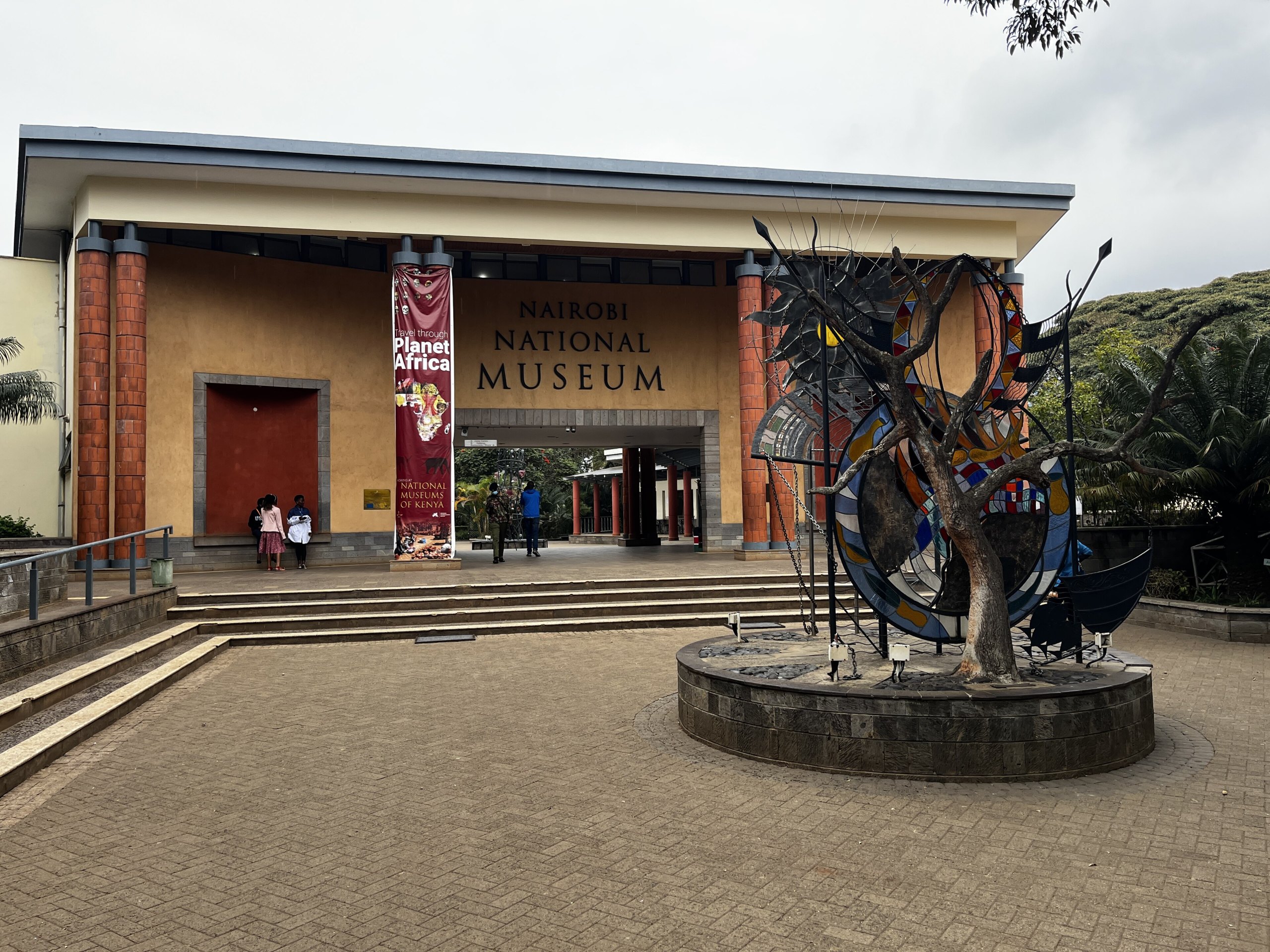
Nairobi National Museum
The Nairobi National Museum on Museum Hill is the flagship of the National Museums of Kenya and the single best place in the country to get the whole of Kenya into one afternoon: human origins, mammals, birds, the history of the state and the cultures that make it up, all under one roof about twenty minutes from the central business district.
How the Museum Came to Be Here
It started as a storage problem. In 1910 a group of naturalists in the East Africa and Uganda Natural History Society, now the East African Natural History Society, needed somewhere to keep the specimens they were collecting. The first site was where Nyayo House stands today. That was outgrown, and a larger building went up in 1922 on the ground now occupied by the Nairobi Serena Hotel.
In 1929 the colonial government set aside land at Museum Hill for a purpose-built museum, which opened on 22 September 1930 as the Coryndon Museum, named for Sir Robert Coryndon, a former Governor of Kenya. After independence in 1963 it was renamed the National Museum of Kenya.
The building visitors see now is largely the result of a rebuild. The museum closed to the public on 15 October 2005 for an extensive modernisation and expansion, and reopened in June 2008 as the Nairobi National Museum. That is why the interior feels modern in a way the 1930 date would not suggest.
The Permanent Galleries
Six permanent galleries carry the museum, and they are arranged so that a visitor can walk them in sequence in a couple of hours.
- Cradle of Humankind sets out the fossil evidence for human origins and the stone tool record. Kenya’s contribution to this field is unusually large, and the material here connects directly to the excavations in the Turkana basin at Sibiloi, which include the Turkana Boy skeleton found at Nariokotome.
- The Story of Mammals handles evolution, movement, feeding and defence, working from elephants down to shrews and bats.
- The History of Kenya covers the origins of the country’s communities and language groups, the pre-colonial period, colonial rule, the struggle for independence and independence itself.
- Cycles of Life follows the stages of a human life through the material culture of different communities, from childhood to the ancestral stage, and is the most hands-on of the galleries for children.
- The Numismatic exhibition traces trade, exchange and banking through currency, with an interactive section aimed at teaching children about saving.
- The Asian African Heritage exhibition covers the history and place of Kenya’s Asian communities.
A birds gallery arranges East Africa’s bird diversity by family, grouping raptors, water birds and sunbirds so that the adaptations are visible side by side. It is a useful hour for anyone about to spend a fortnight trying to identify birds from a moving vehicle, and it pairs with birdwatching in Kenya.
Ahmed, and the Art Collection
Two things in the museum get remembered long after the gallery labels are forgotten. The first is Ahmed, the Marsabit bull elephant whose tusks were so large that Kenya’s first president placed him under round-the-clock protection. His skeleton, with the original tusks, is in the mammals hall, and a life-size model of him stands in the courtyard of the main gallery building. Visitors walk past him on the way in without always realising what they are looking at.
The second is the Joy Adamson collection. Commissioned by the colonial government, Adamson painted a systematic portrait record of Kenyan communities in traditional dress, running to several hundred works. Selections are shown in the galleries and the full collection is held in the museum’s archives.
What Else Is on the Site
The museum grounds hold botanical gardens, a shop and places to eat, and the Nairobi Snake Park is immediately adjacent and run by the same body, with a combined ticket available for the two. Temporary exhibitions run alongside the permanent galleries, so it is worth checking what is on.
Night tours are offered, which very few visitors know about. They run between 6pm and 10pm, are available only to organised groups of at least ten people, must be booked in advance, and do not run when the museum has a private function.
Practicalities
Admission is set by regulation, not by the museum. The rates below are from the National Museums of Kenya notice revising heritage facilities admission fees under Legal Notice No. 79 of 2025, the National Museums and Heritage (Admissions Fees) Regulations 2025, which took effect on 7 May 2026. They were checked against that notice on the NMK website in September 2026.
| Ticket | Kenya and East African citizens (KSh) | Residents and rest of Africa (US$) | Visitors from outside Africa (US$) |
|---|---|---|---|
| Museum, adult | 350 | 9 | 18 |
| Museum, child | 200 | 6 | 9 |
| Museum and Snake Park, adult | 600 | 15 | 25 |
| Museum and Snake Park, child | 300 | 10 | 15 |
NMK sells tickets through the government’s eCitizen platform and states that it does not accept cash at its sites, so arrive able to pay electronically. Because these rates are set by regulation they are revised periodically, and because NMK has restructured its website a great many third-party pages still quote superseded figures. Sites publishing confident NMK rates on domains that are not museums.or.ke or nmk.go.ke are not the museum service and should not be used to budget from.
The museum publishes admission hours of 8.30am to 5.30pm, Monday to Sunday, all year round including weekends and public holidays. Ticketing desks are at the main entrance. Allow two to three hours for the permanent galleries; a thorough visit including the Snake Park and the gardens takes most of a half day.
Nearby
Museum Hill is close to the city centre, which makes this museum easy to combine with the Kenya National Archives on Moi Avenue and the viewing deck at KICC for a day on foot. Nairobi Arboretum is a short distance away for an hour outdoors afterwards. The city as a whole is covered on the Nairobi guide, and related sites elsewhere in the country sit under heritage tours and archaeological tours.
Questions Visitors Ask
How long do I need?
Two to three hours covers the permanent galleries at a reasonable pace. Half a day is right if the Snake Park, the gardens and a temporary exhibition are included.
What does it cost?
Admission is set by regulation rather than by the museum, and separate rates apply to Kenyan and East African citizens, to residents and other Africans, and to visitors from outside Africa. The rates from the revision that took effect in May 2026 are set out in the practicalities table on this page, along with the combined museum and Snake Park ticket. Payment is through eCitizen and cash is not accepted.
Is the Snake Park included?
It is a separate attraction on the same site, run by the same body, and a combined ticket for the two is available.
Is it suitable for children?
Yes. The Cycles of Life gallery and the numismatic section are built around interaction, and the mammals hall and the Snake Park hold most children’s attention easily.
Can I visit in the evening?
Night tours run from 6pm to 10pm but only for organised groups of ten or more, booked in advance, and only when no private function is booked.
Where exactly is it?
On Museum Hill, roughly twenty minutes from the central business district depending on traffic.
11 Places to Visit in This Area
Other sites in Nairobi, each with its own guide.
Safaris That Visit Nairobi
3 of the 16 safaris listed here that visit Nairobi, from different operators where the listings allow it. Each is sold and run by an independent tour company. This site lists them and passes on enquiries; it takes no booking and charges you nothing.

12 Days Best of Kenya Safari
by Kori Safaris Verified operator
Operator quotes on request
View Safari

7-Day Fly-In Kenya Safari Package to Maasai Mara and Amboseli
by Insight Safari Holidays Verified operator
Operator quotes on request
View Safari

Kenya Classic: Amboseli, Tsavo & the Mara
by Ancient Africa Safaris Verified operator
From $9,400 per person
View Safari