
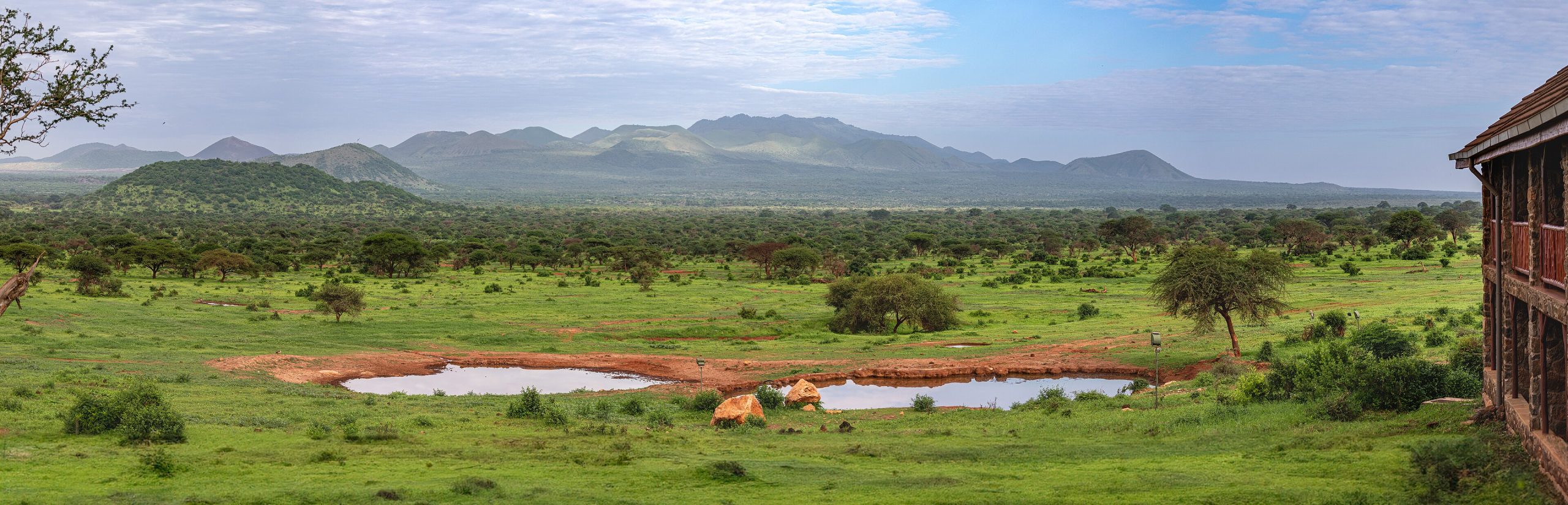
Tsavo West National Park Safari Guide
Tsavo West National Park is Kenya’s second largest national park, a volcanic stretch of about 9,065 square kilometres in Taita-Taveta County built around lava flows, hill country and permanent springs. Mtito Andei Gate lies 240 kilometres from Nairobi and 250 from Mombasa, and Chyulu Gate connects the park directly to Amboseli, which is why most Tsavo West safaris start inland. It is the scenic half of Tsavo and the half that holds the rhino.
What Makes a Tsavo West Safari Different From Tsavo East
Both Tsavos were gazetted in 1948 and the A109 Nairobi to Mombasa highway and the railway line run between them. That boundary is administrative. The difference travellers actually notice is geological.
Tsavo West sits higher, gets more water and is far more broken ground. Volcanic hills, cones and old lava fields interrupt the bush, there are springs that run year round, and the vegetation is thicker. That last point is the one to plan around: a Tsavo West safari does not hand you animals the way flat open country does. Game is harder to pick out of dense bush, and a guide who knows the circuits earns their fee here more obviously than they do next door. What you get in exchange is country worth photographing in its own right, standing water that concentrates wildlife reliably, and the black rhino population that Tsavo East does not have.
The other practical difference is tsetse. Thick riverine bush suits them, and travellers report them far more often in the west than in the east. They are a nuisance rather than a danger on a normal safari, they cluster on narrow tracks through close bush, and dark blue and black clothing draws them. Light colours and closed windows through the worst sections handle most of it.
Volcanic Country on a Tsavo West Game Drive
The geology is not background here, it is the itinerary. Tsavo West’s hills are volcanic, the black lava fields are young enough to still look raw, and the water that surfaces in the park has travelled underground from the Chyulu Hills to the north, filtering through porous volcanic rock on the way. That is why the springs run clear and cold in a park surrounded by dry bush.
It is also why the water matters beyond wildlife. Since the 1950s a pipeline has carried spring water from the park towards Mombasa, and it still supplies a meaningful share of the coastal city’s municipal supply. Long term measurements of the spring flow show wide variation between wet and dry years, and falling levels have been reported. A Tsavo West game drive that stops at the water is looking at a regional water source, not just a photogenic pool.
The volcanic features do something else useful for visitors: they give you height. In a park where bush hides the game, the viewpoints on the hills are where you get the overview, and they are the reason drives here often build in a stop that has nothing to do with animals at all.
Black Rhino Watching in the Tsavo West Rhino Sanctuary
This is the part of the park where the guide pages are furthest out of date, so it is worth being precise. For decades the rhino story in Tsavo West was the Ngulia Rhino Sanctuary, a fenced area of about 92 square kilometres holding eastern black rhino, Diceros bicornis michaeli. It worked, and it worked so well that the population outgrew the ground available and pushed past the ecological carrying capacity of the enclosure, which suppressed breeding and survival.
On 9 December 2025 an enlarged Tsavo West Rhino Sanctuary was unveiled, covering about 3,200 square kilometres. It brought together 150 black rhino from Ngulia and 50 from the Tsavo West Intensive Protection Zone to form a founder population of 200. The Kenya Wildlife Service now describes it as the largest rhino sanctuary in the world. Kenya holds somewhere around 2,000 rhino in total, including more than a thousand black rhino, which is close to 78 per cent of the global eastern black rhino population.
What that means for a visitor is honest and slightly deflating: more space for rhino means lower density, and lower density means sightings are less of a sure thing than they were inside a small fenced block. Rhino viewing in Tsavo West has always been a matter of patience, early starts and being in the right sector. Nothing about a larger protected area makes it guaranteed. The detail on the original enclosure and how viewing is arranged sits on the Ngulia Rhino Sanctuary page.
Tsavo West Attractions to Plan a Safari Around
Five named sights carry their own pages on this site. This is the orientation; the detail lives with each one.
Mzima Springs is the park’s best known feature, a set of clear pools fed from the Chyulu aquifer, with hippo, crocodile and barbel, and a walk that is done on foot under ranger escort. Shetani Lava Flow is the black field of relatively recent lava near Chyulu Gate, with a cave system alongside it. Chaimu Crater is a volcanic cone that can be climbed on foot for the view over the surrounding country. Roaring Rocks is the escarpment viewpoint that gives the long panorama over the plains and the raptors working the thermals. Ngulia Rhino Sanctuary is the fenced sanctuary inside the park, now superseded by the much larger Tsavo West Rhino Sanctuary that replaced it.
Several smaller features sit alongside them without needing pages of their own. Poacher’s Lookout is a short drive and climb to a hilltop with a wide view and is one of the few places in the park you are allowed out of the vehicle without a ranger at your elbow. The Five Sisters are the line of volcanic hills that appear in most photographs taken here. Shetani Cave sits with the lava flow. The full index of named sights across the country is on the Kenya attractions hub.
Lake Jipe and the Southern Reaches of a Tsavo West Safari
The far south of the park is a different trip again and most itineraries never get there. Lake Jipe straddles the Kenya and Tanzania border at the foot of the Pare Mountains, with its own gate and its own airstrip, and it is a birding and boat destination rather than a game drive one. Elephants come down to the shoreline, the reed beds hold species you will not find in the dry interior of the park, and hippo and crocodile are resident.
Jipe is also the quietest part of Tsavo West by a distance. If the appeal of a park is the absence of other vehicles, this is where that is available. The cost is driving time, since it sits a long way from Mtito Andei, and a KWS public campsite at the lake is one of the few places to stay down there. Maktau and Ziwani gates serve this southern end from the Voi to Taveta road.
The lake is Kenyan and Tanzanian ground both. This guide covers the Kenyan side and the Kenyan gates; what lies across the water belongs to another country’s park system.
Birdwatching Safaris at Ngulia and the Migrant Falls
Over 600 bird species have been recorded in Tsavo West, comfortably ahead of its eastern neighbour, and the variety comes from the range of habitat: lava fields, acacia woodland, permanent water, riverine bush, hills and a lake all inside one park.
What makes a Tsavo West birdwatching safari genuinely unusual is Ngulia. Since 1969, ringers have worked at Ngulia Safari Lodge through November and December, catching and ringing Palaearctic songbirds that migrate south from Europe and Asia. On dark, misty, moonless nights the birds become disoriented by the lodge lights and drop into the surrounding bush in what the ringers call falls. Marsh warbler, thrush nightingale and common whitethroat dominate the catch. Between 1969 and 2020 the station ringed 597,694 Palaearctic migrants of 72 species, along with 15,570 Afrotropical birds of 234 species, which makes it one of the longest running migration studies anywhere in the tropics.
The falls depend on weather and cannot be booked. What can be planned is the season: a November or December visit puts you in the park while the migration is passing through, whether or not the conditions produce a fall. The country wide picture is on the birdwatching in Kenya page.
Walking, Viewpoints and Slow Travel on a Tsavo West Trip
Tsavo West is one of the few Kenyan parks where a good part of the day happens outside the vehicle. The Mzima walk is done on foot with a ranger. Chaimu Crater is climbed. Poacher’s Lookout is a walk up to a view. Roaring Rocks is reached and then walked along. None of it is technical, but all of it is at the mercy of heat, so the walking happens early or late.
Anything on foot inside a national park is arranged through your camp or through the Kenya Wildlife Service, not decided on the spot, and armed escort is the rule rather than the exception away from the designated viewpoints. Several competitor guides publish trail distances and elevation gains for named Tsavo West routes; those figures come from a single aggregator and could not be confirmed against the park authority, so this page describes the walks without putting numbers on them. Ask at the gate, where the current position on which trails are open is what actually matters. The wider context sits on the walking safaris in Kenya and hiking in Kenya pages.
This is also the park’s honest answer to the traveller who found Tsavo East monotonous. If the appeal of a safari is landform, quiet, water and getting out of the car, Tsavo West is the better fit, although the game count per hour is lower.
Best Time to Visit Tsavo West for a Safari
Two wet seasons and two dry ones, the same rhythm as the rest of southern Kenya, but Tsavo West’s greater elevation and rainfall soften the extremes a little.
Two things follow from that. Tsetse activity tracks the thickness of the bush, so the wet months are when travellers complain about them most, and light coloured long sleeves are the cheap fix. And if the springs are the reason you are going, the dry season is when they are most obviously doing their job, because they are the only water for a long way in any direction.
Getting to Tsavo West National Park for Your Safari
Mtito Andei Gate on the A109 is the main entrance, 240 kilometres from Nairobi and 250 from Mombasa, which puts Tsavo West within a half day’s drive of either city. Chyulu Gate connects the park to Amboseli National Park to the west, and that link is the reason the two parks are so often sold together. Tsavo River, Lake Jipe, Maktau and Ziwani gates serve the southern and western sides.
By air, Kilaguni and Finch Hattons are the main airstrips, with Kamboyo, Ziwani, Tsavo River, Lake Jipe, Maktau and Kasigau also available. Charter flights from Nairobi cut the drive to roughly an hour and make a two night stay practical in a way a full day of driving each way does not.
The Standard Gauge Railway runs to Mtito Andei Station from both Nairobi Terminus and Mombasa Terminus. It works if your camp collects you from the station. It does not work if you were expecting to pick up a vehicle there.
The Railway, the Man-Eaters and the War in the Bush
Tsavo West carries the history that gave the whole region its name outside Kenya. In 1898, during construction of the Kenya to Uganda railway at the Tsavo River crossing, two male lions killed railway workers over a period of months and brought the work to a halt. The popular figure of 135 victims comes from the account written by the engineer who eventually shot them, John Henry Patterson, whose two lion skins were sold to the Field Museum in Chicago in 1924 and are still on display there. A stable isotope study of the lions’ bone collagen and hair keratin, published in 2009, put the number much lower, estimating that the two animals together consumed roughly 35 people in their final months.
The park’s second historical layer is less known. Tsavo was a theatre of the First World War East African campaign, fought through exactly the kind of dense bush and broken hill country that makes game spotting difficult today, and the Kenya Wildlife Service treats that campaign as part of the park’s heritage alongside the railway story.
Neither of these is a stop on a game drive in any organised sense, which is worth saying plainly. They are context, and they are the reason a park with harder game viewing than its neighbour has the more famous name.
Where Travellers Base Themselves on a Tsavo West Safari
The Kenya Wildlife Service runs Kamboyo Guest House under its Mbugani Homes scheme, public campsites at Komboyo, Chyulu and Lake Jipe, and a set of special campsites including Kudu, Little Royal, Simba, Palm Tree, Maji ya Chumvi, Kichwa Tembo and Pipeline. Privately run lodges and tented camps inside the park include Finch Hatton’s, Kilaguni Serena Safari Lodge, Severin Safari Camp and Ngulia Safari Lodge.
Where you sleep shapes what you see, more so than in a flat park. A base in the north puts Mzima, Shetani and Chyulu Gate within an easy morning. A base near Ngulia puts you in the rhino country and at the ringing station in season. Lake Jipe is its own trip. This site does not rank properties or operators; the listings on this page reflect what is currently being sold and by whom. If camping appeals, the camping safaris in Kenya guide sets out what KWS sites do and do not provide.
Tsavo West National Park Safari FAQ
What are the Tsavo West National Park entry fees?
The Kenya Wildlife Service publishes daily conservation fees by visitor category. These are the official rates on the KWS Tsavo West park page, checked on 21 September 2026. They cover park entry only, not a vehicle, guide, accommodation or any operator charge.
| Visitor category | Adult | Child |
|---|---|---|
| East Africa Citizen | KES 1,000 | KES 500 |
| Kenya Resident | KES 1,350 | KES 675 |
| Africa Citizen | USD 40 | USD 20 |
| Non Resident | USD 80 | USD 40 |
Several widely read guide pages publish far lower figures for Tsavo West, in one case quoting around a thousand shillings for a non resident adult. Those are wrong. Check the KWS site directly before you travel.
Is Tsavo West worth it if I have already booked Tsavo East?
Yes, and the case is that they are barely the same experience. Tsavo East gives you open country and large elephant herds. Tsavo West gives you volcanic scenery, permanent springs, the rhino population and activity on foot. Only a highway separates them, so adding two nights in the west to an eastern trip costs a transfer rather than a travel day.
Are tsetse flies really a problem in Tsavo West?
They are a recurring complaint and the honest answer is that it varies by sector and season. They concentrate in thick riverine bush and along narrow tracks, and they are drawn to dark blue and black. Light coloured long sleeves and trousers, windows up through the worst thickets, and a guide who knows which tracks to avoid handle most of it. They are a nuisance on a normal safari rather than a health risk, but they bite hard enough that people remember it.
How likely am I to see rhino in Tsavo West?
Possible, not probable, and less predictable than it used to be. The black rhino population has been moved into a far larger protected area than the old fenced enclosure, which is good for the animals and harder for viewing, because density has dropped. Early morning drives in the right sector with a guide who knows the current movements are what improves the odds. No one can promise a rhino sighting and you should be wary of anyone who does.
Can I get out of the vehicle in Tsavo West?
In specific places, yes, which is unusual for a Kenyan national park. The Mzima Springs walk is done on foot with a ranger escort. Chaimu Crater and Poacher’s Lookout involve walking. Elsewhere you stay in the vehicle, keep the doors closed and keep 20 metres or more from wildlife. Anything beyond the designated spots is arranged in advance through your camp or through KWS, usually with an armed escort.
How many nights should I spend in Tsavo West?
Two nights covers the northern circuit properly: Mzima, Shetani, a viewpoint and two game drives. Three lets you add the rhino country around Ngulia without rushing. Lake Jipe in the far south is a separate leg in practice and needs its own night, since the driving time from the northern lodges is substantial.
Can I combine Tsavo West with Amboseli?
Easily, and it is one of the standard southern Kenya routings. Chyulu Gate links the two parks directly, so a vehicle can move between them without returning to the main highway. Travellers often run Amboseli, then Tsavo West, then either Tsavo East and the coast or back to Nairobi.
What is the best month for birds in Tsavo West?
November and December, when the Palaearctic migrants are passing through and the ringing season at Ngulia is running. The resident list is strong year round and the variety of habitat means a good day is possible in any month, but the migration window is the one that produces species you will not see here at other times.
Is Tsavo West suitable for self drive?
It is, and the hillier terrain is more interesting to drive than Tsavo East’s flats, but take a high clearance four wheel drive rather than a soft roader. Lava rock is hard on tyres, so carry more than one spare. Phone coverage is unreliable across much of the park and vehicle traffic is light, so tell your camp your route and your expected arrival time. The self drive safaris in Kenya guide covers the trade in full.
Building Tsavo West Into a Southern Kenya Circuit
Tsavo West is rarely a destination on its own and it does not need to be. Its position between Nairobi, Amboseli and the coast makes it the connective park in southern Kenya, and the itineraries that work treat it that way. Running west to east, the sequence is Amboseli through Chyulu Gate, then Tsavo West, then across the A109 into Tsavo East and out to Mombasa or Diani Beach. Running the other way, it is the last park before Nairobi.
The Chyulu Hills sit immediately north and supply the water that surfaces at the springs, and the Taita Hills lie to the south east. Both add a night for travellers who want more than the standard run. When you send an enquiry, saying which of these you want to include is more useful than naming a number of days, because the gates and the transfer routes are what determine whether an itinerary is realistic.
5 Places to Visit in This Area
Individual sites within reach of here, each with its own guide. Some are written up because the name circulates and the place does not, which is worth knowing before you plan a drive around one.
Safaris That Visit Tsavo West National Park
3 of the 5 safaris listed here that visit Tsavo West National Park, from different operators where the listings allow it. Each is sold and run by an independent tour company. This site lists them and passes on enquiries; it takes no booking and charges you nothing.


7 Days Wildlife Safari in Kenya
by Kori Safaris Verified operator
Operator quotes on request
View Safari

Kenya Classic: Amboseli, Tsavo & the Mara
by Ancient Africa Safaris Verified operator
From $9,400 per person
View Safari

3 Days Tsavo East and Tsavo West Safari
by Tranquil Safaris Verified operator
Operator quotes on request
View Safari