
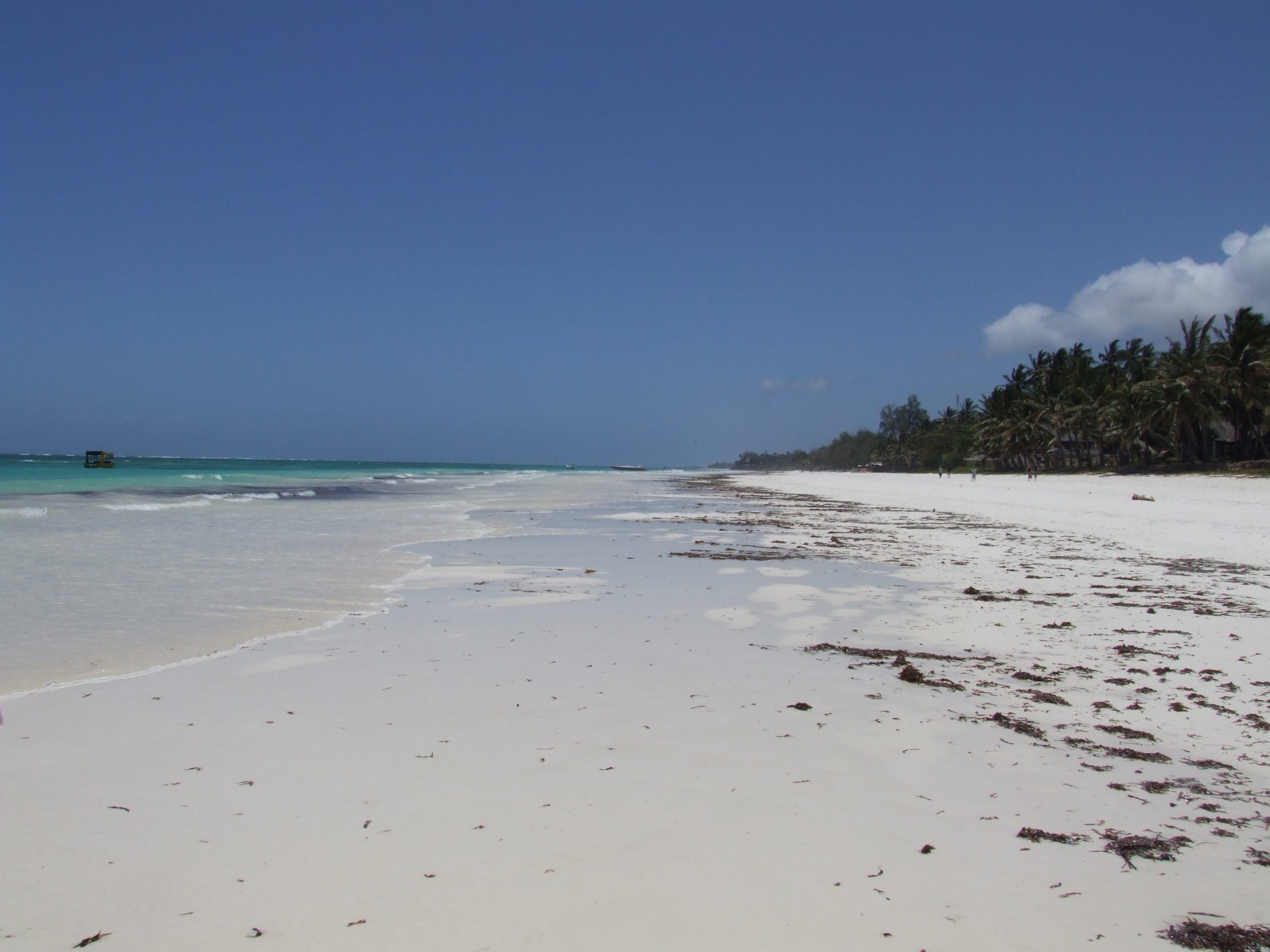
Diani Beach
Diani Beach is a seventeen kilometre stretch of coral sand on Kenya’s south coast, running from the Mwachema River mouth down to Galu, and it is the country’s busiest beach destination outside Mombasa. Most visitors arrive on a short flight into Ukunda or by road from Mombasa, thirty kilometres north. It sits in Kwale County, inside a fringing reef that shapes almost everything about a day here.
What a Diani Beach Trip Covers
Diani works as a single base. The hotels, the water sports operators, the forest walks and the road inland all sit within about a twenty minute drive of each other along one spinal road, which is why people come here for a week rather than a night. That compactness is the real draw, more than the sand.
Three things sit behind the beach and give the destination its depth. There is the coastal forest, which is what is left of a habitat that once ran most of the way up this coast and which still holds a monkey found almost nowhere else. There is Mijikenda sacred ground at Kaya Kinondo, which is open to visitors under rules set by its elders rather than by a tourism board. And there is the escarpment inland, where the ground lifts into the Shimba Hills and the temperature drops.
Diani is also the gateway to the rest of the south coast. Shimoni, Wasini and the reefs of Kisite Mpunguti lie further south towards the Tanzanian border, and they are day trips from here rather than separate holidays for most people.
The Beach, the Reef and the Tide
The reef sits offshore and the lagoon between reef and sand is shallow. At high tide that lagoon is a wide flat swimming pool. At low tide it drains, the water pulls back a long way, and what is left is exposed reef flat, seagrass and rock pools. Neither state is a problem once you know which is coming, but arriving without knowing is the single most common complaint travellers make about Diani, because a room booked for the swimming is a room booked around a timetable nobody mentioned.
Tide tables are posted at most hotel receptions and the swing between the two states runs on roughly a six hour cycle. Plan snorkelling, boat departures and swimming around high water. Plan the long beach walk, the reef pools and the photographs around low water, when the sand widens out and you can walk for an hour without leaving the strand.
Two practical points come up again and again in traveller reports. Wear something on your feet on the reef flat, because sea urchins are common and stonefish are present. And expect seaweed on some stretches in some months, driven by current and wind rather than by season alone, with the southern end around Galu usually clearer than the middle of the strip.
Vendors work the beach. Some visitors find it persistent, particularly on the central stretch near the larger hotels. A civil no is usually enough, and the pressure drops off sharply at the quieter northern and southern ends.
Kaya Kinondo Sacred Forest Tours
A Kaya Kinondo tour is the one thing at Diani that has nothing to do with the sea, and it is the one kaya with an established community-run visitor arrangement, although it is not itself one of the inscribed ten. The Sacred Mijikenda Kaya Forests were inscribed by UNESCO in 2008 under criteria three, five and six, as ten separate forested sites spread along roughly two hundred kilometres of the Kenyan coast, together covering 1,538 hectares and representing more than thirty surviving kayas.
A kaya was a fortified village. The Mijikenda began leaving them in the early twentieth century, after which the sites passed from being places people lived to being places people revere, held as the burial grounds and spiritual homes of the ancestors. The restrictions that came with that shift are why the forest is still standing at all. Where the coastal lowland forest around them was cleared, the kayas were not.
Kaya Kinondo is the one open to visitors, and it is visited on Digo terms. A guide from the community walks you through, a black kaniki cloth is worn around the waist, headwear comes off, and there are rules about noise and behaviour inside the grove. Entry fees go to community projects. Treat the visit as a guided walk through a working religious site rather than as a nature trail with a cultural label attached, because that is what it is.
Read the full account at Kaya Kinondo Sacred Forest.
Sheldrick Falls and Shimba Hills Trips Inland
About an hour inland the ground rises, the air cools and the coconut gives way to a coastal rainforest that holds elephant and sable antelope. That is Shimba Hills National Reserve, and it is a destination in its own right rather than an afternoon out of Diani, so it has its own page.
The part most Diani visitors actually do is the walk to Sheldrick Falls. It is a guided descent on foot to a waterfall in forest, out and back, and it needs a Kenya Wildlife Service ranger as escort because you are walking in a reserve with elephant in it. Walks leave at set times in the morning and early afternoon, so this is a trip you commit to at the gate rather than one you improvise. There is a plunge pool at the bottom and most people swim.
Take proper shoes. The descent is steep in places and the path is slippery after rain.
Kongo Mosque Tours at the Mwachema River Mouth
At the northern end of the strip, where the Mwachema River meets the sea, stands Kongo Mosque, built of coral rag and dated by architectural historians to the fourteenth or fifteenth century. It has been called the Diani Persian Mosque and the Tiwi Mosque at different times. The barrel vaulting and the form of the mihrab tie it stylistically to early Swahili sites further up the coast.
It is a short structure under old baobabs, on a tidal river mouth, and it takes twenty minutes to see. The value of it is context: it puts a medieval Swahili trading coast behind a beach that otherwise reads as entirely modern. The mosque is still used, so visit quietly and dress as you would for any working mosque.
Colobus Monkey Watching Along Diani Beach Road
The Angolan colobus is the animal Diani is known for among people who care about such things. It is a black and white leaf-eating monkey that depends on continuous canopy, and the canopy here has been cut apart by the beach road and by hotel development, leaving a small population in fragments of forest south of Mombasa.
Colobus Conservation, a non-profit working in Diani since 1997, runs rescue and education work and is responsible for the rope bridges strung above the road. The bridges, known locally as colobridges, let the monkeys cross without coming down to tarmac. Look up as you drive the beach road and you will see them. Vervets and Sykes’ monkeys are everywhere along the strip too, and unlike the colobus they will come into a room through an open door.
The centre can be visited, and the visit is a short guided one rather than a zoo.
Water Sports and Reef Trips Out of Diani
Diani’s lagoon and steady offshore wind carry most of the coast’s water activity. Kitesurfing has the strongest following, because a flat shallow lagoon behind a reef with a reliable trade wind is close to an ideal teaching environment, and the schools cluster at the southern end. Snorkelling and scuba diving run off the reef and further out, and deep sea fishing boats work the drop-off beyond it.
Skydives onto the beach run here seasonally, which is unusual for the region and worth knowing about if that is your thing. Dhow cruises run from the creeks at either end of the strip.
All of it is tide-dependent and most of it is wind-dependent, which loops back to the season. A reef trip in flat water in February is a different activity from the same trip in a July swell.
Day Trips South Towards Shimoni and Wasini
The road south from Diani runs to Shimoni, where the slave caves are, and from there boats cross to Wasini Island and out to Kisite Mpunguti Marine National Park. This is the best reef in the region and the standard day trip is a long one, leaving early and returning late. Dolphins are regularly seen on the crossing, though sightings are never guaranteed.
Chale Island sits just off the coast at the southern end of the Diani strip and is reached at low tide across the flats or by boat at high water.
Going the other way, Mombasa and its old town are within an easy drive now that the bypass is open, which makes Fort Jesus a half day rather than an expedition.
Getting to Diani Beach for a Coast Trip
Three routes in, and the road one has changed.
Scheduled flights land at Ukunda Airport, a short airstrip a few minutes from the beach road, with services from Nairobi’s Wilson Airport. This is the quickest way in and it skips Mombasa entirely.
By road from Mombasa, traffic used to funnel onto the Likoni Ferry, which was the reason Diani transfers were quoted in hours rather than minutes. The Dongo Kundu bypass, a dual carriageway of about seventeen and a half kilometres also called the Mombasa Southern Bypass, now links Miritini to Kwale County and takes the ferry out of the equation. Transfers from the Mombasa area that once ran well over two hours are now commonly quoted at around an hour. Older guidance you may read still assumes the ferry, so check the date on anything that tells you to budget half a day.
The third route is the Standard Gauge Railway to Mombasa Terminus at Miritini, then road, which now feeds straight onto the bypass.
Kaskazi and Kusi: Timing a Diani Trip
The Kenya coast does not really have four seasons. It has two monsoons, and they decide the water.
Use that rather than a generic dry season rule. If the trip is built around the reef, come in kaskazi. If it is built around wind, kusi is not a compromise but the point. If it is built around the forest, the kayas and the hills, the rain matters less than the footing, and a wet path to Sheldrick Falls is a slow one.
Diani Beach Questions
What does it cost to enter the marine reserve and the parks around Diani?
Kenya Wildlife Service publishes one conservation fee band for all six of its marine protected areas, which includes Diani Chale and Kisite Mpunguti. On the KWS conservation fee schedule current at the time of checking on 21 September 2026, that band is KSh 500 for an East African citizen adult and KSh 250 for a child, KSh 675 for a Kenya resident adult and KSh 350 for a child, USD 25 for a non-resident adult and USD 15 for a child, and USD 15 for an African citizen adult and USD 10 for a child. Shimba Hills National Reserve sits in the KWS scenic parks band at KSh 500 for an East African citizen adult, KSh 675 for a Kenya resident adult, USD 50 for a non-resident adult and USD 20 for an African citizen adult. Kaya Kinondo charges its own community entry fee, set locally rather than by KWS, so confirm it when you arrange the walk. Fees change, so check kws.go.ke before you travel.
Can you swim at Diani at any time of day?
Not comfortably. The lagoon drains at low tide and the water retreats a long way, leaving reef flat and seagrass rather than swimming depth. Check the tide table at your hotel on arrival and build the week around it. Hotel pools cover the gap, which is one reason nearly every property on the strip has one.
Do you need shoes in the water?
On the reef flat, yes. Sea urchins are common in the seagrass and rock pools, and stonefish are present on this coast. Reef shoes or old trainers solve it. On the open sand at high tide it is not an issue.
Does Diani work as a base for a safari and a beach stay together?
It works for the coastal parks. Shimba Hills is roughly an hour inland and Tsavo East is reachable, which is why a lot of coast holidays add a short inland leg rather than flying to the Mara. It is a long way from the Maasai Mara and Amboseli by road, so those pair better with a flight than with a drive from the coast.
How persistent are the beach vendors?
Persistent on the central stretch, much less so at the quieter ends. Most travellers report that a polite and firm refusal, repeated once, ends it, and that the same faces stop asking after the first day or two. Walking with a hotel guide or in company reduces it further.
What should you know before visiting Kaya Kinondo?
That it is sacred ground with rules, not a park. You walk with a Digo guide, wear the black kaniki cloth provided, remove headwear, and follow instructions about where you may and may not go. Photography is restricted in places. A visit takes a couple of hours including the community walk around it.
Is the Likoni Ferry still part of the trip from Mombasa?
No, not for most transfers. The Dongo Kundu bypass links Miritini to Kwale County by road and bypasses the crossing entirely. Guidance written before the bypass opened still budgets for the ferry queue, so check how old your source is.
What is the best month for kitesurfing at Diani?
Both monsoons deliver usable wind, and the schools run across most of the year. The southeast monsoon, kusi, from around June to September, brings the stronger and steadier wind. The northeast monsoon, kaskazi, from December to around March, is lighter and warmer and suits beginners better.
Diani is also the northern anchor of a run of south coast destinations that includes Shimoni, Wasini Island, Chale Island and Shimba Hills National Reserve. For the coast as a whole, start at Kenya Coast.
2 Places to Visit in This Area
Individual sites within reach of here, each with its own guide. Some are written up because the name circulates and the place does not, which is worth knowing before you plan a drive around one.
No operator on the marketplace currently lists a safari to Diani Beach.
See every Kenya safari