
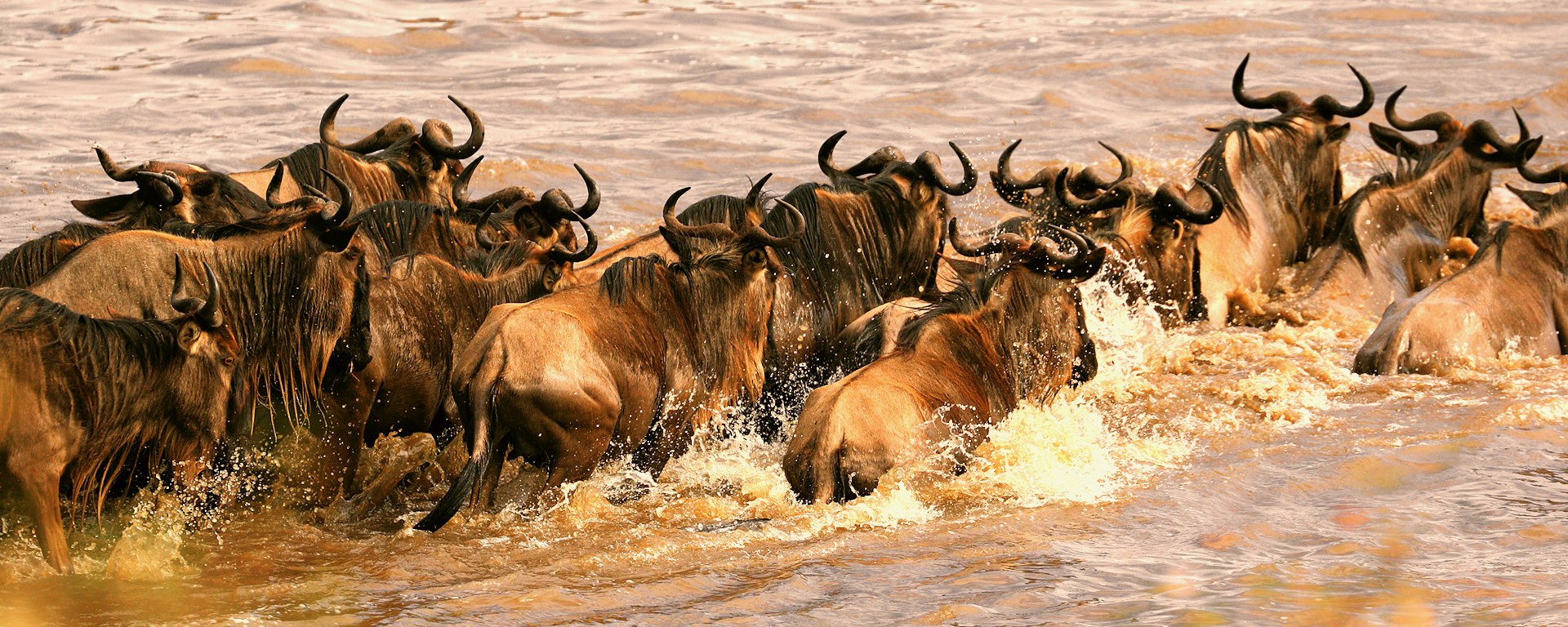
Planning a Migration Safari in Kenya
A migration trip is planned differently from every other Kenyan safari, because it is the only one where the thing a traveller has come for is a probability rather than a place. Everything else in the Maasai Mara is reliably there. A river crossing is not, and the whole shape of a well planned trip follows from accepting that.
This page is about the planning. What the migration actually is, why the herds move, where the crossings happen and what the science says about the population is covered in full on the Great Migration guide, which is the place to start if those are the questions. What follows assumes them and deals with the decisions: where to stay and what that settles, how many nights the trip needs, what the days actually cost, and how to set an expectation that survives contact with the reserve in August.
The Window Is an Input, Not a Date
The herds are in Kenya for roughly a third of the year, broadly July to October, with August and September the densest part of it. That is a probability drawn from decades of observation, not a schedule, and the migration guide sets out the evidence behind it and the reasons the dates move.
For planning purposes only two consequences matter.
The first is that the trip is committed long before anyone knows what the animals will do. Accommodation in the Mara is fixed months ahead and the rains that will decide the herds’ position have not fallen yet. A traveller is choosing a fortnight and accepting the distribution of outcomes inside it, which is a different exercise from choosing a date for a fixed event.
The second is that the window and the peak season are the same weeks. Everything that follows about fees, beds, vehicles and crowding is a consequence of that single overlap. There is no version of a migration trip that avoids it, and plans built on the assumption that there is tend to come apart.
The Decision That Settles Everything: Reserve, Triangle or Conservancy
Where a traveller sleeps in the greater Mara decides more about the trip than the month does. There are three answers and they are genuinely different products, not price tiers of the same one. The Maasai Mara guide sets out what each is; what matters here is what each one settles.
| Staying in | Access to crossings | Vehicles at a sighting | Night drives and walking |
|---|---|---|---|
| Reserve, eastern sector | Direct, this is where they happen | Uncapped | Not permitted |
| Mara Triangle | Direct, western third of the reserve | Uncapped but far fewer present | Not permitted |
| A conservancy | Only by driving into the reserve and paying its fee | Capped by agreement | Permitted |
The trade is stark once it is stated plainly. Staying inside the reserve puts a traveller where the crossings are and in the company of everyone else who came for them. Staying in a conservancy buys quiet, a capped sighting and activities the reserve does not allow, at the cost of a drive and a second entry fee on any day aimed at the river.
The Mara Triangle is the answer people most often arrive at and least often know about in advance. It is the western third of the reserve, about 510 square kilometres between the Mara River, the Oloololo Escarpment and the Tanzanian border, managed by the Mara Conservancy under contract rather than directly by Narok County. Same entry rules, same prohibition on night drives and walking, materially fewer vehicles. For a traveller whose priority is the crossings without the eastern sector’s traffic, it is the structural answer rather than a preference.
The conservancy system is larger than most trips realise. The Maasai Mara Wildlife Conservancies Association states 24 conservancies across the greater Mara, 16,530 landowners and 178,668 hectares under lease, figures from its own site checked in September 2026. Five of them are written up individually: Mara North, Mara Naboisho, Olare Motorogi, Ol Kinyei and Olderkesi, and they differ from one another more than the marketing suggests.
Split trips are common and usually the best answer for a week: nights in a conservancy for the quiet game viewing, walking and night drives, and nights in the reserve or the Triangle for the river. The sequencing matters and is dealt with below.
What Each Choice Decides About Fees
Reserve entry is set by Narok County in its Finance Act, not by Kenya Wildlife Service, which is why the Mara has a seasonal split that no national park has. The rates below are as published in the Narok County Finance Act, checked on 21 September 2026, per person per day.
| Visitor category | Low season, Jan to Jun | High season, Jul to Dec |
|---|---|---|
| Non-resident adult | USD 100 | USD 200 |
| Non-resident child, 9 to 17 | USD 50 | USD 50 |
| Kenyan citizen adult | KSh 1,500 | KSh 3,000 |
| Kenyan citizen child, 9 to 17 | KSh 300 | KSh 500 |
| East African resident adult | KSh 2,500 | KSh 5,000 |
| East African resident child | KSh 1,000 | KSh 2,000 |
Children aged eight and under enter free in every category. Vehicles are charged separately by seat band, starting at KSh 1,000 for under six seats, KSh 1,500 for six to twelve and KSh 3,500 for thirteen to twenty four.
Two features of that schedule are worth reading properly, because they change the arithmetic of a migration trip.
The high season runs 1 July to 31 December and the low season 1 January to 30 June. The entire migration window therefore sits inside the high season, and the non-resident adult rate doubles across all of it. There is no early July discount and no late October one. The split also does not track the herds: November and December are charged at the high season rate although the animals have gone south, and June is charged at the low season rate although the leading edge often arrives in it.
The fee is per person per day, not per stay. A traveller sleeping inside the reserve for four nights is paying it four times over, and that is usually the largest single government charge on a Mara trip. Whether it sits inside a quoted figure or outside it is the question worth asking first of anyone quoting, because entry fees are set by the authority that runs the place rather than by whoever sells the trip.
Conservancy fees work on a different basis entirely. Each conservancy sets its own, they are charged per guest per night, and they are the money that funds the monthly lease payments to the landowning Maasai families. Most camps fold the charge into the rate rather than billing it separately, and some do not. Because these are private and community bodies rather than a government authority, no single published schedule covers them, and the figure is a question for the specific camp.
The Second Fee a Conservancy Guest Pays for a Crossing Day
This is the detail that most often surprises people after arrival, and it follows directly from the table above.
The river crossings happen on the Mara River inside the national reserve. A conservancy guest who wants to see one drives into the reserve for the day, and that day attracts the reserve’s own per person entry fee, at the high season rate, paid to Narok County. It is a genuine additional cost and it is separate from the conservancy fee already being paid for the same night.
Camps arrange these days routinely and they are a normal part of a conservancy stay in the window. What matters is that the traveller knows the charge exists before the trip is costed rather than after, and knows whether the camp includes it. A four night conservancy stay with two reserve days is paying two days of reserve entry on top of four nights of conservancy fee.
The reverse case has no equivalent problem. A traveller staying inside the reserve can drive to the river without a second fee, but cannot enter a conservancy at all, because conservancies are closed to day visitors. There is no gate at which a day ticket can be bought.
How Many Nights a Migration Trip Actually Needs
Two nights in the Mara is the practical minimum for an ordinary safari and three is more comfortable. A migration trip needs more than that, and the reason is arithmetic rather than enthusiasm.
A crossing is not a scheduled event and a promising gathering on a bank can dissolve without one. A traveller with a single full day in the reserve during the window has one attempt. A traveller with three full days has three, and the difference in the probability of seeing a crossing between one attempt and three is not a marginal improvement; it is the difference between a likely outcome and an unlikely one.
Three full days in the reserve or the Triangle is the sensible floor for a trip whose purpose is a crossing. Because the arrival day and the departure day are usually partial, that means four nights. A split trip combining a conservancy with reserve days needs more again, because the conservancy nights are not crossing attempts.
The other pressure runs the opposite way. Getting to the Mara costs the better part of a day by road, around six hours from Nairobi to the eastern gates, and the getting around Kenya page sets out what flying instead buys back. A trip that adds a second region loses days to the transfers between them, and a migration trip that has been thinned to two Mara nights in order to fit a coastal extension has usually given away the thing it was built for.
What a Crossing Day Actually Costs in Hours
The mechanics of the day are what the brochures do not describe, and they are entirely knowable in advance.
The reserve’s gates operate from 6am to 6pm, and the Kenya Wildlife Service principle that visitors vacate between those hours applies here through Narok County’s own rules. Critically, the entry ticket runs on that same 6am to 6pm window regardless of what time the vehicle arrived. A mid-afternoon entry buys a few hours, not a day, which is why a transfer day is not a crossing attempt and why crossing days start before first light.
The day itself is mostly waiting. Vehicles position on a bank where animals have gathered and then hold there, because leaving to look elsewhere forfeits the position. Waits of several hours are normal and a morning can end without a crossing. Travellers who understand this in advance treat the wait as the activity and bring what makes a long stationary morning bearable; travellers who do not tend to push their guide to move, which is how a group misses the crossing that eventually happens.
Food and comfort are practical questions on a day like that. Camps pack a breakfast and a lunch for a full day out, and no one leaves the vehicle at a crossing site. It is worth establishing what the camp provides for a full day drive rather than assuming a return for lunch, because a return for lunch means abandoning the bank.
A crossing can also run in both directions within the same day. A herd that crosses north in the morning may recross in the afternoon, which is why guides sometimes hold a position that looks spent.
Why Beds Are Scarce in the Window
The scarcity in August and September is structural, and understanding the structure is more useful than any lead time figure.
Inside the conservancies, accommodation is capped by agreement rather than by demand. Olare Motorogi publishes a maximum of 94 beds across five camps on roughly 15,200 hectares, alongside one game viewing vehicle for every 2,100 acres. Mara Naboisho publishes a ceiling of 150 beds across eight camps on about 22,500 hectares. Those ceilings are the point of the model, and they mean the supply of conservancy beds in the window cannot expand however many people want one.
Inside the reserve the constraint is different but the effect is similar: camp numbers are limited by the county’s own licensing rather than by a published ceiling, and the Mara Triangle in particular carries relatively few.
Set that fixed supply against a window of roughly four months, of which two are the peak, and the result is that the best placed camps in the window are spoken for a long way ahead. No authority publishes a lead time and the figures that circulate come from the businesses selling the beds, so this page does not repeat one. The planning consequence is simple enough without a number: in a migration trip the bed is the binding constraint, not the flight and not the park fee, and it is the thing to settle first. Fixing flights around an unsecured camp in the window is the wrong order.
The corollary is worth stating too. Because supply is capped rather than elastic, a traveller who is flexible about which conservancy is in a much stronger position than one fixed on a particular camp, and the five conservancies differ more in character than in quality.
Getting In During the Busy Months
Both routes into the Mara work in the window and they suit different trips.
The road from Nairobi runs through Narok and takes around six hours to the eastern gates, with the final stretch rough enough to matter for low clearance vehicles, particularly after rain. It costs a day in each direction and it is the route that lets a trip stop in the Rift Valley on the way.
Scheduled light aircraft leave from Wilson Airport in Nairobi, not from the international airport, and the flight runs about an hour. Which airstrip a traveller uses is decided by where they are staying rather than by preference, and the camp sends a vehicle to meet the aircraft. Luggage limits on light aircraft are strict and most require soft bags.
The window is the period when both are busiest, and a camp that cannot be reached before the 6pm gate closure on the arrival day has effectively cost the trip that day. Arrival timing is therefore worth treating as a planning decision rather than a detail.
Balloon Flights in the Window
A dawn balloon flight is the one way to see the herds at scale without joining a queue of vehicles, and it is the most commonly added activity on a migration trip. Two planning points apply.
It is a separate arrangement with its own operator and its own capacity, and in the peak weeks that capacity fills in the same way beds do. It also carries a charge that is not the flight price: Narok County levies a balloon landing fee per person, which is a charge on the landing itself and sits apart from whatever the balloon operator asks. Kenya Wildlife Service publishes its own balloon landing fee for the national parks, but the Mara is not a Kenya Wildlife Service park and that figure does not apply here.
Flights launch before dawn, which means leaving camp in the dark and being back by the middle of the morning. On a four night trip it consumes one morning drive, and in the window a morning drive is a crossing attempt. That is a real trade rather than a free addition. The hot air balloon safaris page covers how the activity itself works.
Setting the Expectation Honestly
The most useful thing anyone can do before a migration trip is decide what would make it a good trip, and make that decision before departure rather than on the third morning at the river.
A crossing is a possibility. Several days in the window during the season make it a likely one; a single afternoon makes it unlikely. Nobody can promise it, and a source that implies otherwise is describing a product rather than an animal.
What is close to certain in those same months is the rest of it: plains carrying more large animals than most people have seen in one view, predators concentrated around the herds and working visibly, and a landscape doing something that has no equivalent elsewhere. A trip framed around the ecosystem in its busiest state delivers. A trip framed entirely around one event at one river has made its own outcome binary.
The honest framing to carry into the planning is that the crossing is the possible upside on a trip whose baseline is already exceptional. Travellers who hold that framing report coming home satisfied whether or not the herds went into the water. Travellers who do not can spend four excellent days disappointed.
Travelling With Children in the Window
The window is the hardest time of year to take young children to the Mara, and the reasons are practical.
Crossing days are long, stationary and hot, which is a poor combination for small children and for the adults managing them. Many conservancy camps set minimum ages, and the activities that make a conservancy attractive for families, particularly walking, carry their own age restrictions.
On fees, Narok County charges children aged nine to seventeen at USD 50 for non-residents in both seasons, which is the one line in the schedule that does not double in the high season, and children of eight and under enter free. For a family the seasonal doubling therefore falls entirely on the adults, which changes the arithmetic of a high season trip more than people expect.
A family trip that wants the Mara without the migration crowds has a strong case for the shoulder months, and a family trip that specifically wants a crossing should weigh the long stationary days honestly against the ages travelling.
The Case for Not Chasing the Window at All
This belongs in a planning page because it is a real option rather than a consolation.
The Mara’s resident game does not leave when the herds do. Outside the window the reserve carries the same lion prides, the same leopards in the riverine forest and the same elephant and buffalo, with a fraction of the vehicles and at the low season entry rate of USD 100 for a non-resident adult rather than USD 200. January and February are dry, warm and quiet. The long rains from March to May bring tall grass and harder spotting, and almost nobody else.
A traveller whose real objective is excellent big cat viewing without company is better served outside the window than inside it, and a traveller who specifically wants the crossings is not served outside it at all. Being clear which of those two people is doing the planning is the single most useful thing to establish at the start. Whether the rest of a trip’s regions favour the same months is a separate question and belongs with the wider planning guides.
What to Establish Before Committing
A short list of questions separates quotes that look identical.
- Which sector the accommodation is in: the eastern reserve, the Mara Triangle, or a named conservancy. Not simply the Maasai Mara.
- Whether the Narok County entry fee is inside the quoted figure or outside it, and how many days of it the quote covers.
- For a conservancy stay, whether reserve days for the river are included, how many, and who pays the reserve entry fee on those days.
- Whether the conservancy fee is included in the camp rate or billed separately.
- How many full days in the reserve the itinerary actually contains, counting the arrival and departure days honestly.
- What the camp provides for a full day out, since a return to camp for lunch means leaving the river.
- Whether the vehicle is shared or private, which decides whether the group can hold a bank when one person wants to move on.
- Whether a balloon flight is included, and whether the landing fee is inside or outside that figure.
Fees are set by Narok County through its Finance Act and change with each one, so the current figure is a question for whoever is taking a traveller through the gate.
Questions About Planning a Migration Safari
When should a migration trip be arranged?
Earlier than most other Kenyan trips, because the bed is the constraint rather than the flight. Conservancy accommodation is capped by agreement, with Olare Motorogi publishing 94 beds across five camps and Mara Naboisho 150 across eight, so supply in the window cannot expand. No authority publishes a lead time and the figures that circulate come from businesses selling the beds, so this page does not repeat one. The practical rule is to settle the accommodation before fixing anything around it.
How many nights are needed to see a river crossing?
Three full days in the reserve or the Mara Triangle during the window is the sensible floor, which usually means four nights once partial arrival and departure days are counted. A crossing is not scheduled, so each full day is one attempt, and the difference between one attempt and three is large. A trip with a single reserve day during the window is not really a crossing trip.
Is it better to stay in the reserve or in a conservancy during the migration?
They answer different questions. The crossings happen inside the reserve, so staying there or in the Mara Triangle puts a traveller where they are. A conservancy caps vehicles at a sighting, permits night drives and guided walks, and excludes day visitors, but a crossing day from a conservancy means driving into the reserve and paying its entry fee for that day. Many trips split the nights for exactly this reason.
How much is the Maasai Mara entry fee during the migration?
The whole migration window falls in Narok County’s high season, which runs 1 July to 31 December. The Finance Act rate checked on 21 September 2026 is USD 200 per non-resident adult per day in high season against USD 100 in low season, with non-resident children aged nine to seventeen at USD 50 in both. Children eight and under enter free and vehicles are charged separately by seat band. It is charged per person per day, so a four night stay inside the reserve pays it four times.
Do I pay twice if I stay in a conservancy and visit the reserve?
In effect, yes. The conservancy fee is charged per guest per night and funds the land leases. A day driving into the reserve to look for a crossing attracts Narok County’s own per person entry fee for that day, at the high season rate. Camps arrange these days routinely, but whether the reserve fee is included varies, and it is worth confirming before the trip is costed.
What are the odds of actually seeing a crossing?
Nobody can put a number on it honestly, because it depends on where the herds are grazing, on conditions on both banks and on how the animals in front react in the first minutes. What can be said is that travellers who allow several full days in the reserve during the window see one more often than not, and travellers who allow a single afternoon frequently do not. Treating it as the possible upside on an already exceptional trip is the framing that survives the week.
How crowded is it really, and can that be avoided?
In the eastern sector of the reserve in August, a promising river bank draws vehicles by the dozen, and that is where crossings are most often attempted. The structural answers are the Mara Triangle, the western third of the reserve, which carries noticeably fewer, and the conservancies, which cap numbers by agreement but are not where the crossings happen. Moving dates a fortnight either side of the peak reduces the pressure more than any other single choice.
Is a balloon flight worth adding to a migration trip?
It is the one way to see the herds at scale without a queue of vehicles, and in the peak weeks its capacity fills in the same way beds do. The trade is that it consumes a morning, and in the window a morning is a crossing attempt. Narok County also levies a balloon landing fee per person which is separate from the flight itself, and the Kenya Wildlife Service balloon fee does not apply in the Mara because the reserve is not a national park.
Can I do a migration trip as a day visit from Nairobi?
Realistically, no. The drive is around six hours each way to the eastern gates, the gates run 6am to 6pm, and the entry ticket runs on that same window whatever time it was bought. A day visit spends both ends of the daylight in a vehicle on the road and arrives in the reserve at the worst hours for wildlife. The reserve is worth a minimum of two nights for an ordinary safari, and more than that for a crossing.
Is the migration a reason to add Tanzania to the trip?
That decision sits outside what this page covers, which is planning the Kenyan side. What is relevant here is that the Kenyan window and the crossings on the Mara River are what a Kenyan trip is being planned around, and thinning the Mara nights to fit another region in is usually the wrong trade on a trip built for the crossings.
What if the herds have not arrived, or have already gone?
It happens, because the timing moves with the rains and the trip was committed months earlier. The reserve in those weeks still holds its resident lion, leopard, elephant and buffalo and the country is at its most open, so the game viewing does not collapse. What changes is that the trip becomes the excellent Mara safari it always was underneath, without the spectacle. Travellers who framed it that way in advance are rarely disappointed by it.
Are night drives and walking safaris possible during the migration?
Not inside the national reserve, which does not permit either at any time of year. Both are permitted in the conservancies, which is one of the main reasons a split trip works: the conservancy nights supply the activities the reserve cannot, and the reserve days supply the river. Camps inside the reserve cannot offer them however long the stay.