The Great Migration in Kenya
The Great Migration is not an event with a date. It is a continuous movement of wildebeest, zebra and gazelle around one ecosystem, driven by rainfall and grass, that crosses into Kenya for part of every year. The river crossings are a possibility, never a promise.
The Great Migration is not an event with a date. It is a continuous movement of wildebeest, zebra and gazelle around one ecosystem, driven by rainfall and grass, that crosses into Kenya for part of every year. The river crossings are a possibility, never a promise.
Safaris That Include Great Migration


3 Days Safari in Maasai Mara, Kenya
by Kori Safaris
Operator quotes on request
View Safari

3 Day Safari Masai Mara
by Insight Safari Holidays
Operator quotes on request
View Safari

5 Days Rwanda Gorilla Safari and Masai Mara
by Oree Safaris
Operator quotes on request
View Safari

7 Days Kenya Safari
by Tranquil Safaris
Operator quotes on request
View Safari
5 Days Kenya Wildlife Safari
by Tranquil Safaris
Operator quotes on request
View Safari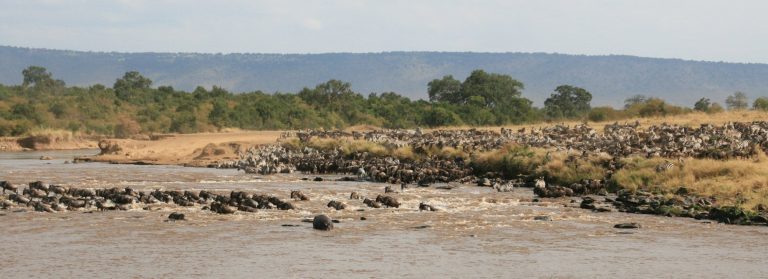
12 Days Best of Kenya Safari
by Kori Safaris
Operator quotes on request
View SafariSee all 15 safaris that include great migration
Great Migration Guide in Kenya
The Great Migration is not an event with a date. It is a continuous, year-round movement of ungulates around a single ecosystem, driven by rainfall and by the grass that rainfall produces, and it crosses into Kenya for part of every year. Understanding what the animals are responding to is the only reliable way to plan around it, because no calendar published anywhere can promise what the herds will do in a given week.
What the Great Migration Actually Is
The migrating animal is the western white-bearded wildebeest, Connochaetes taurinus mearnsi, a subspecies of the common wildebeest. The Convention on the Conservation of Migratory Species puts the migratory Serengeti-Mara population at approximately 1,300,000 animals, the largest of four wildebeest populations in the wider ecosystem and the only one of them that still migrates. Plains zebra and Thomson's gazelle move with them in large numbers, and the predators of both countries adjust their year around the herds' arrival and departure.
The ecosystem straddles the Kenya-Tanzania border, and the animals cross it freely regardless of which authority manages the ground on either side. On the Kenyan side that ground is the Maasai Mara National Reserve and the belt of conservancies to its north and east. Calving happens far to the south, on the short-grass plains outside Kenya, in the peak of the rains; it is not something a traveller sees from the Mara.
What makes the movement legible is the interaction of two gradients. Rainfall is higher and more reliable in the north and west, and lower and more seasonal in the south and east. Soil fertility runs the other way, with the volcanic southern plains producing short grass that is poor in bulk but rich in the minerals a lactating female needs. The herds trade nutrition for water and back again, year after year, and the route is an adaptation to unreliable rainfall rather than a habit.
Why No One Can Give You a Date
Between 1999 and 2022, researchers tracked 62 collared wildebeest to work out when the population actually moves rather than when it is reported to. The Global Initiative on Ungulate Migration published the result as median transition dates. The move out of the wet-season range towards the dry-season range begins around 6 May and ends around 29 June, taking an average of 38 days. The return journey begins around 10 October and ends around 2 November, taking an average of 41 days.
Those are medians across more than two decades, which is exactly the point. Half the years fall on one side of them. A late start to the long rains, or an unusually wet June in the north, shifts the whole schedule, and the herds respond to conditions that a traveller booking six months earlier cannot see. The same dataset gives the length of the seasonal route: a minimum of 44.3 kilometres, a mean of 131.9 and a maximum of 224.7, which is a useful corrective to the much larger circuit distances that circulate in travel writing. Those larger numbers describe an idealised annual loop; the collar data measures what individual animals actually walked between seasonal ranges.
When the Herds Are in Kenya
In a typical year the leading edge reaches the Mara from late June or early July, numbers build through July and August, the herds spread across the reserve and the northern conservancies through September, and the return south begins in the second half of October as the short rains start. July to October is therefore the window, with August and September the densest part of it, and the crossings confined to that window because the herds have to be north of the river to be crossing it.
Two things follow. The first is that the migration months and the peak tourism months in the Mara are the same months, and the vehicle numbers at a good sighting reflect that. The second is that the animals are in Kenya for roughly a third of the year, so a trip outside the window is not a trip that misses the wildlife. It is a trip that misses this particular spectacle and gains a great deal of quiet. The Maasai Mara guide sets out what the reserve offers in the other eight months, and the safaris guide explains how the reserve, the Mara Triangle and the conservancies differ as places to stay.
Where the River Crossings Happen
The crossings people travel for are on the Mara River, which runs roughly north to south through the western part of the reserve before turning towards Tanzania. There is no single crossing point. The river has a series of established places where the banks shelve enough for animals to get in and out, spread over many kilometres, and the herds use different ones in different years and different weeks depending on where they happen to be grazing when the pressure to move builds. Guides know these places; nobody can tell you which one will be used tomorrow.
The Sand River, on the Kenya-Tanzania border in the southeast of the reserve, carries the herds in and out of the country and is a crossing in its own right, though a far less dramatic one than the Mara. The Talek River, which joins the Mara inside the reserve, is crossed too. The Mara is the one with the crocodiles, the height of bank and the mass of animals that produces the images.
Crossings also run in both directions. A herd that crosses north in the morning may cross back south the same afternoon if the grazing on the far bank disappoints, and this can repeat for days. It is not disorganisation; a river crossing is a response to local conditions on two banks, not a stage in a journey.
What Watching a Crossing Is Really Like
This is the sighting most likely to fall short of expectation, and it falls short in a specific, predictable way. Animals gather on the bank, sometimes many thousands of them, and then do nothing. They mill, they approach the water, they turn back. A crossing can start in fifteen minutes or it can fail to start at all across an entire morning. Trip reports routinely describe four to six hour waits, and describe travellers who spent several days in the reserve in peak season without seeing a crossing at all.
The second reality is the vehicles. In the eastern sector of the reserve during peak season, a promising bank can draw dozens of them, and when vehicles push inside the distance the animals will tolerate, the herd turns away and the wait begins again. This is well documented and it is the most common complaint travellers make about the Mara in August. The structural answers are the Mara Triangle, the western third of the reserve where vehicle pressure is considerably lower, and the conservancies, which cap vehicle numbers at a sighting but are not where the river crossings happen. A dawn balloon flight is the other way to see the herds at scale without a queue, and the etiquette that keeps a crossing from being aborted is covered in the wildlife photography guide.
A crossing is a possibility, not a deliverable. Anyone whose trip depends entirely on seeing one should plan several days in the reserve during the window rather than a single afternoon, and should treat the rest of the ecosystem as the reason for the trip.
The Mara River Is the Whole Story
The river is not scenery. It is the only permanently flowing river in the ecosystem and it is the core dry-season refuge for the entire migratory population, the primary water source from August to October. Wildebeest need to drink at least every few days and will die if they cannot. The Convention on the Conservation of Migratory Species states the consequence plainly: if the Mara River were to stop flowing for ten days, the population would likely fall by at least 100,000 animals, and beyond that threshold 500,000 could easily die.
That is not a hypothetical framed for effect. Discharge meters on the river have recorded the first instances of no-flow within the last seven years, and those events have become more frequent and longer. The catchment lies partly outside the protected areas, in forest and farmland where abstraction and land-use change determine what reaches the reserve. The most significant threat to the Great Migration is not poaching or tourism pressure. It is water.
What the Drownings Do to the River
Animals die at the crossings, in numbers that surprise people who assume the losses are incidental. Research published in the Proceedings of the National Academy of Sciences found that mass drownings occurred in the Kenyan reach of the Mara in almost every year between 2001 and 2015, on average four or five times a year, delivering a mean of around 6,250 carcasses annually and more than a thousand tonnes of biomass into the river.
The ecological effect is long. Soft tissue is consumed within weeks by crocodiles, fish, vultures and marabou storks. Bone, which is roughly half the dry mass, takes about seven years to break down, and while it does it supports a film of microbes that feeds fish and invertebrates. The crossings are not just a spectacle for visitors; they are an annual nutrient subsidy that the river's food web is built around.
How Many Wildebeest Are There
The figure of 1.3 million has been in circulation since the 1970s and remains the number used by the Convention on the Conservation of Migratory Species. In September 2025, a study in PNAS Nexus applied two machine-learning models to high-resolution satellite imagery across the ecosystem and returned considerably lower counts: roughly 324,000 to 338,000 animals in 2022 and roughly 503,000 to 533,000 in 2023.
It is worth being careful about what that means, because the authors are careful about it themselves. They do not claim the population has halved. They point out that the satellite and aerial methods differ in the area and the timing they cover, that animals under canopy or outside the surveyed area are not counted, and that a satellite survey flown against a simultaneous aerial survey would be needed to measure the bias between the two. What the study establishes firmly is that the long-standing figure has not been independently tested for a long time. Anyone quoting either number as settled is overstating the evidence.
Kenya's Other Migration
A second wildebeest migration exists entirely within Kenya and almost nobody writes about it. The Mara-Loita population spent the wet season on the fertile short-grass Loita Plains northeast of the reserve and the dry season on the Mara River, sharing that refuge with the Serengeti-Mara herds from May to December. It was one of the last large terrestrial mammal migrations left in the country.
It has all but gone. A fact sheet published by the Global Initiative on Ungulate Migration in December 2025 records a population of 120,000 to 150,000 animals in the 1970s and around 26,700 as of 2024, a decline of 69 to 75 per cent on Kenyan government estimates. Conversion of the Loita Plains to wheat began in the 1970s, and private livestock fencing across the landscape grew exponentially after 2010. The animals cannot reach the range they need, so most are now resident rather than migratory, compressed into a patchwork of conservancies north and east of the reserve. The mean route length that remains is 30.5 kilometres.
The two migrations are connected. The Mara-Loita landscape is the northernmost dispersal area of the Serengeti-Mara population, and the two herds mix and compete there in the dry season. Further habitat loss on the Kenyan side is a risk to the larger population as well as the smaller one, which is why the conservancies of Mara North, Mara Naboisho, Olare Motorogi, Ol Kinyei and Olderkesi matter beyond the quality of the game viewing inside them.
The migration window is only one of the calendars that decide when to travel in Kenya. Best time to visit Kenya sets it against the rainfall seasons, the coast and the published arrival figures, and how many days you need in Kenya covers how long to allow in the Mara when a river crossing is the point of the trip.
Questions About the Great Migration
What month is best for the Great Migration in Kenya?
August and September are the densest part of the window, with July and October the shoulders. That is a probability rather than a schedule, and the collar data behind it shows the return journey starting around 10 October in a median year, which means an early October trip can still find the herds and a late October one may not.
Am I guaranteed to see a river crossing?
No, and any source that implies otherwise is selling something. Crossings depend on where the herds are grazing, on conditions on both banks and on how the animals in front react in the first few minutes. Travellers who allow several days in the window during the season see one more often than not. Travellers who allow a single afternoon frequently do not.
Is the migration better in Kenya or Tanzania?
It is the same animals in one ecosystem, so the question is really about which part of the cycle appeals. The Kenyan side offers the Mara River crossings between roughly July and October. The calving season and the short-grass plains phase happen south of the border outside that window. Neither is a better version of the other.
Can I see the migration from a conservancy instead of the reserve?
Partly. The herds spread into the northern conservancies during the season and the game viewing there can be excellent with a fraction of the vehicles. The river crossings, though, happen inside the reserve. Many travellers split their nights between the two for exactly this reason.
How crowded does it actually get?
In the eastern sector of the reserve in August, a good sighting draws vehicles by the dozen and a promising river bank draws more. The Mara Triangle, the western third of the reserve, carries noticeably fewer. Conservancies cap numbers at a sighting by agreement. Moving dates a fortnight either side of the peak reduces the pressure more than any other single choice.
Why do wildebeest cross a river full of crocodiles at all?
Because the alternative is worse. The herds are tracking grass and water across a landscape where both are patchy and seasonal, and most wildebeest mortality in this ecosystem comes from starvation rather than predation. Crossing is a cost the population absorbs. The drownings at the crossings, averaging several thousand animals a year, are part of that arithmetic.
Is the migration under threat?
The Serengeti-Mara migration continues, and the most serious identified threat to it is the Mara River ceasing to flow during the dry season, something the discharge record shows has begun to happen for short periods. The separate Mara-Loita migration inside Kenya has already collapsed by around 70 per cent since the 1970s, mainly through fencing and the conversion of its wet-season range to farmland.