
Best Time to Visit Kenya
Kenya does not have one best month. It has several calendars running at once, and they do not line up. The rain arrives on one schedule, the migrating herds on another, the Indian Ocean on a third, and the other two million visitors on a fourth. A month that is ideal for a game drive in the Mara is the wrong month for diving at Watamu, and the month with the clearest water on the coast is the month the plains are green and the animals are spread out. Choosing well means deciding which of those calendars your trip is actually built around.
The short version, for a first safari built around game drives: late June to October, or January to early March. The first carries the migrating herds and the largest crowds. The second is dry, quiet and often overlooked. Everything below is the detail that makes those two windows better or worse for a particular trip.
Kenya Has Two Rainy Seasons, and the Weather Service Names Them
Almost every travel article about Kenya refers to the long rains and the short rains without saying where the terms come from. They are not informal. The Kenya Meteorological Department uses both as formal season names in its seasonal outlooks, and its definitions are the ones worth planning against.
In its climate outlook issued on 6 February 2026, the department titles the document a forecast for the “Long Rains” season of March to May, together with a review of the October to December “Short Rains” season. It states that the March to May period is the main rainfall season over most parts of Kenya and much of equatorial Eastern Africa, and that the peak of the season is expected in April over most regions, with the exception of the Coast, where the peak is expected in May.
Three things follow from that, and they do most of the planning work on this page. The long rains are March to May and peak in April. The short rains are October to December. And the coast is a month out of step with the interior, which is why a single national calendar never quite works.
Between and around those two wet seasons sit the dry periods: roughly late June through October, and roughly January to mid-March. Those are the windows most safari trips are built in, and the reasons are practical rather than aesthetic.
The Dry Months and What They Do to Game Viewing
Dry weather does not create wildlife. It concentrates it, and it removes the things that hide it.
As surface water disappears, animals that can range widely stop ranging widely. They come to the rivers, the swamps and the permanent springs, and they come repeatedly, at predictable times. A vehicle parked near water in September is in a different position from the same vehicle in the same place in April, when every depression in the ground holds water and an elephant has no particular reason to walk past.
The second effect is the grass. Savannah grass after the long rains stands high enough to swallow a resting lion completely, and it stays high for weeks after the rain stops. By August it has been grazed, trampled and dried down, sightlines open up, and the animals that were always there become findable. This matters more for predators than for anything else, because a leopard in long grass is simply not visible from a vehicle.
The third is the roads. Kenya Wildlife Service describes April to June as its low season and notes that many park roads require four-wheel drive during it. That is the managing authority saying plainly that its own parks are harder to move around in for a quarter of the year. It does not close them, and plenty of people travel then deliberately, but it changes what a day can cover. The safaris guide sets out how that plays across the different park types, and the self-drive guide covers what it means for anyone driving themselves.
The trade is crowds. The dry months are the busy months, and in the most visited places that is not a minor consideration.
The Long Rains, March to May
This is the season most guides tell readers to avoid, and the advice is roughly right and wrongly explained. The long rains are not a wall of water. Kenya’s rain typically arrives as heavy afternoon and overnight storms rather than continuous drizzle, and mornings can be clear. What the season actually costs is reliability.
Grass grows fast and tall. Animals disperse because they no longer need to walk to water. Black cotton soil, which underlies large parts of the Mara and the Laikipia plateau, turns to a surface that stops vehicles rather than slowing them. Minor roads and park tracks degrade. Some small camps close for part of the period to do maintenance, which on the coast is a well established annual rhythm rather than an inconvenience.
What the season gives back is real. The country is green in a way it is not for the rest of the year, the light after a storm is exceptional, the parks are close to empty, and rates fall. For anyone whose trip is built around landscape photography, birds, or simply not sharing a sighting, April and May are a serious option rather than a compromise. For a first safari built around finding big cats in a week, they are the hardest months to make work.
April is the wettest month over most of the country and, as the arrivals data further down shows, the month with the fewest visitors in it.
The Short Rains, October to December
The short rains are a different proposition from the long rains and are frequently lumped in with them, which costs travellers good trips. They are lighter, more scattered and less likely to interrupt a day. Rain tends to fall in the late afternoon and clear. Roads suffer, but far less.
Game viewing through November and December is generally good rather than compromised. The country greens up quickly, the dust of the late dry season settles, and resident wildlife is still readily found. Migrant birds arrive. For a traveller who wants dry-season-adjacent game viewing without dry-season pressure on beds and sightings, November is one of the better-value months in the Kenyan year.
December splits in half. The first two or three weeks behave like November. From roughly the third week the festive period arrives, and with it the second-busiest travel month of the year, peak rates at the coast and camps that were quiet running full. That division inside a single month is one of the sharper edges in Kenya’s calendar and it is worth planning around precisely.
When the Migrating Herds Are in Kenya
The migration is the single factor that most distorts Kenya’s travel calendar, and it is worth being exact about what it does and does not determine.
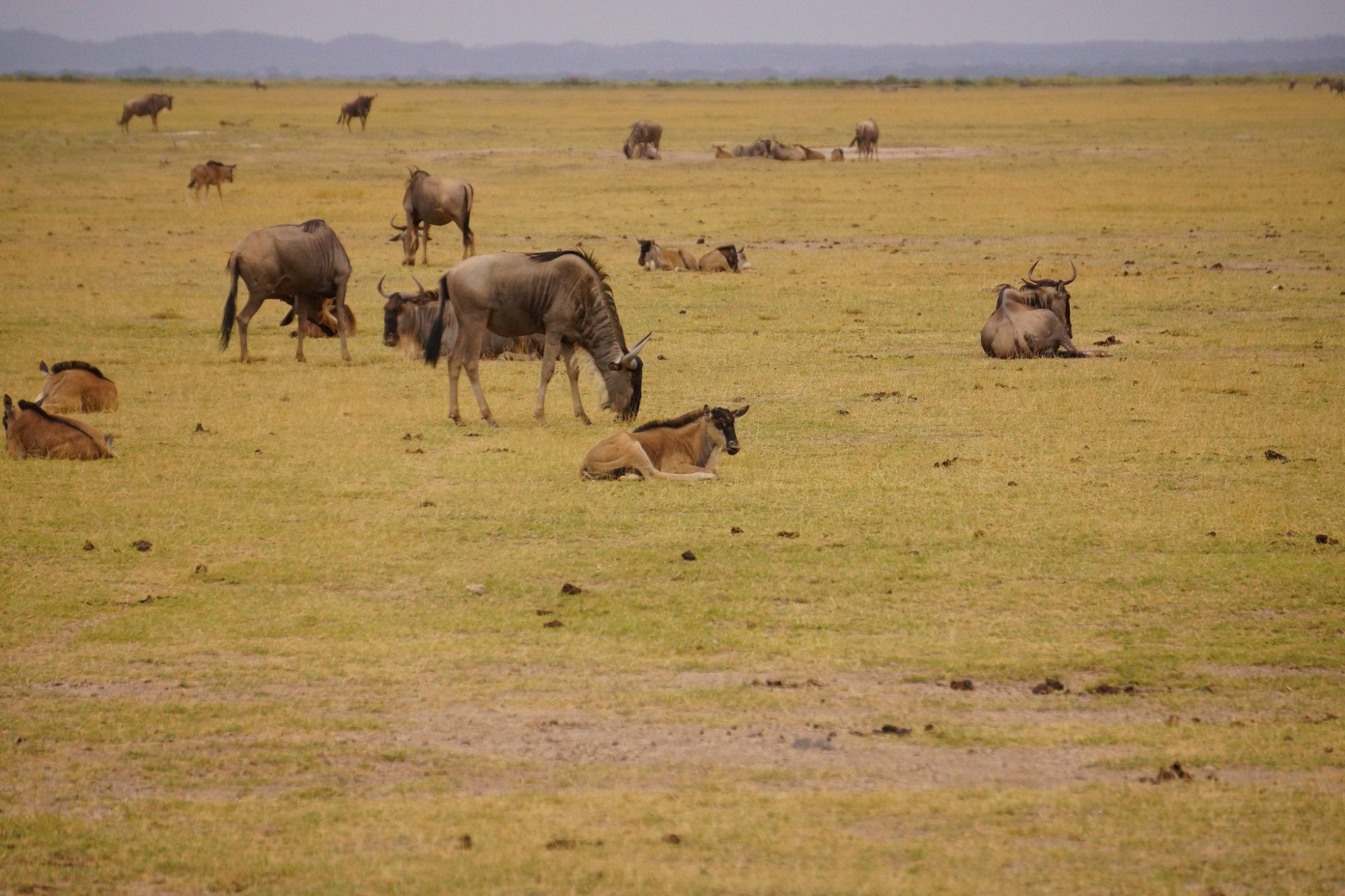
The herds are in Kenya for roughly a third of the year. In a typical year the leading edge reaches the Mara from late June or early July, numbers build through July and August, the herds spread across the reserve and the northern conservancies through September, and the return south begins in the second half of October. July to October is the window, and August and September are the densest part of it.
That is a timing statement, not a booking guarantee. The movement responds to rainfall and grass, and a late start to the long rains or an unusually wet June shifts the whole schedule. The river crossings, which are what most people picture, are a possibility on any given day rather than a scheduled event, and no operator can promise one. What the phenomenon actually is, why it has no fixed date, where the crossings happen and what the ecology behind it looks like are covered in full in the Great Migration guide, and there is no point repeating it here.
The planning consequence is the part that belongs on this page. The migration months and the peak tourism months in the Mara are the same months. Travelling in the window means accepting vehicle numbers at a good sighting that a quiet-season visitor would find hard to believe. Travelling outside it does not mean missing the wildlife: the resident lions, leopards, cheetah, elephant and plains game are there year round. It means missing this particular spectacle and gaining a great deal of space. The Maasai Mara guide sets out what the reserve offers in the other eight months and how the reserve, the Mara Triangle and the conservancies differ as places to stay.
The Coast Runs on a Different Calendar
The Kenyan coast does not run on long rains and short rains in any way a visitor experiences directly. It runs on two monsoons, and they have Swahili names still in daily use among sailors and fishers.
Kaskazi is the north-east monsoon. It sets in from around November, is at its most settled from mid-December through March, and is the lighter and warmer of the two. It gives flat water, high visibility and dependable boat days.
Kusi is the south-east monsoon, running from around April or May to October and blowing hardest and most consistently between June and September. It brings swell, rougher seas and the coastal long rains of May and early June.
The names are frequently swapped in published guides, including some widely read ones, so they are worth fixing in mind: kaskazi is the gentle north-easterly, kusi is the strong south-easterly.
The consequence is that the coast inverts the safari calendar for anything happening in or on the water. Diving and snorkelling are at their best in the kaskazi months and at their worst from April to June, when river sediment cuts visibility, the sea gets rough and much of the coastal boat trade slows down for maintenance. Dhow cruises and island hopping want the same calm months. Deep-sea fishing follows a species calendar of its own, with May and June the one period when the fishery genuinely stops.
Surfing and kitesurfing run the other way, on the kusi swell and wind from roughly May to September. So do the humpback whales, which pass along the Kenyan coast between roughly July and October with the peak in August. Turtle nesting splits by stretch of coast: April to October around Watamu and the north, November to February around Mombasa and the central coast.
A trip combining a safari and a beach holiday therefore has a genuine tension in it. The classic July to September safari window lands on the coast during kusi, when the sea is rough and the diving poor. January to March gives excellent coast conditions and good, quiet, dry-season game viewing inland, and it is the combination that works best without compromise. Anyone whose beach week is mainly about lying on sand rather than getting into the water can ignore most of this.
Mountains, Forests and Rivers
High ground follows the rainfall calendar closely, because the limiting factor is rain rather than temperature. The drier windows of January to mid-March and July to September give firmer ground, clearer summit views and shorter days spent wringing out socks. Hiking and mountain climbing are possible year round and trails do not close, but volcanic soil and clay that make a pleasant path in February make a difficult one in April. Rock climbing has the same constraint sharpened: afternoon storms in both wet seasons soak a wall quickly and dry it slowly, so climbing days shift earlier.
Forests invert it again. The long rains and the short rains make coastal and western forest trails muddy and leech-prone, and they also bring the greatest bird activity, which is why naturalists often prefer exactly the months everyone else avoids. Forest walks covers that trade.
Rivers invert it completely. White-water rafting runs on the opposite calendar to everything else, because a highland river responds to rainfall with a lag and the fullest water on the rafted reach comes during and just after each wet season, broadly April to June and again in November and December. Waterfalls behave the same way: loud, brown and heavy after the rains, clearer and gentler in January and February and from July into September.
Two more that run on their own schedules. Coffee has a main crop picked roughly from October into December, and anyone travelling specifically to see a wet mill working should aim at November. Camel safaris in the north have a long walking season, with June to October the most reliable stretch for cooler mornings and firm ground.
Birds Run Against the Safari Season
Kenya’s birding calendar is the clearest case of a good month being a month most safari planning treats as bad.
Palearctic migrants, the species that breed in Europe and Asia and winter in Africa, are present in Kenya roughly from September to April. At the Sabaki River mouth and along the mangrove shorelines, whimbrel, Eurasian curlew, greater and lesser sand plovers, grey plover, curlew sandpiper, little stint and sanderling are among the regulars through that window. Mangrove tours are timed to it.
That window covers both wet seasons and almost entirely excludes the peak safari months of July and August. It also overlaps the months when resident birds are breeding and in fresh plumage. A birding trip and a big-cat trip are not the same trip, and trying to build one that does both well usually produces one that does neither.
When Everyone Else Comes
Most writing about Kenya’s seasons describes crowds impressionistically. The arrival figures are published, and they are more useful than an adjective.
The Tourism Research Institute’s Annual Tourism Sector Performance Report for 2024 gives monthly international arrivals, sourced to the Directorate of Immigration Services. Kenya received 2,394,376 international arrivals in 2024, distributed across the year as follows.
| Month | Arrivals, 2024 | Month | Arrivals, 2024 |
|---|---|---|---|
| January | 201,161 | July | 226,951 |
| February | 195,778 | August | 249,086 |
| March | 180,731 | September | 204,496 |
| April | 154,211 | October | 200,937 |
| May | 170,197 | November | 183,124 |
| June | 202,617 | December | 225,087 |
Those figures were taken from the Tourism Research Institute’s 2024 report and checked on 22 September 2026.
Three things in that table are worth more than any general statement about high season. August is the peak, at 249,086, and it is the peak by a clear margin. April is the trough, at 154,211. And December is the second-busiest month of the year, at 225,087, ahead of July.
That last point contradicts a great deal of published advice, which files November and December together as low season. November genuinely is quiet, at 183,124. December is not, because the festive period concentrates a very large number of arrivals into the last ten days of it. A traveller told that December is a quiet month and who books for Christmas at the coast will find otherwise.
The spread between the busiest and quietest months is about 61 per cent. That is the size of the effect a change of dates can have on how a place feels, before any other decision is made.
The same report records inbound tourism earnings of KSh 452.20 billion in 2024, against KSh 377.49 billion in 2023, a rise of 19.79 per cent, and total bed-night occupancy up 16 per cent to 9,992,721. Demand is rising overall, which sharpens the peak rather than smoothing it.
What the Season Does to What You Pay
Season affects cost through two separate mechanisms, and only one of them is published.
The first is official and fixed. The Maasai Mara is not a Kenya Wildlife Service park; Narok County sets its entry fees in its Finance Act, and those fees carry an explicit seasonal split that no national park has, with a low season from January to June and a high season from July to December. A non-resident adult pays USD 100 in low season and USD 200 in high season, figures checked on 21 September 2026. That is a doubling written into a county statute, and it lands on exactly the months the herds are present.
The second is commercial and is set by accommodation and operators rather than by any authority. It is real, it is large, and it is not something this site can put a number on. What drives it, and what can honestly be said about safari costs, is set out in how much a Kenya safari costs.
Kenya Month by Month
A summary of the interior and the main safari regions. The coast, as above, runs on its own calendar.
| Month | Conditions inland | Game viewing | Worth knowing |
|---|---|---|---|
| January | Dry, hot, clear | Very good | Quiet after the first week; good coast conditions |
| February | Dry, hot, clear | Very good | Driest month in many areas; firm trails |
| March | Dry early, rains build late | Good, then variable | The long rains usually arrive mid to late month |
| April | Wettest month inland | Hardest | Fewest visitors of the year; many tracks need 4WD |
| May | Wet, greening | Dispersed | Coast peaks in rain; some camps close for maintenance |
| June | Drying out | Improving through the month | Herds usually begin arriving in the Mara late in the month |
| July | Dry, cool mornings | Excellent | Migration window opens; numbers build fast |
| August | Dry, cool, dusty | Excellent | Busiest month of the year; book far ahead |
| September | Dry, cool, dusty | Excellent | Migration still present with slightly fewer visitors |
| October | Dry, warming; short rains may start | Very good | Herds begin the return south in the second half |
| November | Short rains, scattered | Good | Quietest of the good months; migrant birds arrive |
| December | Short rains easing | Good | Quiet until roughly the third week, then very busy |
Choosing the Month by What You Want to Do
| If the trip is about | Best window | Avoid | Guide |
|---|---|---|---|
| Big cats and open-plains game drives | Jul to Oct, or Jan to early Mar | Apr to May | Safaris |
| The migrating herds | Jul to Oct | Nov to Jun | Great Migration |
| Diving and snorkelling | Nov to Mar | Apr to Jun | Scuba diving |
| Surfing and kitesurfing | May to Sep | Dec to Mar | Kitesurfing |
| Humpback whales | Jul to Oct, peak Aug | Nov to Jun | Whale watching |
| Birds, including migrants | Sep to Apr | Jun to Aug | Birdwatching |
| Trekking and summits | Jan to mid-Mar, Jul to Sep | Apr to May | Mountain climbing |
| Rafting and waterfalls in spate | Apr to Jun, Nov to Dec | Jan to Feb | White-water rafting |
| Photography with few vehicles | Nov, or Jan to Mar | Aug | Wildlife photography |
| Coffee harvest | Nov | Feb to Sep | Coffee tours |
The Country Does Not Have One Climate
Kenya runs from coral coast to glaciated equatorial mountain to true desert, and altitude does more to local conditions than latitude does. A national month-by-month table is a generalisation, and in four places it generalises badly.
The northern drylands. Samburu and the country north of it are drier and hotter than the rest of Kenya, and the rains that define the calendar further south are lighter and less reliable there. The practical effect is a longer usable season, with June to October the most dependable stretch. Lake Turkana is hotter still, and the constraint there is wind rather than rain: it gets up with enough force in the afternoons to make boat movement genuinely unsafe, which governs daily schedules more than any season does.
The highlands. Mount Kenya, the Aberdares and Laikipia sit high enough that cold, not heat, is the thing people are unprepared for. Early game drives in July and August on the Laikipia plateau are genuinely cold, and the highlands can be overcast through those months even when the lowlands are clear.
Western Kenya. The Lake Victoria basin and the highlands west of the Rift receive rain across more of the year than the rest of the country and have a less pronounced dry season. The Kenya Meteorological Department’s outlook for March to May 2026 expected near to above average rainfall there while expecting below average rainfall at the Coast in the same season, which is a useful illustration of how far apart the two halves of the country can be in a single season.
The Rift Valley lakes. Lake Nakuru and Lake Naivasha are close enough to Nairobi to be reached in a morning and are accessible in every month. Their lake levels have changed substantially over the past decade, and what a visitor sees at the shoreline depends more on that than on the month of travel.
Questions About When to Visit Kenya
What is the single best month for a first safari?
If the migrating herds matter, September: the window is still open, conditions are dry and arrivals are lower than in August. If they do not, February: dry, clear, firm underfoot, good coast conditions at the same time, and none of the August pressure on beds and sightings.
Is it worth going during the long rains?
For a landscape, birding or photography trip, or for anyone who values an empty park more than a guaranteed leopard, yes. April is the quietest month of the Kenyan year by arrivals. For a short first safari built around finding predators, it is the hardest window to make work, because tall grass and dispersed animals both cut against you and many park roads need four-wheel drive.
Will it rain every day in the wet season?
Usually not. Kenyan rain tends to come as heavy afternoon and overnight storms rather than continuous drizzle, and mornings are often clear. The cost of the season is unreliability and road conditions rather than being wet all day.
When are the fewest other visitors around?
April, on the published arrivals figures, followed by May, March and November. August is the busiest month and December the second busiest, which surprises people who have read that December is quiet. It is quiet for about three weeks and then it is not.
Can one trip cover a good safari and a good beach week?
Yes, but the months pull in opposite directions. January to March gives dry, quiet game viewing inland and the calm, clear kaskazi conditions on the coast at the same time, and it is the cleanest combination. A July to September trip gives the migration window inland and a rough, windy sea on the coast. If the beach half is mainly about swimming, snorkelling or diving, that matters; if it is mainly about sand and a book, it does not.
Do the migrating herds arrive on a fixed date?
No. The movement tracks rainfall and grass, and the timing shifts from year to year. Late June or early July for the leading edge and the second half of October for the return south are typical rather than scheduled, and the river crossings are never predictable more than a day or two ahead. The Great Migration guide explains why no date can be given.
Does the month change what park entry costs?
In the Maasai Mara, yes, and substantially: Narok County’s Finance Act sets a low season from January to June and a high season from July to December, with a non-resident adult paying USD 100 and USD 200 respectively, checked on 21 September 2026. Kenya Wildlife Service parks do not have a seasonal split in their conservation fee schedule.
How far ahead is it necessary to plan?
The constraint is beds rather than fees or entry. August in the Mara, and the last ten days of December at the coast, are the two periods where the better-known camps fill a long way out. Outside those, the picture is far more relaxed, and April and May are close to walk-up in many places.
Is there a bad month for the northern parks?
Less so than further south. The northern drylands are hotter and drier and the rains are lighter and less reliable there, which gives a longer usable season, with June to October the most dependable stretch for walking and camel travel. Heat, not rain, is the thing to plan around.
What about school holidays and public holidays?
Domestic travel rises sharply around Kenyan school holidays and the festive period, and the December effect in the arrivals table is partly that. Rift Valley lakes, the coast and Nairobi National Park feel it most, because they are the places reachable for a short domestic trip.