Amboseli National Park
Amboseli National Park is a 392 square kilometre park in Kajiado County, southern Kenya, known for its elephant herds and for the view south to Kilimanjaro across the Tanzanian border. Most visitors arrive by road from Nairobi or fly into the park airstrip. Amboseli sits in a dry basin fed by groundwater running off the mountain, and that water is what keeps its swamps green while the rest of the country dries out.
What Makes Amboseli National Park Worth a Safari
Amboseli is small by Kenyan standards and it is not trying to be a Big Five box ticking exercise. What it does, it does better than anywhere else in the country: elephants in the open, close, in family groups, with a snow topped mountain behind them on the mornings the cloud allows it.
The park is a shallow basin that was a lake in the Pleistocene and is now mostly dust. Five habitat types sit inside it, and they are close enough together that a single morning drive crosses all of them: open savannah, acacia woodland, the seasonal bed of Lake Amboseli, the permanent swamps, and the dry lake flats where almost nothing grows.
The dust is worth mentioning before anyone arrives. In the dry months it is fine, grey and pervasive, and it gets into cameras, bags and skin. That is not a flaw in the park; it is the park. The name says so.
Elephant Watching in Amboseli National Park
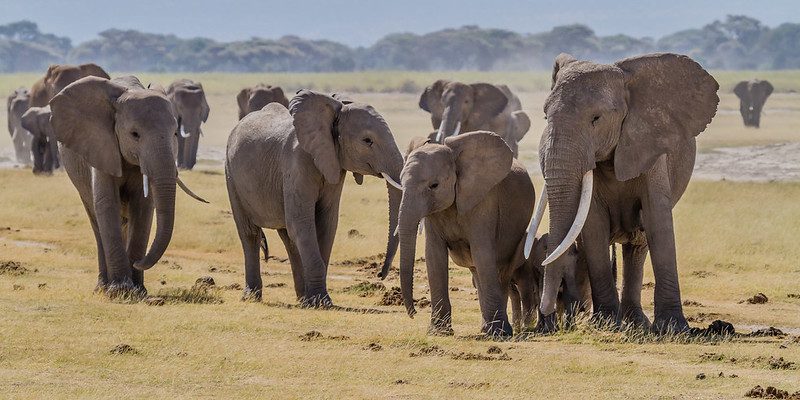
Elephant watching in Amboseli is unlike elephant watching anywhere else in Kenya, for one structural reason: there is nowhere for them to hide. The terrain is open, the swamps pull herds into predictable places through the middle of the day, and the animals are relaxed around vehicles after decades of being observed rather than hunted.
Those decades are the second thing that sets Amboseli apart. Research on this elephant population has run since 1972, when the ethologist Cynthia Moss began the study that became the Amboseli Elephant Research Project. The Amboseli Trust for Elephants states that it monitors more than 3,500 elephants. Individual animals here have been followed across entire lifetimes, families are known by name and lineage, and the best known matriarch of all, Echo, died in 2009 at around sixty years old.
Practically, that means guides in Amboseli often know which family you are looking at. It is worth asking. The difference between watching a herd and watching a specific family whose history someone can tell you is the difference between a photograph and a story.
Big tusked bulls are more common here than in most Kenyan parks. Seeing one is still not guaranteed, and the number of genuinely large tuskers left anywhere is small.
The Kilimanjaro View from Amboseli and When It Shows
Kilimanjaro is in Tanzania. The view of it is Kenyan, and it is the second reason people come to Amboseli.
The mountain is visible from most of the park’s southern half when conditions allow, rising above the plains with no foothills in front of it. Whether conditions allow is the whole question, and the honest answer is that the summit is hidden more often than it is showing.
The mechanism is simple enough to plan around. Overnight, the air cools and clears. Once the sun starts working on the plains, warm moist air rises against the mountain, condenses, and builds a cloud cap that usually settles over the summit through the middle of the day. So the reliable windows are the first hours after sunrise and the last hour or so before it goes, and the unreliable window is everything between.
Clear mornings are more common in the dry months than in the wet ones, though the pattern is a tendency rather than a rule. Nobody can promise you the mountain, and anyone who does is selling something.
Reading the Amboseli Basin on a Game Drive
Almost everything that happens in Amboseli is explained by where the water is, and the water does not come from the sky.
Rain and melt on Kilimanjaro sinks into porous volcanic rock, travels north underground, and surfaces in the basin as permanent springs. Those springs feed the swamps: Enkongo Narok, Ol Tukai and Longinye are the three that matter. They flow through droughts that empty rivers elsewhere in Kenya, which is why a semi arid basin with low rainfall supports the wildlife densities it does.
Once you know that, the drive makes sense. Herds move out to the plains overnight and pull back towards the swamps as the day heats up. Predators work the margins. Birds concentrate wherever the water is shallowest. A guide who takes you swampward at eleven in the morning is not running out of ideas; that is where the animals will be.
Lake Amboseli, in the northwest, is a different thing entirely. It holds water only after good rain and spends most of the year as a white salt flat that throws up dust devils and mirages. After the rains it can draw flamingo. The roads around it flood and turn to mud when it fills, which is one of the few genuine access problems the park has.
Wildlife Beyond the Elephants on an Amboseli Safari
Buffalo, giraffe, zebra, wildebeest, impala and Grant’s gazelle are all resident and easily seen. Hippo hold the deeper swamp channels. Spotted hyena are common and often visible in daylight.
Lion are present and cheetah occur on the open plains, but predator sightings here are less reliable than in the Maasai Mara or Tsavo West. Leopard are rarely seen. There are no rhino in the park.
Setting that expectation matters. Amboseli is a place to watch one species closely rather than to hunt for a checklist, and travellers who arrive wanting all five of the Big Five in two days end up frustrated by a park that was never offering that.
Birdwatching in Amboseli National Park
Kenya Wildlife Service records over 400 bird species in the park, including around 40 birds of prey. The swamps hold pelican, heron, egret, crake and kingfisher, and the dry country either side produces a completely different set within a few hundred metres.
The wet months from November and again from March bring migrants and push the list higher, which puts the best birding in the season that is worst for the mountain. That trade is unavoidable. Wider coverage of the subject sits on the birdwatching in Kenya page.
Attractions to Work into an Amboseli Game Drive
Observation Hill is the one place inside the park where visitors are allowed out of the vehicle, and it gives the only high view over the swamps and plains. It is a short climb and it is where most people end an afternoon drive.
Lake Amboseli is the seasonal lake bed in the northwest, worth the detour when it has water and worth seeing as a salt pan when it does not.
The swamp viewpoints, the individual Kilimanjaro vantage points and the smaller features inside the park are grouped on the Kenya attractions hub rather than treated separately, because none of them supports a trip on its own.
Outside the gates, Maasai cultural experiences are arranged on community land around the park, and wildlife photography trips run to timings built around the light rather than around a standard drive schedule.
Best Time to Visit Amboseli National Park for a Safari
What follows from that in practice: if the elephants and the mountain are the priority, aim at the dry months and accept dust and company. If birds, green country and low vehicle numbers matter more, the rains are not the problem they sound like, and the roads inside the park hold up better than most people expect.
Days are hot and nights in the basin are cold. Pack for both, in every month.
Getting to Amboseli National Park for a Safari
Kenya Wildlife Service gives the road distance from Nairobi as 204 kilometres via Iremito Gate and 220 kilometres via Meshanani Gate, with a longer route of about 240 kilometres coming through Tsavo West. The Meshanani route runs down the Namanga road towards the Tanzanian border; the Iremito route comes in from the east.
Driving times vary more than the distances suggest, because the final stretches into the gates are unsealed and slow. Allow most of a morning from Nairobi rather than treating it as a short hop.
By air, the park has a single tarmacked airstrip at Kimana, 1.2 kilometres long, serving light aircraft. Scheduled flights leave from Wilson Airport in Nairobi. Lodges meet arrivals at the strip. Flying is the sensible option for anyone combining Amboseli with the Maasai Mara, because the overland transfer between the two is a very long day.
Amboseli pairs naturally with Tsavo West National Park and the Chyulu Hills, both of which sit on the road towards the coast, and it is the usual first or last stop for trips running between Nairobi and the coast.
Gates, Rules and Conservation Fees
Kenya Wildlife Service lists three gates in general use: Iremito, Kimana and Meshanani. Kitirua and Kelunyet also appear on park maps and serve specific corners. Lodge transfers most often use Kimana and Iremito. Gates open at 6am and close at 6pm unless you are staying inside.
The park rules are stricter than some visitors expect and they are enforced. Wildlife must be viewed from at least 20 metres. The speed limit is 40 kilometres per hour. Feeding wildlife is prohibited. Walking is not permitted anywhere in the park except at Observation Hill, and cycling and motorbikes are not allowed at all.
Amboseli is classed by Kenya Wildlife Service as a Premium Park. The conservation fees below are taken from the KWS conservation fee schedule published at kws.go.ke, checked on 21 September 2026. Rates are per person per day and there is no seasonal split.
| Visitor category | Adult | Child or student |
|---|---|---|
| East African citizen | KSh 1,500 | KSh 750 |
| Kenya resident | KSh 2,025 | KSh 1,050 |
| African citizen | USD 50 | USD 25 |
| Non resident | USD 90 | USD 45 |
Vehicles are charged separately by seat band, starting at KSh 600 per day for anything under six seats. Camping inside the park carries its own per person charge, higher in the Premium Parks than elsewhere. Combined tickets covering Amboseli with Tsavo West, or with both Tsavo parks, are published in the same schedule and work out cheaper than paying each park separately on a multi park route.
Fees are reviewed periodically, so confirm the current rate before travelling.
Amboseli Safari Questions Travellers Ask
Will you actually see Kilimanjaro from Amboseli?
Sometimes. The summit spends much of the day under cloud, and the odds are best in the first couple of hours after sunrise and again in the last light. Dry months are better than wet ones. Two nights in the park gives two attempts at a clear dawn, which is the single most useful thing you can do to improve your chances. Treat a clear summit as a good morning rather than the purpose of the trip.
How many days do you need in Amboseli?
Two nights works well. The park is small and the road network is short, so a full day covers a lot of it, and the second morning is your insurance on the mountain. One night is enough to see elephants and not much else. Three nights suits photographers and anyone who wants to spend real time at the swamps.
What does it cost to enter Amboseli National Park?
Kenya Wildlife Service charges per person per day, with no high or low season. A non resident adult pays USD 90 and a non resident child or student USD 45. East African citizens pay KSh 1,500 and KSh 750, Kenya residents KSh 2,025 and KSh 1,050, African citizens USD 50 and USD 25. Vehicles are charged separately. These figures were checked against the KWS conservation fee schedule on 21 September 2026.
Can you walk in Amboseli?
Only at Observation Hill, which is the one point in the park where leaving the vehicle is allowed. Walking safaris proper happen on community land and conservancies outside the park boundary, arranged through lodges that sit there rather than inside. Cycling and motorbikes are prohibited within the park.
Is Amboseli better than the Maasai Mara?
They answer different questions. The Mara is large, cat led, and busiest during the migration. Amboseli is small, elephant led, and built around one view. Predator sightings are more reliable in the Mara; close relaxed elephants in open country are more reliable in Amboseli. Plenty of Kenya routes include both for exactly that reason, usually with a flight rather than a road transfer between them.
How bad is the dust?
In the dry season, considerable. It is fine volcanic dust off an old lake bed and it gets into everything. Bring a dust cover or a bag for camera gear, something to cover your face on a windy drive, and do not pack anything you would mind getting grey. It settles after the rains, which is one of the underrated arguments for a green season visit.
Are there rhino in Amboseli?
No. The park holds four of the animals usually grouped as the Big Five and rhino are not among them. Kenyan parks where rhino are reliably seen include Lake Nakuru, Nairobi National Park and the Laikipia conservancies.
2 Places to Visit in This Area
Individual sites within reach of here, each with its own guide. Some are written up because the name circulates and the place does not, which is worth knowing before you plan a drive around one.
Safaris That Visit Amboseli National Park
3 of the 15 safaris listed here that visit Amboseli National Park, from different operators where the listings allow it. Each is sold and run by an independent tour company. This site lists them and passes on enquiries; it takes no booking and charges you nothing.


7 Days Wildlife Safari in Kenya
by Kori Safaris Verified operator
Operator quotes on request
View Safari

7-Day Fly-In Kenya Safari Package to Maasai Mara and Amboseli
by Insight Safari Holidays Verified operator
Operator quotes on request
View Safari

Kenya Classic: Amboseli, Tsavo & the Mara
by Ancient Africa Safaris Verified operator
From $9,400 per person
View Safari