
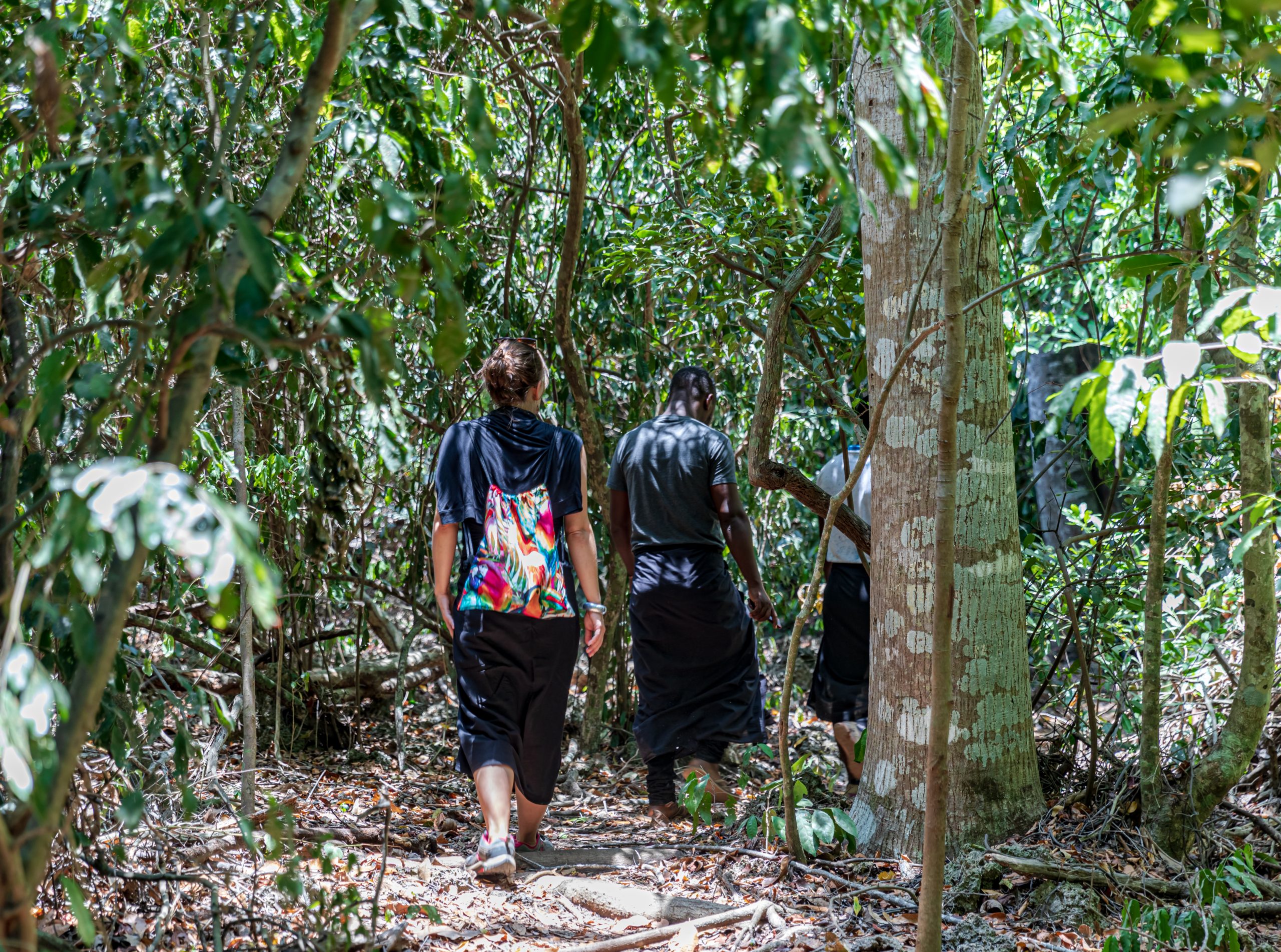
Kaya Kinondo Sacred Forest
Kaya Kinondo is a patch of coral rag forest a few hundred metres inland of the beach south of Diani, and the one Mijikenda sacred forest with a working arrangement for outside visitors. It is held by the Digo community, entry is by guided walk on terms the elders set, and the reason it can be visited is bound up with the reason it is not on the World Heritage List.
What Kaya Kinondo Is
A kaya is the site of a fortified Mijikenda village, abandoned in the first half of the twentieth century and since revered as the dwelling place of the ancestors. Tradition records that the A-Digo were the first Mijikenda group to leave the ancestral homeland of Singwaya, later splitting in two to found Kaya Kinondo and Kaya Kwale. Excavation here recovered tenth-century local pottery and fourteenth-century imported wares, so the ground has been occupied far longer than the tradition alone suggests.
Physically it is a small remnant of the coral rag forest that once ran along this shoreline, rich in moths and butterflies, growing on sharp fossil coral. There is no ruined architecture. The kaya survives as the layout of a settlement readable in the forest: paths, gates, a central clearing, and shrines and graves in the trees around it, including that of the healer and diviner Me-Kirombo. Unlike most kayas, the graves here lie well away from the centre.
Why Kinondo Is Not on the World Heritage List
This detail explains everything else about the site. Kenya’s revised 2008 nomination of the Sacred Mijikenda Kaya Forests put forward eleven kayas, Kinondo among them. ICOMOS found that hotel and holiday-home expansion between the kaya and the sea had cut into the forest on its eastern side, that coral-block extraction was adding to the pressure, and that its integrity had been compromised in a way the other ten had not. It recommended withdrawal, and decision 32 COM 8B.50, taken at Quebec City in 2008, inscribed the property “with the exception of Kaya Kinondo”.
So the forest a visitor from Diani can most easily reach is precisely the forest that development around Diani disqualified. Kinondo is a gazetted national monument and remains sacred to the Digo exactly as before; what it does not carry is the international listing.
The Visitor Arrangement and Who Runs It
The arrangement grew out of a pilot ecotourism project launched here with funding and technical assistance from WWF, designed to open part of the forest to visitors while keeping its spiritual integrity intact. That model has continued. The forest is run today by the Kinondo community as a guided-walk operation with a tree nursery selling indigenous and medicinal seedlings.
The elders remain the custodians. The guides work for them, not for a tour company, and what a visitor is shown on any given day is the elders’ decision. ICOMOS noted a high level of elder involvement here when it inspected, which is why the arrangement has held.
The Protocol
You are entering a place of worship and a burial ground. The community accords a kaya the same status as a mosque or a church, and says so directly to visitors. The rules below are reported consistently, but they are set locally and the guide’s instruction on the day governs.
- The wrap. Visitors put on a black cloth, the kaniki, tied around the waist over their own clothes before entering. It is provided.
- Headwear off. Hats and caps come off at the entrance.
- A guide throughout. Nobody walks in alone, and a briefing on what is and is not permitted is given in a reception area before you set off.
- Photography is conditional. Much of the forest can be photographed, but the graves and the shrines near the centre cannot. Ask first, and accept the answer without argument.
- Conduct. Keep voices down, stay on the path, and refrain from physical affection inside the grove.
- Take nothing out. No plants, no coral, no stones.
The ground is fossil coral, uneven and genuinely sharp in places, and the path crosses tree roots. Closed walking shoes rather than sandals, and insect repellent.
What the Walk Involves
Guided walks run about sixty to ninety minutes. The guide names trees and explains their use in Digo medicine, points out shrines and ancestral sites from a permitted distance, and works the rules of the kaya into the walk rather than leaving them at the gate. Birding is decent under the closed canopy and the butterflies are the obvious pleasure. The best-known moment is the invitation to hug a large tree, offered as a way of handing over worries.
What it is not is a hike with a cultural veneer. The pace is slow, the distance is short, and most of the content is spoken. Anyone who wants forest walking for its own sake is better served elsewhere; forest walks in Kenya sets out the alternatives.
Getting There and What It Costs
Kinondo is in Kwale County, around 35 kilometres south of Mombasa and a short drive south of Diani Beach. Transport is not provided; most visitors come by taxi or tuk-tuk from Diani, and the community will explain the route if you contact them first.
Visits are booked as reservations by phone, message or form, with payment on arrival in cash or by M-Pesa. The community publishes no rate and none could be sourced for this page, so none is quoted: confirm the charge when you book. A tip for the guide is separate and customary. Buying a seedling from the nursery is the most direct way of putting money into the forest itself.
Kaya Kinondo Questions
Do I need to book ahead?
Yes, or at least make contact first. Visits are arranged as reservations so a guide is available, and turning up unannounced at a sacred site is not the way in.
Can I take photographs inside the forest?
In most of it, yes, with the guide’s agreement. Not at the graves and shrines. The rule is enforced by the guide and is not negotiable.
Is Kaya Kinondo a UNESCO World Heritage Site?
No. It was nominated in 2008 and excluded, because tourist development on its seaward side had reduced the forest and damaged its setting. The other ten kayas were inscribed. Kinondo is a gazetted national monument in Kenyan law.
How long does the visit take, and is it suitable for children?
Sixty to ninety minutes for the guided walk, longer if you want time at the tree nursery. The walk is short and the guides adjust the pace, but the surface is uneven fossil coral with exposed roots, and quiet and restraint are expected throughout.
1 Place to Visit in This Area
Other sites in Diani Beach, each with its own guide.
No operator on the marketplace currently lists a safari to Diani Beach.
See every Kenya safari