
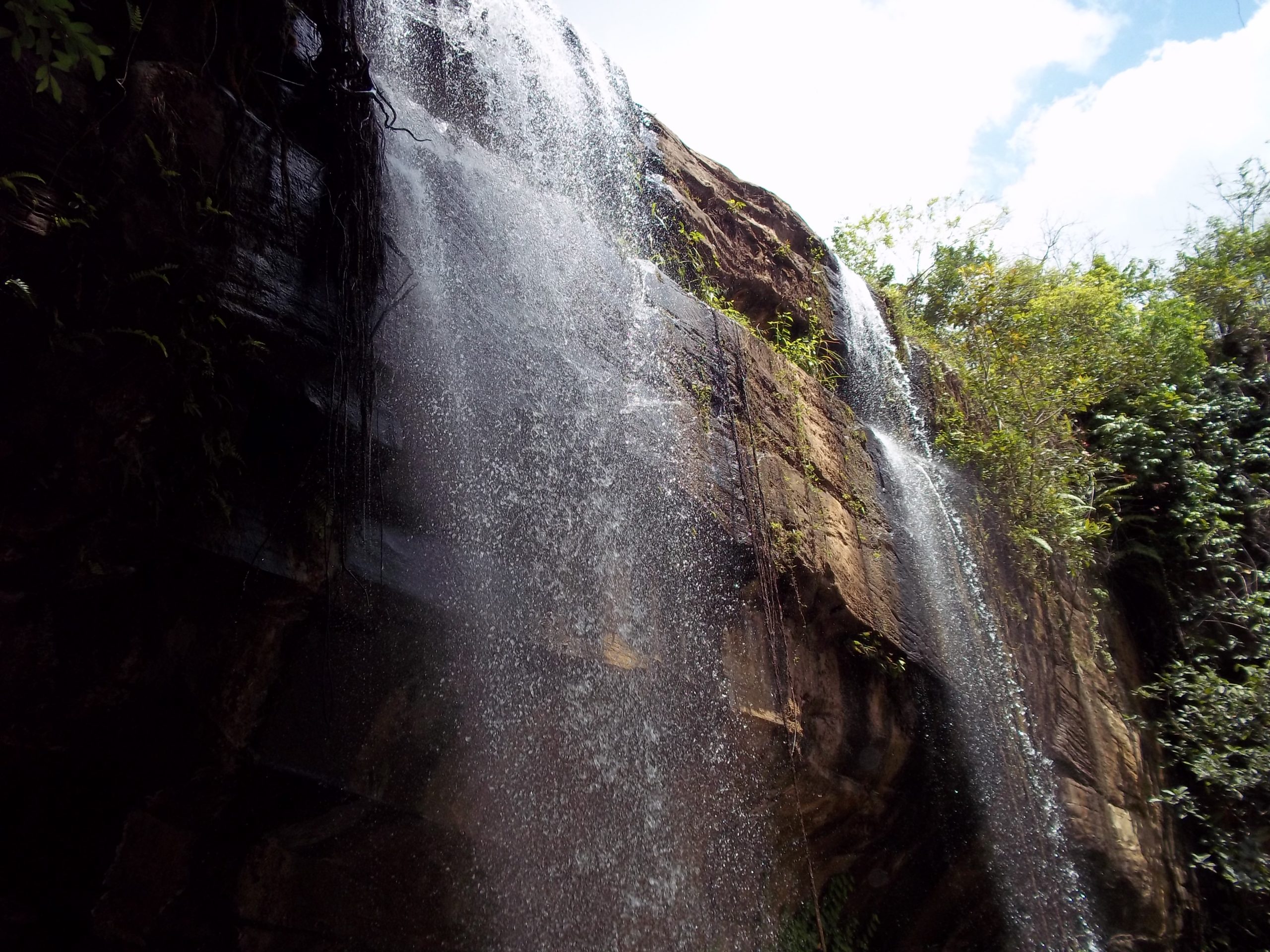
Sheldrick Falls
Sheldrick Falls is a single plunge of water dropping into a pool in the coastal forest of Shimba Hills National Reserve, and the only way to reach it is to walk down to it with a Kenya Wildlife Service ranger. The walk, not the waterfall, is what a visitor is actually buying, and the return leg is the part people underestimate.
What It Is and How It Got Its Name
The falls sit in the interior of Shimba Hills National Reserve in Kwale County, gazetted under Legal Notice 298 of 16 September 1968 and managed jointly by the Kenya Wildlife Service and the Kenya Forest Service. Two areas get quoted for it and both are correct: the gazetted national reserve is 192.5 square kilometres, while the Kenya Wildlife Service park brochure gives 300 square kilometres for the wider conservation area, which takes in the adjoining Mkongani and Mwaluganje forest reserves. The falls sit inside the gazetted reserve, and the Kenya Wildlife Service lists them among its principal attractions alongside the scenic trails and panoramic viewpoints.
They are named after David Sheldrick, the founding warden of Tsavo East National Park, who is credited with spotting them from the air while flying over the Shimba Hills. That story is usually told as a discovery, which it plainly was not: people had farmed and lived along these hills for generations. What Sheldrick did was put them on a map that the colonial administration recognised, and the name stuck.
The height of Sheldrick Falls is not stated on this page, and that is deliberate. Figures of 21 metres and 25 metres both circulate widely and confidently, and the Kenya Wildlife Service, which manages the reserve, publishes no height for them at all. With no primary figure available, giving one would be guessing with a decimal point attached.
The Walk
You cannot drive to the falls and you cannot walk to them unaccompanied. Visits leave from the Sheldrick Falls ranger post inside the reserve, on foot, with a ranger, and the ranger’s presence is not ceremonial: Shimba Hills carries a substantial elephant population and the forest is dense enough that you will not see one until you are close.
The route is roughly two kilometres each way on a developed path with stepped sections, descending steadily through coastal forest to the level of the pool. Reported walking times run to thirty or forty-five minutes on the way down, with the whole outing around two hours. Departures have long been reported at set times in the morning and early afternoon; the reserve sets them and they change, so confirm at the gate rather than planning a day around a published hour.
The asymmetry of the walk is the practical warning. Going down is easy and everyone enjoys it. Coming back up is a continuous climb in coastal humidity, generally in the hottest part of the day if you went down after lunch, and it takes noticeably longer than the descent. Anyone in the group who is unfit, elderly or very young will feel it on the return, not on the way out, by which point turning back is no longer an option. The path is also slick underfoot after rain, and the stepped sections become the awkward part rather than the helpful part.
At the Falls
The water falls clear of the rock face into a pool at the bottom, which is cold, deep enough to swim in and the reason most people make the walk. Swimming is the normal practice here. Bring a towel and something to change into, because the walk back in wet clothes in that humidity is unpleasant.
Volume varies sharply with rainfall. After the long rains the falls are full and loud; in a dry spell they thin, and visitors arriving in the driest weeks sometimes find the flow underwhelming relative to the effort. The forest compensates: fig trees carrying epiphytes, butterflies in the clearings, and birdsong.
Fees, Access and Practicalities
Sheldrick Falls lies inside a Kenya Wildlife Service reserve, so reserve entry is payable on top of anything else. Shimba Hills sits in the Scenic band of the KWS conservation fee schedule that took effect in October 2025, and the figures on the KWS Shimba Hills park page and in that schedule agree, which is not always the case. Both give, per person per day: East African citizens KSh 500 adult and KSh 250 child, Kenya residents KSh 675 and KSh 350, non-residents USD 50 and USD 25, and African citizens USD 20 and USD 10. Vehicles are charged separately by seat capacity. These were checked on 21 September 2026 and are revised by regulation, so verify before travelling.
Gates open at 6am and close at 6pm, and the reserve is plastic-free. The main gate is reached from the Likoni to Ukunda road, branching at Kombani junction, about 37 kilometres from Mombasa and 31 kilometres from Diani Beach, which is where most walkers come from. Bring water, insect repellent, closed shoes with grip rather than trainers, and swimming things.
Most people combine the falls with a game drive for the reserve’s sable antelope and with the viewpoints on the same visit, which fills a day comfortably. Waterfall hiking in Kenya covers the country’s other falls and forest walks the habitat.
Sheldrick Falls Questions
Can I walk to Sheldrick Falls without a guide?
No. The walk leaves from the ranger post inside the reserve and a Kenya Wildlife Service ranger accompanies every group. This is a reserve with elephants in thick forest, and the escort is a safety requirement rather than a formality.
How long is the walk?
About two kilometres each way on a stepped path, commonly around thirty to forty-five minutes down and longer coming back up. Allow roughly two hours for the whole outing including time at the pool.
How high are the falls?
No reliable figure exists. Both 21 and 25 metres are widely repeated and the Kenya Wildlife Service does not publish a height, so this page does not give one.
Is it hard?
The descent is easy. The return climb in coastal humidity is the real test, and it is the part people are not ready for. Anyone unsure of a sustained uphill walk in heat should think about it before setting off, because there is no other way out.
What is the best time of year?
After the rains, when the flow is strongest. In the driest weeks the water thins and the walk carries the day rather than the falls. The path is slippery while it is actually raining.
1 Place to Visit in This Area
Other sites in Shimba Hills National Reserve, each with its own guide.
No operator on the marketplace currently lists a safari to Shimba Hills National Reserve.
See every Kenya safari