
Kisite-Mpunguti Marine National Park
Kisite-Mpunguti is the furthest south of Kenya’s six marine protected areas, a cluster of coral islands lying eleven kilometres off Shimoni and eight kilometres north of the Tanzanian border. It is the only one of the six that is genuinely offshore, and the only one where the whole visit is a boat day. Kenya Wildlife Service calls it the home of the dolphins and the coconut crabs.
Where Kisite-Mpunguti Is and How Far Out
The protected area sits in Kwale County, within what Kenya Wildlife Service describes as the Shimoni to Vanga seascape. Kisite Island lies eleven kilometres out from the mainland at Shimoni, with the Upper and Lower Mpunguti islands between it and the coast. Kenya Wildlife Service gives the road distance as about 100 kilometres from Mombasa, but the only way in is a boat from Shimoni, and the crossing is the trip.
That offshore position is the whole difference between this park and the other five. Watamu, Malindi and Mombasa protect fringing reef a few hundred metres from a hotel beach. Kisite protects islands in open water: better visibility, bigger fish, harsher sea state, longer day.
Park and Reserve, and What the Distinction Actually Means
Kenya Wildlife Service runs Kenya’s marine estate in two legal categories, and every one of the six protected areas is a combination of them.
- Marine national park. Total protection from any consumptive use. No fishing of any kind. Research and recreation are the only permitted activities, and both are charged.
- Marine national reserve. Traditional harvesting of resources is allowed alongside research and tourism. In practice this means artisanal fishing continues under rules.
At Kisite-Mpunguti the split is unusually clean. Kisite Marine National Park covers 28 square kilometres around Kisite Island and is a fully protected no-take zone. Mpunguti Marine National Reserve covers 11 square kilometres around the Upper and Lower Mpunguti islands, where controlled artisanal fishing and low-impact tourism continue. Kenya Wildlife Service dates the establishment of the protected area to 1973 and its gazettement to 1978. Tuda and Omar, writing for the George Wright Forum in 2012, place Kisite alongside Malindi and Watamu as the three Kenyan marine parks that have been closed to all fishing since the period between 1968 and 1972.
Almost forty years of no-take protection on an offshore reef is why the fish here are the size they are. It is the longest-running closure in the country applied to water this far from a river mouth or a city.
What Is Actually in the Water
Kenya Wildlife Service describes three coral rag forest islands fringed by reef, hosting endemic marine life and migratory birds, and identifies the protected area as a climate refugia for coral reefs. That last phrase is a technical designation rather than a marketing line: it means the local conditions, currents and depth give the coral here a better chance of surviving the sea temperature spikes that kill reefs elsewhere.
On the fish side the reef carries the full Indian Ocean cast: angelfish, butterflyfish, parrotfish, surgeonfish, groupers, snappers and sweetlips over hard coral, with larger pelagic fish working the drop-offs. Green and hawksbill turtles use the area, and Kenya Wildlife Service names a turtle site here as Kijamba cha Kasa. Coconut crabs, the largest land-living arthropod on earth, live on the Mpunguti islands, which is the detail in KWS’s own strapline for the park and the one almost nobody writing about the place bothers with.
The islands themselves matter as much as the reef. They are low coral rag with scrub, and they carry nesting and roosting seabirds, which is why the area appears in bird literature as well as dive literature.
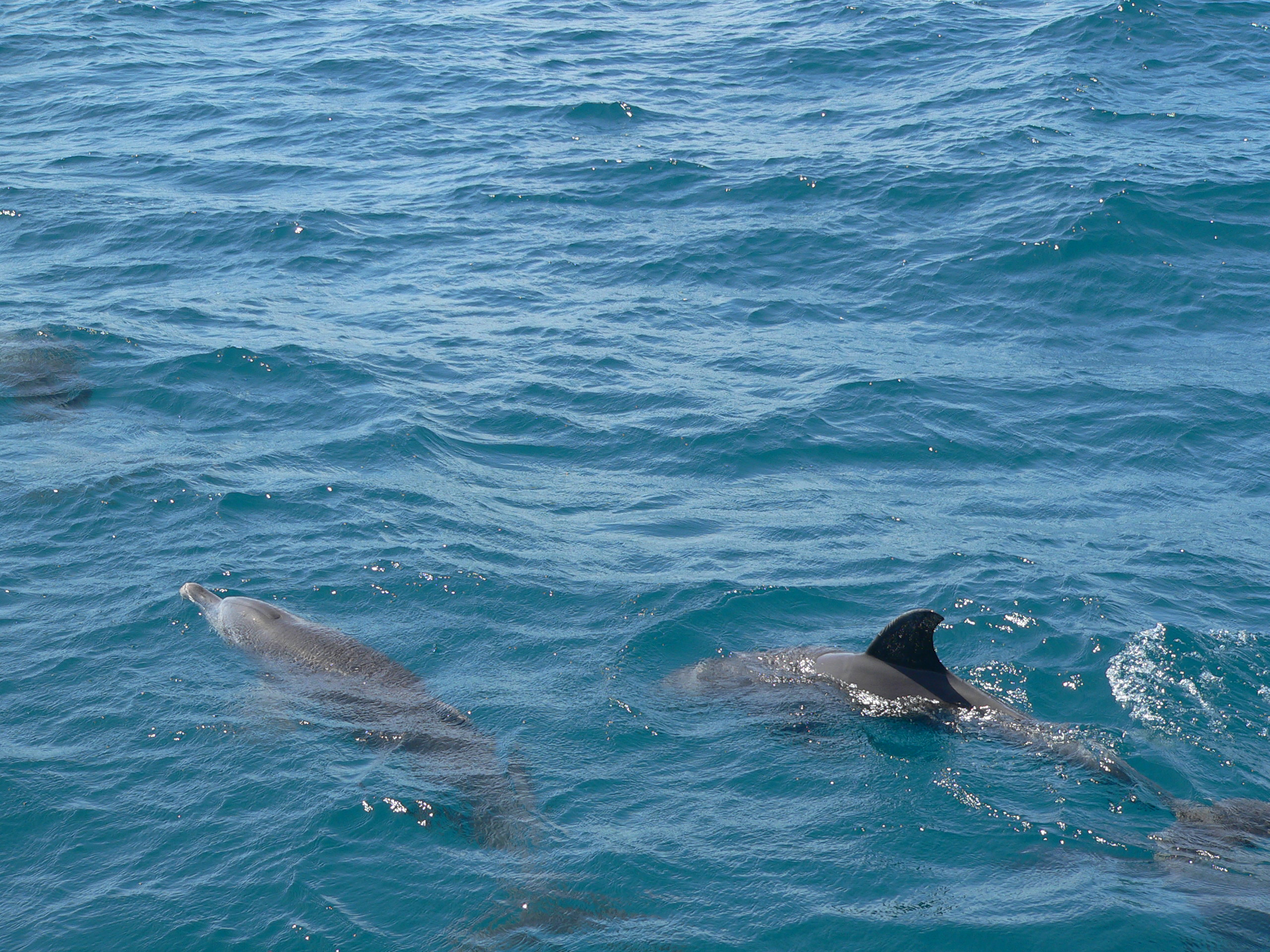
Dolphins at Kisite-Mpunguti
Kisite is the most reliable place in Kenya for dolphin watching, and the reason is geography rather than luck: the islands shelter the water from both monsoons, so boats work here on more days of the year than anywhere else on the coast.
The 2021 national wildlife census records the Indo-Pacific bottlenose dolphin as one of the two most frequently reported marine mammals in Kenyan waters, with the reporting season running November to April. Humpback dolphins are also present on this coast. Nothing is promised on any single trip, and a crew that guarantees a sighting is telling you something about the crew rather than the dolphins.
The Reefs, and What the Bleaching Left
Honesty is more useful here than enthusiasm. Coral reefs along the entire Kenyan coast suffered widespread bleaching and mortality in the first half of 1998, an event documented in the scientific literature and summarised by Tuda and Omar. Kenyan reefs also carry longer-running pressures: overfishing outside the protected areas, sea urchin populations released by the loss of their predators, crown-of-thorns starfish outbreaks and sediment washing off the land.
The result at Kisite is a reef where visitors regularly see large areas of dead or broken coral structure alongside dense, healthy fish life, and are surprised by the contrast. Both are true at once. Dead framework still functions as habitat, and the no-take status is doing its work on the fish even where the coral has not recovered. The climate refugia designation is a statement about prospects, not a claim that the reef is untouched.
Getting Out There from Shimoni
Boats leave from Shimoni, which is reached by road down the south coast past Ukunda and Msambweni. From Diani Beach it is a straightforward morning transfer. Most visitors come as part of a dhow trip that pairs the marine park with lunch on Wasini Island, and that pairing is so standard that the park and the island are effectively one product on this coast.
Boats are run by local operators and community groups rather than by Kenya Wildlife Service, and boat charges are separate from the conservation fee in every case. The KWS schedule does set two charges of its own that apply here: a dhow excursion within a marine protected area is charged at KSh 1,000 or USD 10, and parking at Shimoni is KSh 1,000 for East African citizens or USD 30 for non-residents, though parking does not apply to visitors holding paid park tickets. There is also a helicopter landing charge of USD 300 for Kisite-Mpunguti, which is on the schedule for the small number of people it concerns. All of these come from the Kenya Wildlife Service conservation fee schedule of October 2025, checked on 21 September 2026.
Marine Park Fees for All Six Protected Areas
Kenya Wildlife Service charges one single band for entry to every marine protected area it manages: Kisite-Mpunguti, Watamu, Malindi, Mombasa, Kiunga and Diani-Chale. The fee is per person per day.
| Category | Adult | Child or student |
|---|---|---|
| East African citizen | KSh 500 | KSh 250 |
| Kenya resident | KSh 675 | KSh 350 |
| African citizen | USD 15 | USD 10 |
| Non-resident | USD 25 | USD 15 |
Figures come from the Kenya Wildlife Service conservation fee schedule of October 2025, made under Legal Notice No. 160 of 2025, checked against the published schedule on 21 September 2026. A figure of USD 40 for non-resident marine entry circulates widely in search results and does not appear anywhere in that schedule. Fees are set by regulation and revised, so confirm on kws.go.ke before travelling.
One further line is worth knowing. Independent watersport participants who walk in rather than joining an organised operation pay KSh 500 daily. The KWS sport fishing charge, by contrast, explicitly excludes the marine protected areas, because fishing inside a marine national park is not permitted at all.
Timing, Tides and Sea State
The Kenyan coast runs on two monsoon winds. Kaskazi, the northeast monsoon, blows from around December to March and brings flat seas and the clearest water of the year. Kusi, the southeast monsoon, runs from around June to September and brings wind, swell and reduced visibility. The 2021 national wildlife census records a maximum significant wave height of eight metres off the Kenyan coast during the southeast monsoon, and a spring tidal range not exceeding four metres inshore.
For a boat day out of Shimoni this translates simply. October to March is the calm, clear window. Trips still run in the kusi months and the islands shelter the water better than anywhere else on the coast, but a rough crossing is a real possibility, and anyone prone to seasickness should take something for it before boarding rather than after. Morning departures get the calmest water and the best light.
Tide governs the snorkelling as much as wind does. Shallow reef works best around low water and crews time their stops to it. A sandbar stop exists only at certain states of the tide, which is why two boats on the same route can have visibly different days.
Combining Kisite-Mpunguti With Wasini and Shimoni
Almost every visit pairs the marine park with the sights around it, and those are separate places with their own pages rather than paragraphs on this one. Wasini Coral Garden is a raised fossil coral platform crossed on a boardwalk. The Shimoni Caves carry a heavy and contested history connected to the slave trade. Wasini Island itself is a village without vehicles or mains water.
For divers, scuba diving at Kisite is rated the best reef diving in Kenya on fish life and visibility together. For everyone else it is a full day out of the south coast rather than a stop on the way to anything. Further north, the reef options are Mombasa Marine National Park and Watamu, both closer to a hotel beach and both a different kind of day.
Kisite-Mpunguti Questions
What does it cost to enter Kisite-Mpunguti Marine National Park?
KSh 500 for an East African citizen adult and KSh 250 for a child, KSh 675 and KSh 350 for a Kenya resident, USD 25 and USD 15 for a non-resident, and USD 15 and USD 10 for an African citizen, per person per day. Boat hire is separate and is charged by the operator. Figures are from the Kenya Wildlife Service conservation fee schedule of October 2025, checked on 21 September 2026.
Is the entry fee included in a Wasini day trip?
Usually, but not always, and the difference is worth confirming in advance rather than at the jetty. The conservation fee is a KWS charge on the person, the boat is a separate charge by the operator, and some day trips quote one without the other. Anyone entering the water inside the park needs the fee paid whether they arrived by boat or not.
Will you see dolphins?
Often, but never guaranteed. The islands shelter the water from both monsoons, so boats work here on more days than anywhere else on the Kenyan coast, and sightings are common. The national wildlife census records the Indo-Pacific bottlenose dolphin as most frequently reported between November and April.
What is the coral actually like?
Mixed, and visitors should expect that. Kenyan reefs suffered widespread bleaching and mortality in 1998 and have faced sustained pressure since. Kisite holds up better than most because of its offshore position and its long no-take protection, and Kenya Wildlife Service identifies it as a climate refugia for coral, but areas of dead structure alongside abundant fish are what most people see.
Is the boat crossing rough?
It can be, particularly during the southeast monsoon between June and September, when the census records maximum significant wave heights of eight metres offshore. Between October and March the sea is usually flat. Take seasickness medication before boarding rather than once you are on the water.
What is the difference between Kisite and Mpunguti?
Kisite Marine National Park, 28 square kilometres around Kisite Island, is a no-take zone where no fishing of any kind is permitted. Mpunguti Marine National Reserve, 11 square kilometres around the Upper and Lower Mpunguti islands, allows controlled artisanal fishing and low-impact tourism. Both are managed by Kenya Wildlife Service as one protected area.
No operator on the marketplace currently lists a safari to Kisite-Mpunguti Marine National Park.
See every Kenya safari