
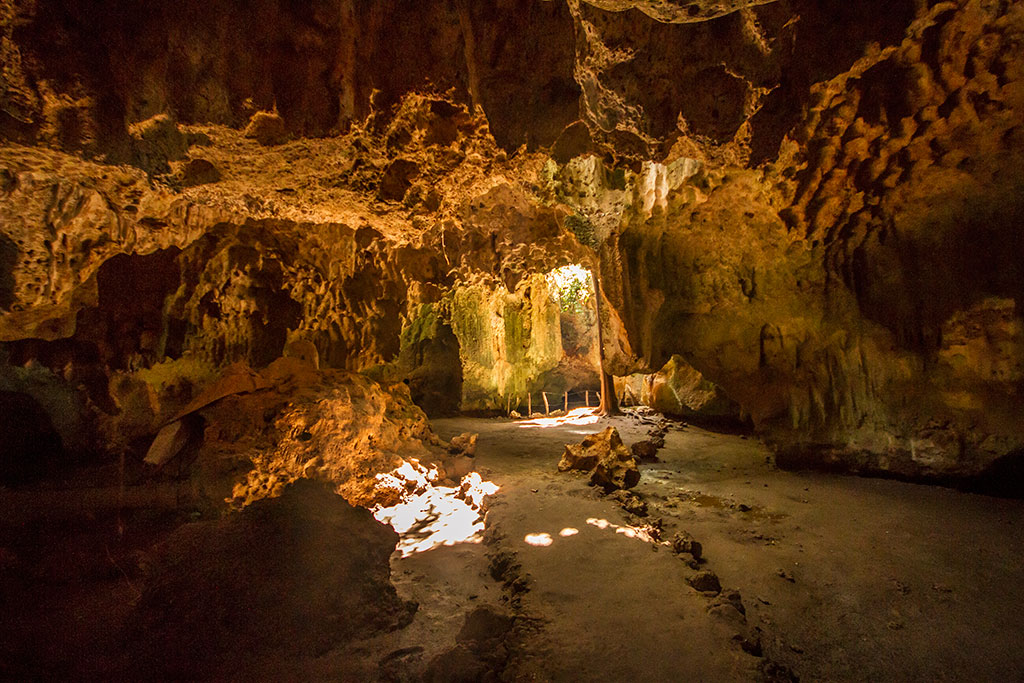
Shimoni Caves
The Shimoni Caves are coral caverns beneath a fishing village on Kenya’s far south coast, used to hold enslaved people before they were shipped out. Iron fittings driven into the rock are still there, partly buried under the mineral crust grown over them. This is a site of the East African slave trade and should be visited as one.
Where the Caves Are
Shimoni sits about 75 kilometres south of Mombasa on the Lunga Lunga road, in Kwale County, near the Tanzanian border and opposite Wasini Island. The name is Swahili for the place of the hole, after the caves. They are coral limestone dissolved out by water over a very long period, opening close to the shoreline, and the system is dark, humid and full of bats.
Claims about the caves’ extent circulate widely, usually five kilometres running inland. No primary source for that could be traced, so it is not repeated here. What visitors see is the accessible section near the sea, large enough to have held many people at once.
What Happened Here
Enslaved people taken from the interior and along this coast were brought to Shimoni and held in the caves while they waited for dhows. From here they were shipped to the market at Zanzibar, the clearing house for the whole East African trade, and onward to Arabia, the Gulf, Persia and India. Captives were also used as porters, carrying ivory down from the interior on the same journey that took them to the ships.
They were held in the dark, restrained. Iron shackles and studs were fixed into the cave walls, and rusted chain and fittings survive in place, in several spots now being encased by stalactite and stalagmite growth. Wooden crates associated with the trade were also recovered. This material is why the site is a monument rather than a story: it is the most direct evidence of the trade surviving on this coast outside a museum case.
The trade’s end here took decades rather than a single event. Britain pressed the Sultan of Zanzibar through the middle of the nineteenth century, and the treaty obligations of the 1870s closed the seaborne trade Shimoni depended on.
What Is Documented and What Is Told
The distinction matters here, because a great deal of confident detail is repeated with no visible source. Keeping the two apart is not scepticism about the history: the documented part is grim enough without embellishment.
- Documented. Shimoni’s role as an embarkation point on the slave route to Zanzibar; the iron fittings and chain in the caves; its status as a gazetted heritage place with an NMK museum; and its later role as an administrative station of the Imperial British East Africa Company, whose buildings went up here in the early 1890s. A colonial-era residence in the village was restored in 2010 with United States embassy sponsorship.
- Locally told. That the caves were used long before the slave trade as a shrine where Kaya elders prayed and made offerings, and as a refuge during raids. This is the community’s own oral tradition, and the guides who tell it generally present it as tradition rather than as record.
- Not sourceable. The numbers. How many passed through per month, how long each group was held, and when the caves first came into use are repeated across travel writing without an underlying source. None appears here.
Kenyan scholarship describes Shimoni as a layered site rather than a single-purpose one: a refuge, a shrine, a slave pen and a gazetted monument in turn. That layering is usually flattened into one sentence about slavery.
Visiting Shimoni Caves
The caves are run by the Shimoni Slave Cave Management Committee on behalf of the community, with technical support from the National Museums of Kenya, which runs the small museum near the cave mouth. The guides are local, the income stays in the village, and the interpretation is the community’s own account of its own history. Entry is by guided visit, daily. Reported hours are 8am to 6pm, while the 2026 fees notice gives general museum hours of 8.30am to 5.30pm; the two do not agree, so confirm which applies.
The National Museums and Heritage (Admissions Fees) Regulations 2025, gazetted as Legal Notice 79 of 2025 and effective from 7 May 2026, list Shimoni in their lowest band: KSh 100 adult and KSh 50 child for Kenyan and East African citizens, USD 3 and USD 2 for residents and other African nationals, and USD 4 and USD 2 for visitors from outside Africa. Checked on 21 September 2026. Museum ticketing is through eCitizen only and takes no cash.
One charge catches drivers out. The Kenya Wildlife Service conservation fee schedule effective from October 2025 levies parking at Shimoni, among a handful of named coastal and Rift Valley sites, at KSh 1,000 for East African citizens and USD 30 for non-residents, and states that it does not apply to visitors holding paid park tickets. So a car driven to Shimoni purely for the caves can meet a Kenya Wildlife Service parking charge even though the caves are not in a Kenya Wildlife Service area; a car whose occupants are also paying to enter the Kisite-Mpunguti marine park should not. Checked on 21 September 2026.
Read that figure with one caution. The regulations price the Shimoni heritage site as a National Museums facility, but the caves are run day to day by the community committee, which collects at the cave entrance. What is asked there may not be the statutory rate and may cover a guide as well, so ask what the payment covers.
The descent is by steps into humid, low-light chambers with uneven coral floors, bats overhead. Closed shoes, a torch even though lighting is provided, and allow forty-five minutes to an hour.
Most visitors reach Shimoni on a day trip from Diani taking in the Kisite-Mpunguti Marine National Park and lunch on Wasini, with the caves bolted on to one end. If that is the plan, do the caves first. Walking into this straight off a snorkelling trip is jarring, and the site does not survive being treated as an interval between activities.
The Shimoni guide covers the village and its boats, the Wasini coral garden is the usual other stop on land, and heritage tours in Kenya gives the wider context.
Shimoni Caves Questions
What were the Shimoni Caves used for?
Enslaved people were held in them awaiting shipment by dhow to the slave market at Zanzibar, and from there to Arabia, the Gulf, Persia and India. Iron shackles and fittings driven into the walls survive in place.
How long does a visit take, and is it suitable for children?
Around forty-five minutes to an hour with a guide, plus the museum. The caves are dark, damp and full of bats, which some children find alarming and others find the best part. The subject matter is the real question, and it is worth deciding in advance how much you want to explain.
Were the caves used before the slave trade?
The community’s oral tradition holds that Kaya elders used them as a shrine for prayer and offerings, and that people sheltered in them during raids. It is told at the site as tradition, and independent corroboration could not be established for this page.
No operator on the marketplace currently lists a safari to Shimoni.
See every Kenya safari