
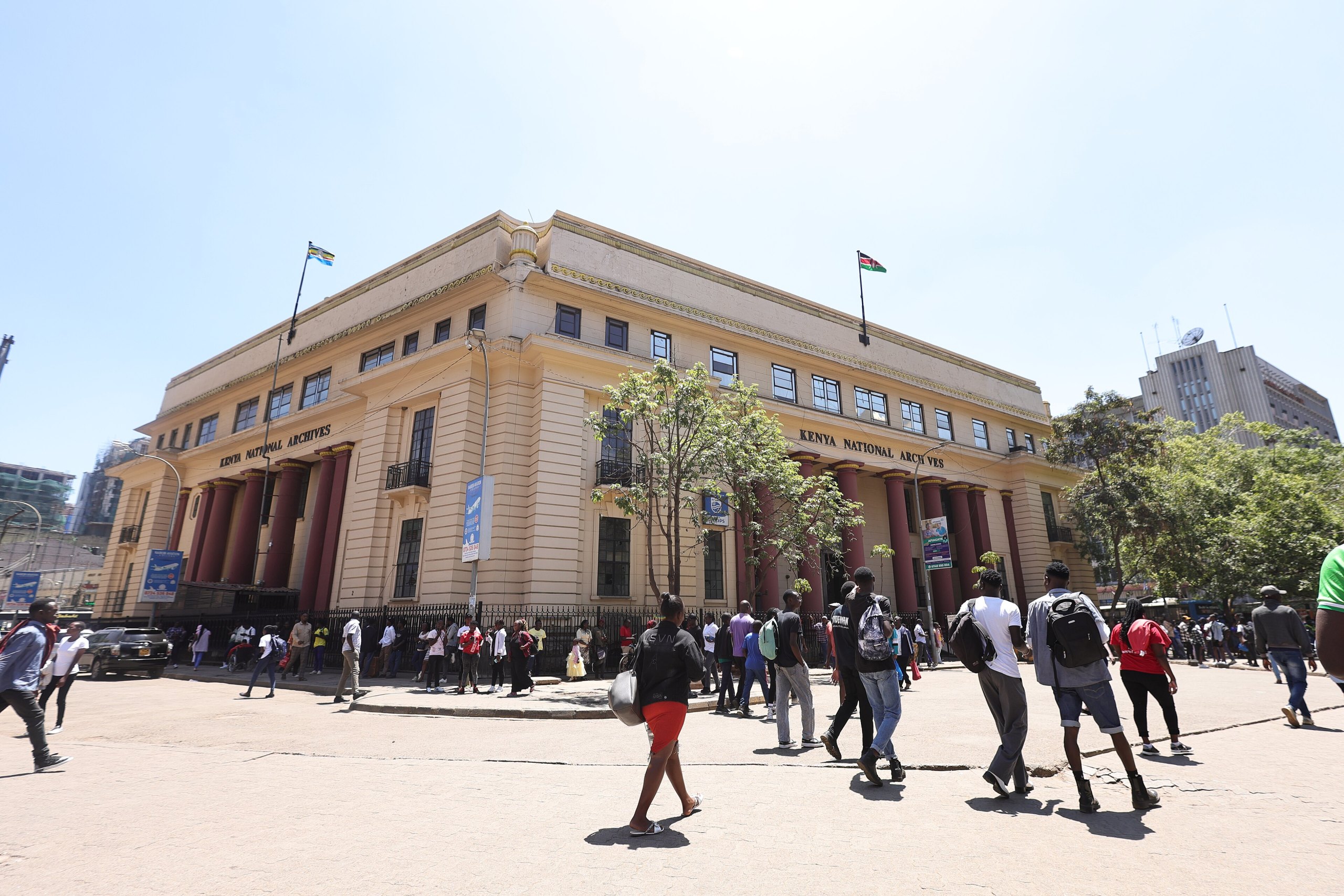
Kenya National Archives
The Kenya National Archives occupies a former bank building on Moi Avenue, at the edge of the central business district opposite the Hilton and next to the Ambassadeur Hotel. It is the country’s record office, and it is also, on its ground floor, one of the most substantial displays of Pan-African art anywhere on the continent. Most visitors come for the second of those without realising the first is upstairs.
The Institution
The Kenya National Archives and Documentation Service was established in 1965, two years after independence, to take custody of the country’s public records. The building it occupies was not built for the purpose. It went up as a bank in the colonial city, and the heavy banking-hall proportions of the ground floor are exactly what makes it work as a gallery now.
What it holds is the documentary spine of modern Kenya: government and parliamentary records, correspondence, books, maps, and a very large collection of historical photographs. Researchers use the reading rooms; casual visitors mostly do not get past the ground floor, which is a reasonable choice given what is on it.
The Murumbi Collection
The ground floor gallery is named for Joseph Murumbi, Kenya’s second Vice-President, who was also one of the most serious collectors of African art and books the continent has produced. His collection came to the archives and forms the display, and it is generally described as the largest Pan-African art collection held in Africa.
What is in it spans the continent rather than Kenya alone: masks, textiles, weaponry, beadwork, furniture, jewellery, stamps and rare books, gathered from across Africa over decades of travel and buying. There are also portraits, paintings and photographs of the independence era on the walls, which gives the whole ground floor a double character, part art gallery and part national portrait collection.
Murumbi founded the African Heritage gallery in 1972 with the collector Alan Donovan and with his own wife Sheila, and Donovan went on to build African Heritage House off Mombasa Road. The two collections are two halves of one project and seeing both makes a great deal more sense of either. Murumbi himself served as Vice-President only briefly, resigning in 1966; the collection is the larger part of what he left behind.
Visiting
The archives sit directly on Moi Avenue in the middle of the city, which makes this one of the easiest attractions in Nairobi to reach on foot or by matatu, and the busiest street frontage of any of them. The building is immediately recognisable and there is no approach road or gate to negotiate.
The gallery and the reading rooms keep different hours. The gallery is open to general visitors through the day; the archives proper operate on office hours and close earlier and at weekends. Anyone coming to consult records rather than look at the collection should contact the service in advance about access, identification and any research permissions required, rather than arriving and hoping.
An entry charge applies to the gallery, with different rates for residents and non-residents. The service’s own website was not reachable when this page was checked, and the figures circulating on travel listings do not trace to the managing body, so confirm the current rate at the door rather than budgeting from a third-party page. Note too that this is a state department in its own right and not one of the National Museums of Kenya sites, so an NMK ticket or arrangement does not apply here.
What a Visit Is Like
Allow an hour, or ninety minutes if the photographs hold attention. The ground floor is dense and poorly lit in places, the labelling is uneven, and a guide makes a substantial difference to how much of it lands. It is the kind of collection where a single object explained properly is worth twenty walked past, so it is worth asking whether a guide is available when buying a ticket.
Because it is in the middle of town, the practical advice about the area applies: this is a busy commercial street, and ordinary city sense about bags and phones is worth applying on the pavement outside.
Nearby
Everything around the archives is walkable. The viewing deck at KICC is a few minutes away and gives the aerial view of the same streets, and the Nairobi Railway Museum is a short walk in the other direction, off Haile Selassie Avenue. The Nairobi National Museum on Museum Hill is a short drive north. The city is covered on the Nairobi guide and the wider subject under heritage tours.
Questions Visitors Ask
Can anyone go in, or is it only for researchers?
Anyone can visit the ground floor gallery. Using the archives themselves for research is a separate arrangement and should be organised with the service in advance.
What does it cost?
A charge applies, with different rates for residents and non-residents. The managing body’s website was unreachable when this page was checked and third-party figures are unreliable, so confirm at the door.
Is this a National Museums of Kenya site?
No. The Kenya National Archives and Documentation Service is a separate state body, so NMK ticketing does not apply.
Who was Joseph Murumbi?
Kenya’s second Vice-President, who held the office briefly in 1966, and a collector of African art and books on a scale few individuals have matched. The ground floor gallery is his collection.
How long do I need?
An hour for the gallery, more if the independence-era photographs and portraits are of interest. A guide is worth asking about.
11 Places to Visit in This Area
Other sites in Nairobi, each with its own guide.
Safaris That Visit Nairobi
3 of the 16 safaris listed here that visit Nairobi, from different operators where the listings allow it. Each is sold and run by an independent tour company. This site lists them and passes on enquiries; it takes no booking and charges you nothing.

12 Days Best of Kenya Safari
by Kori Safaris Verified operator
Operator quotes on request
View Safari

7-Day Fly-In Kenya Safari Package to Maasai Mara and Amboseli
by Insight Safari Holidays Verified operator
Operator quotes on request
View Safari

Kenya Classic: Amboseli, Tsavo & the Mara
by Ancient Africa Safaris Verified operator
From $9,400 per person
View Safari