Wildlife Conservation Experiences in Kenya
Almost every Kenyan safari is sold as helping conservation, and most genuinely do. A conservation experience is narrower: a visit or activity whose subject is the work itself, where a traveller sees how a population is monitored, why a sanctuary exists and what the money actually pays for.
Almost every Kenyan safari is sold as helping conservation, and most genuinely do. A conservation experience is narrower: a visit or activity whose subject is the work itself, where a traveller sees how a population is monitored, why a sanctuary exists and what the money actually pays for.
Safaris That Include Wildlife Conservation Experiences

9 Days Kenya Safari
by Wild Whispers Africa Verified operator
Operator quotes on request
View Safari

9 Days Kenya Wildlife Safari
by Tranquil Safaris Verified operator
Operator quotes on request
View Safari

1 Day Nairobi National Park Safari, Kenya Tours
by Kori Safaris Verified operator
Operator quotes on request
View Safari
3 Days Tsavo East and Tsavo West Safari
by Tranquil Safaris Verified operator
Operator quotes on request
View Safari
12 Days Best of Kenya Safari
by Kori Safaris Verified operator
Operator quotes on request
View Safari
8 Days Safari in Kenya
by Wild Whispers Africa Verified operator
Operator quotes on request
View SafariSee all 12 safaris that include wildlife conservation experiences
Wildlife Conservation Guide in Kenya
Almost every safari in Kenya is sold as helping conservation, and in a genuine sense most of them do. A conservation experience is something narrower: a visit or an activity whose subject is the work itself rather than the wildlife, where a traveller sees how a population is monitored, why a sanctuary exists and what the money actually pays for. The category is worth understanding properly, because it contains some of the best things to do in the country and some of the worst.
What Counts as a Conservation Experience
Three quite different products share the name, and the differences matter.
- Visiting a facility that conservation funds. An elephant orphanage, a rhino sanctuary, a turtle rehabilitation centre. The visitor watches, learns and pays, and the payment is the contribution. These are open to ordinary travellers and need no special arrangement beyond a booking.
- Structured participation. Joining monitoring or management work for a day or more, usually alongside rangers or researchers: tracking collared animals, recording individual identification, fence or patrol work, data entry. This is arranged in advance and priced accordingly.
- Volunteer placements. Weeks or months with an organisation, paid for by the volunteer. The quality range here is wider than in any other part of Kenyan tourism and the due diligence required is correspondingly greater.
The honest framing for the first category is that a visitor is buying access to a working operation, not providing labour. That is not a criticism. Visitor income is a large part of how several of these organisations function, and the transparency about it is a reasonable proxy for how well run they are.
The Numbers Behind Kenyan Conservation
Why any of this exists is best explained by what nearly happened. Kenya Wildlife Service records that by the early 1970s the greater Tsavo ecosystem supported more than 8,000 black rhinos, one of the largest concentrations in Africa. By 1989, poaching, drought and land pressure had reduced that population to fewer than twenty animals. The service itself was created that year in response.
The recovery is real and it is partial. Kenya Wildlife Service states that Kenya today holds approximately 2,102 rhinos: 1,059 black, 1,041 southern white and the last two northern white rhinos in the world. Sport hunting has been illegal since the national hunting ban of 1977, and the protected-area framework goes back further still, to the Royal National Parks Ordinance of 1945 and the gazetting of Nairobi National Park in 1946 as the first national park in East Africa.
Rhino Conservation You Can See
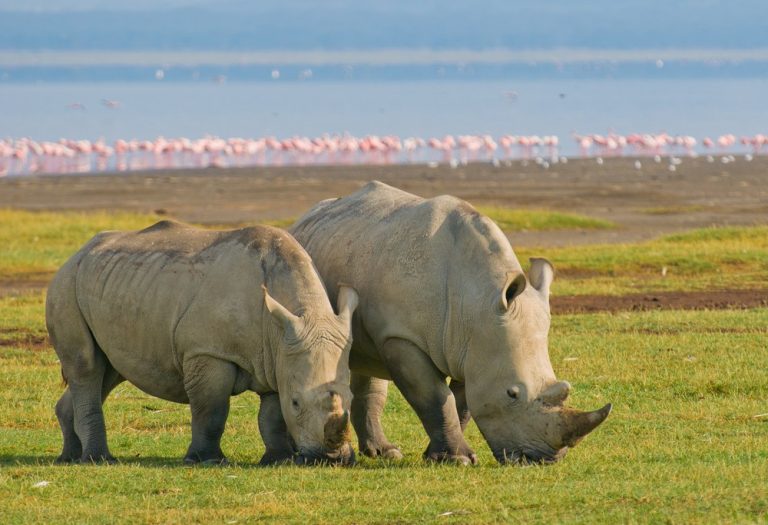
Rhino work is the most visible conservation activity in Kenya because the animals are individually known, intensively monitored and largely confined to sanctuaries. In December 2025 Kenya Wildlife Service consolidated its Tsavo rhino programme, merging 150 animals from the 92 square kilometre Ngulia Rhino Sanctuary, which had been holding nearly 150 rhinos against a stated carrying capacity of 60, with 50 already in Tsavo West to form a founder population of 200 in a far larger sanctuary. Most published descriptions of Ngulia have not caught up with this.
Lake Nakuru is the most accessible place in the country to see both black and white rhino from a vehicle. Ol Pejeta on the Laikipia plateau is where the last two northern white rhinos, Najin and Fatu, live under permanent guard, and where an international assisted-reproduction programme continues to produce and transfer embryos. Lewa carries a substantial rhino population and was added, together with the Ngare Ndare Forest Reserve, to the Mount Kenya World Heritage property in 2013, connected to the mountain by a 9.8 kilometre elephant corridor; the extension also holds the largest resident population of Grevy's zebra in the world. Rhino tracking on foot, where it is offered, is a conservancy activity rather than a park one, for the reasons set out in the walking safaris guide.
Elephant Orphan Facilities and How They Work
The best-known conservation visit in Kenya is the Sheldrick Wildlife Trust's Nairobi Nursery, which sits inside Nairobi National Park. Orphaned calves, most of them casualties of poaching, drought or conflict with people, are hand-raised by keepers who stay with them day and night, then moved through reintegration units at Voi and Ithumba in Tsavo East and at Umani Springs in the Kibwezi Forest, where they rejoin wild herds over a period of years.
The public visit is one hour a day, from 11am to noon, every day except 25 December, and access is strictly by advance booking with no same-day admission. Kenya Wildlife Service now requires park gate entry fees from all nursery visitors in addition to the trust's own entry donation, which catches people out. Fostering an orphan gives access to a separate, quieter afternoon visit.
Reteti, in the Namunyak community conservancy in Samburu country, is a different model and arguably the more interesting one. It is community-owned and community-run, with Samburu keepers recruited locally, and it built its milk supply around goat milk bought from local women, which turns the sanctuary into a local economy rather than an enclave. Visits are small and paired with a keeper.
Marine and Coastal Conservation
The coast has its own conservation tradition and it is less visited than it deserves. Local Ocean Conservation at Watamu has worked on sea turtles since 1997, running a rescue and rehabilitation centre, a bycatch release programme that pays fishermen to report and release accidentally caught turtles, and nest monitoring along the beaches. The rehabilitation centre is open to visitors and the work is visible rather than staged.
The marine protected areas themselves, Watamu, Malindi, Mombasa and Kisite Mpunguti, are where reef protection is enforced, and the Wildlife Conservation and Management Act draws a sharp line between a marine park, where fishing and disturbance require written permission, and a marine reserve, where subsistence fishing is permitted. Coastal conservation pairs with sea turtle watching and snorkelling.
Conservancies as the Conservation Model
The largest conservation story in Kenya is not a sanctuary. It is the conservancy movement, which puts wildlife management in the hands of the landowners and communities who live with the animals. The Kenya Wildlife Conservancies Association counts 215 conservancies covering more than 10.3 million hectares, employing 4,201 conservancy rangers and directly affecting a million households, and states that they secure the 65 per cent of Kenya's wildlife that lives outside the national parks and reserves.
The mechanism is a lease. Landowners set aside land for wildlife, camps operate on it under agreement, and a portion of what guests pay flows back to the landowners as rent and to the conservancy as operating budget. A traveller staying on conservancy land is therefore participating in the conservation model whether or not they take part in any activity labelled as conservation, and the questions worth asking are about the lease and the ranger force rather than about the game viewing.
Structured Participation and Its Published Fee
Kenya Wildlife Service publishes a tariff for taking part in its own work, which almost no travel source mentions. Participation in wildlife conservation and management experiences is charged at KSh 20,000 or USD 200 per person per day. Animal tracking in selected parks, on prior arrangement and exclusive of park entry, is KSh 2,000 or USD 20 per person. A warden's lecture, where available and arranged in advance, is KSh 3,000 or USD 30 per group. These figures come from the Kenya Wildlife Service conservation fee schedule published in October 2025, checked on 21 September 2026.
The existence of that tariff is the useful information. A traveller who wants to spend a day with the people doing the work, rather than watching from a vehicle, has a documented route to doing so through park management, in addition to whatever a private conservancy offers its own guests.
How to Judge an Experience Before Paying
The questions that separate serious conservation from conservation theatre are short and most of them can be asked by email.
- Who owns the land and the organisation, and where does the money go? A community-owned conservancy and a privately held attraction are different propositions.
- What is the release record? A rehabilitation facility should be able to say how many animals it has returned to the wild and where.
- Is there hands-on contact between visitors and wild animals? For rehabilitation intended to end in release, habituating an animal to strangers works against the outcome.
- Does the work produce anything beyond the visit? Monitoring data, published research, ranger employment, veterinary capacity.
- Does the organisation say plainly what a visitor is buying?
Three things are reliable warning signs anywhere in Africa: handling or petting predator cubs, walking with lions or cheetahs as a paid activity, and hand-feeding large wild animals for photographs. None of these is compatible with releasing an animal, and facilities offering them should be assumed to be entertainment.
Questions About Conservation Experiences in Kenya
Can I volunteer with wildlife in Kenya?
Placements exist, and the quality range is very wide. The ones worth doing tend to want specific skills, run for weeks rather than days, involve monitoring, habitat or community work rather than animal handling, and are candid that the fee subsidises the organisation. Any placement whose selling point is close contact with young animals should be treated with suspicion.
Where can I see rhinos in Kenya?
Lake Nakuru is the most accessible place to see both black and white rhino from a vehicle. Ol Pejeta and Lewa on and around the Laikipia plateau hold substantial populations and are where most rhino tracking on foot happens. Tsavo West holds the consolidated Tsavo rhino sanctuary, and Nairobi National Park has a long-established population within sight of the city.
Is visiting an elephant orphanage ethical?
It depends entirely on the model. A facility that hand-raises orphans with the explicit aim of returning them to wild herds, limits public contact to a fixed observation period and can describe its reintegration record is doing conservation. A facility built around visitor contact with animals that will never be released is doing something else. The public hour at Nairobi and the keeper-paired visits at Reteti both sit in the first category.
Does my park fee actually fund conservation?
Park entry fees fund Kenya Wildlife Service operations, which includes ranger deployment, veterinary work and species programmes. On conservancy land, bed-night and conservancy fees fund land leases to community owners and the conservancy's own ranger force. Neither is a donation and neither is a marketing line; both are the operating income of the organisations concerned.
Can I take children on a conservation experience?
The visiting facilities suit children well and are often the part of a trip they remember. Structured participation and tracking activities usually carry minimum ages set by the operator, because they involve long periods of quiet attention and sometimes walking in areas with dangerous game.
What happened to the northern white rhino?
Two females remain, Najin and Fatu, both living at Ol Pejeta under permanent protection. No males survive, so natural breeding is impossible and the subspecies depends on an assisted-reproduction programme that has produced a growing bank of embryos and has begun transferring them into southern white rhino surrogates. No pregnancy has yet carried to term.