
Lake Nakuru National Park
Lake Nakuru National Park is a fenced, compact, exceptionally productive game park built around a shallow soda lake on the floor of the Rift Valley, ninety minutes from Naivasha and a little over two hours from Nairobi. For thirty years it was sold on its flamingos. It is now better understood as Kenya’s most reliable rhino park, and a traveller who arrives expecting the old postcard will misjudge it.
What Lake Nakuru National Park Is Today
The park occupies 188 square kilometres around the lake and is enclosed by an electric perimeter fence, which is unusual in Kenya and is the single fact that shapes everything else about it. Inside that fence sit the lake, acacia woodland, yellow-barked fever tree forest, euphorbia stands, grassland and a rim of rocky escarpment and hills. Nothing walks out and nothing walks in, so the wildlife is resident and predictable rather than migratory.
The Kenya Wildlife Service sets out the park’s history clearly. Protection began in 1961, when the southern tip of the lake was designated a bird sanctuary. The sanctuary was extended over the whole lake in 1964, and in 1968 the lake and its shoreline, roughly 6,000 hectares, were gazetted as a national park. A major expansion in 1974, supported by the World Wide Fund for Nature, took in the surrounding habitats and brought the park to its present 188 square kilometres. The perimeter fence went up in 1986, and in 1987 Lake Nakuru became Kenya’s first government-managed rhino sanctuary.
The lake is also a Ramsar wetland of international importance, designated on 5 June 1990 as site 476 and covering 18,800 hectares, and since 2011 it has been one of the three components of the UNESCO World Heritage property known as the Kenya Lake System in the Great Rift Valley, alongside Lake Bogoria and Lake Elementaita. UNESCO records the Lake Nakuru component at 18,800 hectares, which is the national park itself.
Rhino Safaris at Lake Nakuru and What the Fence Buys You
Rhino are the reason to come. The Kenya Wildlife Service describes Lake Nakuru as supporting one of the country’s largest populations of black rhino alongside white rhino, and the fence is why. A rhino sanctuary works only if poachers cannot reach the animals and the animals cannot wander, and this park was the first place in Kenya where that was attempted at scale.
The two species behave completely differently and the difference is worth knowing before a game drive. White rhino are grazers, they move in loose groups, and they are usually out on open grass near the lake where a vehicle can sit and watch them at length. Black rhino are browsers, solitary, and they stay in thicket, so a sighting is short, often partial and genuinely a matter of luck even here. Guides who promise both are overselling.
Kenya’s rhino population, as published by the Kenya Wildlife Service, stands at approximately 2,102 animals: 1,059 black, 1,041 southern white and 2 northern white. Lake Nakuru holds a meaningful share of that national total, and the park has also served as a source population for restocking elsewhere.
A current published rhino count for this specific park was not available at the time of writing. Any page quoting a precise figure for Lake Nakuru alone is probably recycling a number more than fifteen years old.
Rothschild’s Giraffe, Lion and the Rest of the Game
Rothschild’s giraffe were translocated to the park from western Kenya from 1977, as a conservation measure rather than a tourism one, and the population here became one of the important refuges for the subspecies. They are tall, pale, unmarked below the knee, and easy to tell from the reticulated giraffe of the north and the Maasai giraffe of the south.
Lion are present and seen regularly, often in the fever tree forest or on the western escarpment tracks. Leopard occur and are occasionally seen at dusk near Lion Hill. Buffalo are numerous, waterbuck exceptionally so, and the park carries zebra, impala, eland, warthog, olive baboon, rock hyrax and both black-backed jackal and, less often, striped hyena. Elephant are absent, and that absence is the main gap a first-time visitor notices.
Because the park is small and fenced, a single full day covers it properly and two half days cover it comfortably. It is one of the few Kenyan parks where that is true. Safaris in Kenya sets out how a park like this fits into a longer circuit.
Birdwatching at Lake Nakuru and the Flamingo Question
The Kenya Wildlife Service records approximately 450 bird species in the park, and the birding is excellent whatever the flamingos are doing. Great white pelican, African fish eagle, grey crowned crane, African spoonbill, pied avocet, black-winged stilt, yellow-billed stork and a long list of Palearctic migrants all use the lake and its margins, and the woodland behind holds an entirely separate set again. Birdwatching in Kenya covers the national circuit this park sits on.
The flamingos are a different matter, and most published copy about them is a decade out of date. Lake Nakuru once held flocks measured in the high hundreds of thousands, and in 2000 counts reached around a million birds. Then the lake rose. Between roughly 2010 and 2020 its surface area grew from about 40 square kilometres to about 68, and satellite analysis published in 2024 found that the lake nearly doubled in size between 2009 and 2022 while its mean chlorophyll concentration, a proxy for the cyanobacteria lesser flamingos eat, halved over the same period.
Lesser flamingos feed only on the algae of alkaline water. Dilute the alkalinity and the food goes, and the birds leave. Kenya’s own Ramsar Information Sheet for Lake Nakuru, updated in May 2024, puts it plainly: bird counts from 1999 to 2003 averaged 488,908 lesser flamingos and 3,519 greater flamingos at this lake, and “now with the increasing water levels, the large numbers of flamingos have since disappeared to other rift valley lakes”. The same sheet records a January 2021 waterbird count at Lake Nakuru of 19,602 individuals across 77 species, which is the whole waterbird community rather than flamingos alone.
The trend has continued. Kenya’s National Wildlife Census figures show total waterbird numbers at Lake Nakuru falling from 22,533 in 2023 to 15,543 in 2025, and a joint Kenya Wildlife Service, National Museums of Kenya and Nature Kenya count on 18 July 2026 found raised water and reduced alkalinity at Nakuru, Elementaita and Bogoria alike, with the largest lesser flamingo concentrations that day at Lake Logipi in the far north.
The honest position for a traveller: flamingos are still seen at Lake Nakuru, sometimes in good numbers, and they are no longer the reliable spectacle the older photographs promise. Choosing this park for its rhino, its giraffe and its birding as a whole is choosing it for what it actually delivers.
The Rising Lake and What It Did to the Park
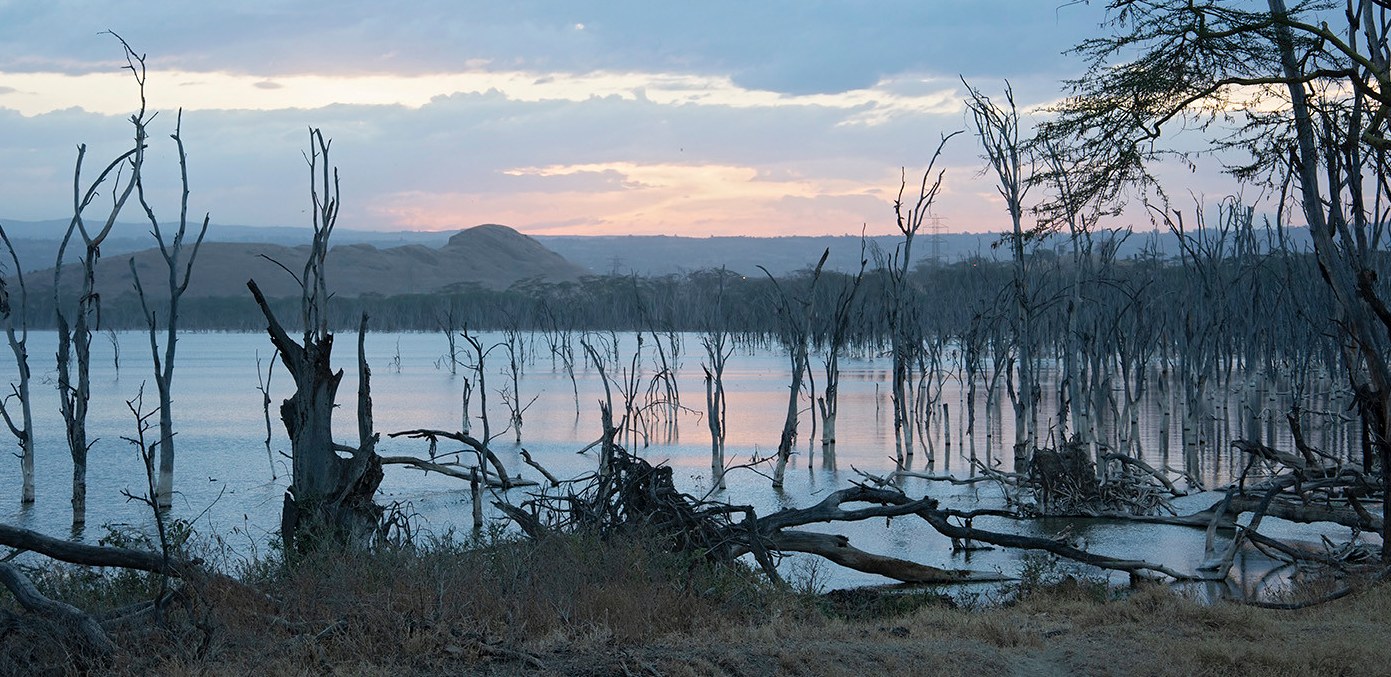
The flooding was not only an ecological event. Rising water submerged park infrastructure through 2020, including buildings at the main gate, and a published assessment found roughly 26.6 square kilometres of the park underwater. Roads on the lake margin were lost, some picnic sites and viewpoints became inaccessible, and lodges around the shoreline were affected.
Much of this has been worked around rather than reversed. Routes inside the park have been rerouted onto higher ground, and the drowned acacia and fever trees standing in open water are now a defining feature of the view from the escarpment. Visitors who last came before 2015 should expect a different shoreline.
The wider context sits on the Great Rift Valley page, because the rise happened across the whole chain of lakes at once and has a single regional explanation.
Viewpoints, Waterfalls and Where to Drive Inside the Park
The park’s set pieces are on the high ground. Baboon Cliff on the western escarpment gives the classic view down the length of the lake and is where most visitors stop. Out of Africa viewpoint further along the same escarpment road opens the wider panorama across the valley. Lion Hill on the eastern side is the counterpart at the other end of the day.
Makalia Falls, in the far south of the park, is the one genuine excursion inside the gates, a modest waterfall on a seasonal river that is worth the drive after rain and not much in the dry. The southern circuit that reaches it also passes the better grassland for white rhino and is the least crowded part of the park.
The lake shore road itself is the variable one. Its condition depends on where the water is, and the rangers at the gate give better current information than any map. Wildlife photography in Kenya covers the light and the working practicalities of a park this compact.
Getting to Lake Nakuru National Park and Which Gate to Use
The park lies about 160 kilometres northwest of Nairobi on the A104, a drive most vehicles do in two to three hours depending on traffic on the escarpment and through Naivasha. It is immediately beside the city of Nakuru, which is the practical base for anyone not staying inside the park.
There are three main gates. The Main Gate sits closest to Nakuru city and is the one most self-drivers and matatu-based travellers use. Lanet Gate, on the eastern side off the A104, is the more convenient entry for anyone arriving from Nairobi without going into town. Nderit Gate serves the south of the park and is the natural gate for anyone approaching from the Elementaita side or heading on towards Naivasha afterwards. Naishi airstrip inside the park takes charter flights, covered on fly-in safaris in Kenya.
Gates open at 6am and close at 6pm, and the Kenya Wildlife Service rule is that visitors vacate the park between those hours unless spending the night inside. Vehicles need to be roadworthy rather than specialist: the internal roads are graded murram and a saloon car manages the main circuits in dry weather, though the escarpment roads and the southern loop reward higher clearance.
Park Fees, Camping and What It Costs to Enter
Lake Nakuru sits in the premium band of the Kenya Wildlife Service conservation fee schedule, the same band as Amboseli and the most expensive in the system. On the schedule effective from 1 October 2025, published by the Kenya Wildlife Service and checked on 21 September 2026, park entry per person per day is KSh 1,500 for an East African citizen adult and KSh 750 for a child or student, KSh 2,025 and KSh 1,050 for a Kenya resident, USD 90 and USD 45 for a non-resident, and USD 50 and USD 25 for an African citizen.
Camping is charged separately per person per night, and premium parks carry their own rate: KSh 500 for an East African citizen adult at a special campsite and KSh 250 at a public campsite, with non-resident adults at USD 50 and USD 30 respectively. Special campsites also carry a non-refundable reservation fee of KSh 10,000 per week. Vehicle charges run from KSh 600 per day for a car with fewer than six seats up to KSh 5,000 for the largest buses.
Parking at Lake Nakuru is charged at KSh 1,000 for East African citizens and USD 30 for non-residents, and the Kenya Wildlife Service notes this does not apply to visitors holding paid park tickets. Fees are set by regulation and are revised periodically, so the current schedule is worth confirming before travelling.
Where to Stay and When to Visit Lake Nakuru
Accommodation splits cleanly. Inside the park are the Kenya Wildlife Service self-catering options at Naishi Guest House and Mbugani, a set of public and special campsites, and a handful of lodges including Sarova Lion Hill, Lake Nakuru Lodge, Lake Nakuru Sopa Lodge and Flamingo Hill Camp. Outside, the city of Nakuru has the full range from budget rooms near the matatu stage to business hotels, at a fraction of the in-park rates and ten minutes from the Main Gate.
Staying inside buys the early morning and the late afternoon, which is when the park is at its best and at its emptiest. Staying in the city buys everything else, including dinner options and a pharmacy.
For timing, the dry months of January to March and July to October give firm roads and concentrated game. The rains from mid-March to June and again in November make the murram heavy and the escarpment roads slippery, though the park is green and the birding is at its best with the Palearctic migrants present from about October to March. Midday is the weak part of any day here; the lake glare is harsh and the game is in shade.
Questions Visitors Ask About Lake Nakuru National Park
Are there still flamingos at Lake Nakuru?
Some, but not the vast flocks of the 1990s and 2000s. Kenya’s Ramsar Information Sheet for the lake records an average of 488,908 lesser flamingos across counts from 1999 to 2003 and states that with rising water levels those numbers have since moved to other Rift Valley lakes. Flamingos are still seen here, and they are no longer the main reason to visit.
Is one day enough for Lake Nakuru National Park?
Yes. At 188 square kilometres and fenced, the park is small enough to cover its main circuits, viewpoints and the southern loop in a single full day, and most visitors do exactly that. Two half days, one at dawn and one in the late afternoon, is the better version.
What is the chance of seeing rhino here?
High for white rhino, which graze in the open near the lake, and much lower for black rhino, which browse in thicket and are solitary. The fence keeps both species resident, so this is among the most reliable places in Kenya to see rhino at all.
Can the park be visited without a safari vehicle?
Yes. Internal roads are graded murram and a normal car handles the main circuits in dry conditions, though clearance helps on the escarpment and after rain. Vehicles must stay on the roads, and gates operate from 6am to 6pm.
Are there elephants at Lake Nakuru?
No. The park has no elephant population. It carries rhino, lion, leopard, buffalo, Rothschild’s giraffe and a long list of plains game, but anyone whose priority is elephant should plan a different park.
How far is Lake Nakuru from Nairobi?
About 160 kilometres northwest on the A104, typically two to three hours by road. The park adjoins the city of Nakuru, and Lanet Gate is the most convenient entry when arriving from the Nairobi direction.
Is Lake Nakuru a World Heritage site?
It is one of three components of a serial property. UNESCO inscribed the Kenya Lake System in the Great Rift Valley in 2011 under three natural criteria, covering Lake Bogoria, Lake Nakuru and Lake Elementaita, with the Lake Nakuru component recorded at 18,800 hectares.
Safaris That Visit Lake Nakuru National Park
3 of the 15 safaris listed here that visit Lake Nakuru National Park, from different operators where the listings allow it. Each is sold and run by an independent tour company. This site lists them and passes on enquiries; it takes no booking and charges you nothing.


7 Days Wildlife Safari in Kenya
by Kori Safaris Verified operator
Operator quotes on request
View Safari

7 Day Safari Kenya
by Insight Safari Holidays Verified operator
Operator quotes on request
View Safari

7 Days Kenya Safari
by Tranquil Safaris Verified operator
Operator quotes on request
View Safari