Lake Bogoria National Reserve
Lake Bogoria is the Rift Valley lake that boils. A line of geysers and hot springs vents along its western shore, steam drifts across water the colour of gunmetal, and the escarpment rises straight out of the far side. It is the least developed of the three World Heritage lakes, the most geologically dramatic, and the only one where the main hazard is the ground itself.
What Lake Bogoria National Reserve Is
The reserve’s own management plan records the legal position precisely: Lake Bogoria National Reserve was gazetted as a wildlife protected area by legal notice number 270 of 1 November 1970, with a boundary delineating a total area of 107 square kilometres. It lies in Baringo County, about ten kilometres north of the Equator, with the lake shore at around 970 metres and the Siracho escarpment rising to about 1,650 metres above it.
Unlike Lake Nakuru and Lake Elementaita, Bogoria is not a Kenya Wildlife Service park. Management passed to the Baringo County Government under devolution, and the reserve’s current ten-year management plan was approved by the county in October 2020 and endorsed jointly by the Endorois community and the Director General of the Kenya Wildlife Service.
The lake carries three international designations. It was listed as Ramsar site number 1097 on 27 August 2001, recognised as Important Bird Area KE 045 the same year, and inscribed in 2011 as one of three components of the UNESCO World Heritage property known as the Kenya Lake System in the Great Rift Valley. All three boundaries are the same 10,700 hectares, because the Ramsar Information Sheet records that the wetland site covers the entire national reserve. That sheet also states directly that the site is managed by the Baringo County Government.
The Geysers and Hot Springs of Lake Bogoria
The springs are the reason most people come. The management plan describes three main clusters: Loburu, Chemurkeu, and the Mwanasis, Kibwu and Losaramat group in the south. Loburu and Chemurkeu draw on a shallow aquifer at around 100 degrees Celsius; the southern springs draw on a deeper one at around 170. All are alkaline, with a pH above 8.
Loburu is the cluster on the visitor route, a stretch of shoreline where boiling water jets into the air, pools bubble at the lake edge and the ground steams underfoot. Marked trails run through it. Eggs are traditionally boiled in the springs by guides, which is a small thing and tells visitors most of what they need to know about the temperature.
Expectations need adjusting, though, and this is the detail most published copy about Bogoria has missed. The lake rose along with the rest of the Rift, and Kenya’s Ramsar Information Sheet for the site, updated in May 2024, records that the rise increased the lake’s coverage by 24.32 per cent between 2010 and 2020 and that the floods “submerged the hot springs and suppressed most of the geysers”, affecting both the habitat and the site’s value to visitors. Steam, boiling pools and venting shoreline remain; the tall, reliable geyser jets of the older photographs do not, and how much is visible depends on where the water is standing when you arrive.
The reserve’s management plan records that the hot springs have caused serious accidents, some of them fatal, and identifies overcrowding at the site as a safety risk. The crust near the vents is thin, the water is at boiling point and there is no barrier between a visitor and either. Stay on the marked trails and keep well back from the jets.
The geothermal system also makes Bogoria scientifically important in a way few visitors expect. Extremophile microorganisms living in the springs have been a subject of sustained research, and the reserve’s planning process was funded through a project developing microbial biotechnology from Kenya’s soda lakes.
Flamingos at Lake Bogoria and Where the Flocks Are Now
Bogoria’s reputation rests on lesser flamingos, and its management plan lists the world’s largest congregations of them among the reserve’s exceptional resource values. The lake’s alkaline water grows the blue-green algae the birds filter-feed on, its shoreline configuration suits them, and freshwater seeps along the margin give them somewhere to drink and bathe.
The Ramsar sheet explains why that mattered so much regionally. Unlike the other soda lakes, Bogoria’s depth fluctuations are normally minimal, so when drought or flooding made neighbouring lakes unusable it was the one that kept enough water and enough algae to hold the regional population, taking in thousands and occasionally millions of birds. It was the system’s shock absorber.
That reputation is still broadly deserved and the numbers have fallen hard. Through the 2010s, as Lake Nakuru rose and diluted, Bogoria became the more dependable of the flamingo lakes. Then Bogoria rose too, by about five metres according to the 2021 Kenyan government report on the Rift lakes. Kenya’s National Wildlife Census figures show waterbird numbers at Bogoria peaking at 54,711 in 2024 and falling to 21,903 in 2025.
A joint Kenya Wildlife Service, National Museums of Kenya and Nature Kenya count on 18 July 2026 found raised water and reduced alkalinity at Nakuru, Elementaita and Bogoria alike, with the large lesser flamingo concentrations that day at Lake Logipi in the far north instead. The practical position for a traveller is that Bogoria remains the most reliable of the three World Heritage lakes for flamingos, the flocks are a fraction of what they were, and no lake in this chain can be promised in advance.
The birding is strong regardless. The management plan records as many as 370 species at Lake Bogoria, including 13 globally threatened and 8 regionally threatened species. Birdwatching in Kenya covers the wider circuit.
Greater Kudu and the Reserve’s Wildlife
Bogoria is the best place in Kenya to see greater kudu, and the species was among the reasons the reserve was created. The acacia woodland and thicket along the shoreline fringe and up the escarpment is exactly their habitat, and the steep rocky ground keeps them there. Bulls carry the long spiral horns; the animals are shy and most often seen early or late on the slopes.
The reserve’s own plan is candid about how little is known: it notes that greater kudu numbers and movement patterns within the reserve are not well established, that Kenya has no national conservation strategy for the species, and that developing one is a priority action. That honesty is worth more than a confident figure.
Beyond kudu, the reserve carries zebra, impala, dik-dik, klipspringer, warthog, olive baboon and caracal, with leopard and spotted hyena present. It is a small, ecologically isolated reserve, and the plan identifies that isolation as a structural conservation problem: at 107 square kilometres the terrestrial component cannot support viable populations of many species that would naturally occur there.
The Endorois and the Land Around Lake Bogoria
Lake Bogoria is Endorois land, and the relationship is central rather than decorative. The Endorois are a pastoralist community who grazed the lowlands around the lake in the rains and moved to the Mochongoi forest in the dry season. The reserve’s management plan states that the lake is the centre of the community’s religious and traditional practice, that prayer sites, circumcision rituals and other ceremonies were held around it, and that the community believes all departed Endorois live in Lake Bogoria regardless of where they are buried.
The community was moved off this land when the reserve was created. The current management plan, unusually among Kenyan protected area plans, was developed with the Endorois Welfare Council as a member of the core planning team and was endorsed by the chairman of the Endorois community alongside the county and the Kenya Wildlife Service. A bio-cultural protocol was developed through the same process.
Visitors interested in this history should engage with it through the community rather than around it. Cultural tours in Kenya sets out how community-led visits work.
Getting to Lake Bogoria and the Reserve’s Gates
The reserve’s management plan gives the access clearly. There are four gates: Loboi, Maji Moto, Nyalilpuch and Emsos. The main approach is along the Nakuru to Marigat road, where a junction to the right three kilometres before Marigat town leads to the reserve, with Loboi Gate 20 kilometres from that junction. Loboi also serves as reserve headquarters. An earth road branching right near Mogotio, 36 kilometres from Nakuru town, reaches the other gates.
Most visitors come from Nakuru, roughly two hours south, or combine Bogoria with Lake Baringo, which is a short drive further north. The two lakes are almost always done together and they are completely different: one is hot, saline and geothermal, the other freshwater with boats and hippos.
Internal roads are rough. The shoreline track to the springs is corrugated and stony, and higher clearance makes a real difference. There is no fuel inside the reserve and limited shade.
Reserve Fees, Camping and Practicalities
Because Bogoria is a county reserve rather than a Kenya Wildlife Service park, the national conservation fee schedule does not apply to it and any page quoting a Kenya Wildlife Service band for this lake is quoting the wrong document. Fees are set by the Baringo County Government.
The reserve’s own site, checked on 21 September 2026, publishes entry at KSh 500 for a citizen adult and USD 50 for a non-resident adult, with children aged three to seventeen at KSh 215 or USD 20 and infants free, all charged per person per 24 hours. Vehicle and camping charges are set separately by the county and are best confirmed at the gate, since the published figures for those vary between sources and no effective date or legal notice is cited alongside them.
Campsites are operated by the reserve, including one located outside the boundary near the Nyalilpuch outpost. Accommodation otherwise sits outside the reserve, at Loboi and around Marigat, with more choice at Lake Baringo. Most visitors treat Bogoria as a half-day stop rather than a base.
When to Visit Lake Bogoria
The dry months, January to March and July to October, give the firmest roads and the clearest air. This is a low, hot part of the valley at under a thousand metres, so the middle of the day is genuinely unpleasant at the springs, where the ground heat adds to the air temperature. Early morning is better for the light on the escarpment, for kudu on the slopes, and for standing next to boiling water.
Rain changes the internal roads quickly and can make the shoreline track difficult. It also raises the lake, which has repeatedly submerged parts of the shore including areas south of the Loburu springs.
Questions Visitors Ask About Lake Bogoria
Are there flamingos at Lake Bogoria right now?
Usually some, and rarely the millions of the past. Bogoria remains the most dependable of the World Heritage lakes for lesser flamingos, but counts fell from 54,711 waterbirds in 2024 to 21,903 in 2025 as rising water diluted the lake. Numbers move between lakes without warning.
Can you swim or bathe at the hot springs?
No. The springs at Loburu are at or near boiling point, the crust around the vents is thin and the reserve’s own management plan records fatal accidents at the site. Marked trails exist for a reason and the water is not for bathing.
Are the geysers still erupting?
Partly. The Ramsar Information Sheet for the site records that rising water through the 2010s submerged the hot springs and suppressed most of the geysers. Steam, boiling pools and venting shoreline are still there, and the tall jets shown in older photographs are not reliable.
Does the Kenya Wildlife Service run Lake Bogoria?
No. The reserve is managed by the Baringo County Government, which sets its own fees. The Kenya Wildlife Service endorsed the current management plan and provides technical support, but the national park fee schedule does not apply here.
How long does a visit to Lake Bogoria take?
Half a day covers the drive along the shoreline, the geyser field at Loburu and time to look for kudu on the escarpment. Most itineraries pair it with Lake Baringo, staying at Baringo and visiting Bogoria as an excursion.
What wildlife is Lake Bogoria known for besides birds?
Greater kudu above all. The thicket and escarpment habitat suits them and the reserve was created partly to protect them. Zebra, impala, dik-dik, klipspringer, warthog and baboon are routine, with leopard and hyena present but seldom seen.
Is Lake Bogoria a World Heritage site?
It is one of three components of one. UNESCO inscribed the Kenya Lake System in the Great Rift Valley in 2011, covering Bogoria, Nakuru and Elementaita, with the Bogoria component recorded at 10,700 hectares.
Safaris That Visit Lake Bogoria National Reserve
Every safari listed here that visits Lake Bogoria National Reserve. Each is sold and run by an independent tour company. This site lists them and passes on enquiries; it takes no booking and charges you nothing.


7 Day Safari Kenya
by Insight Safari Holidays
Operator quotes on request
View Safari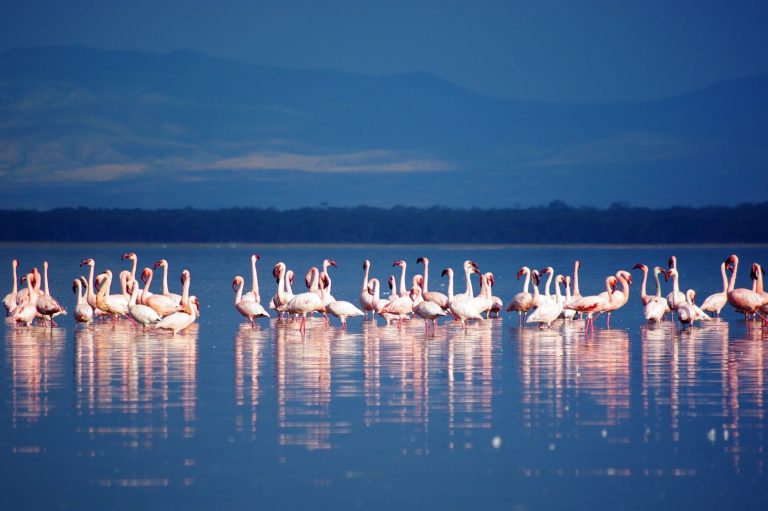

10 Day Kenya Birding Safari
by Wild Whispers Africa
Operator quotes on request
View Safari