
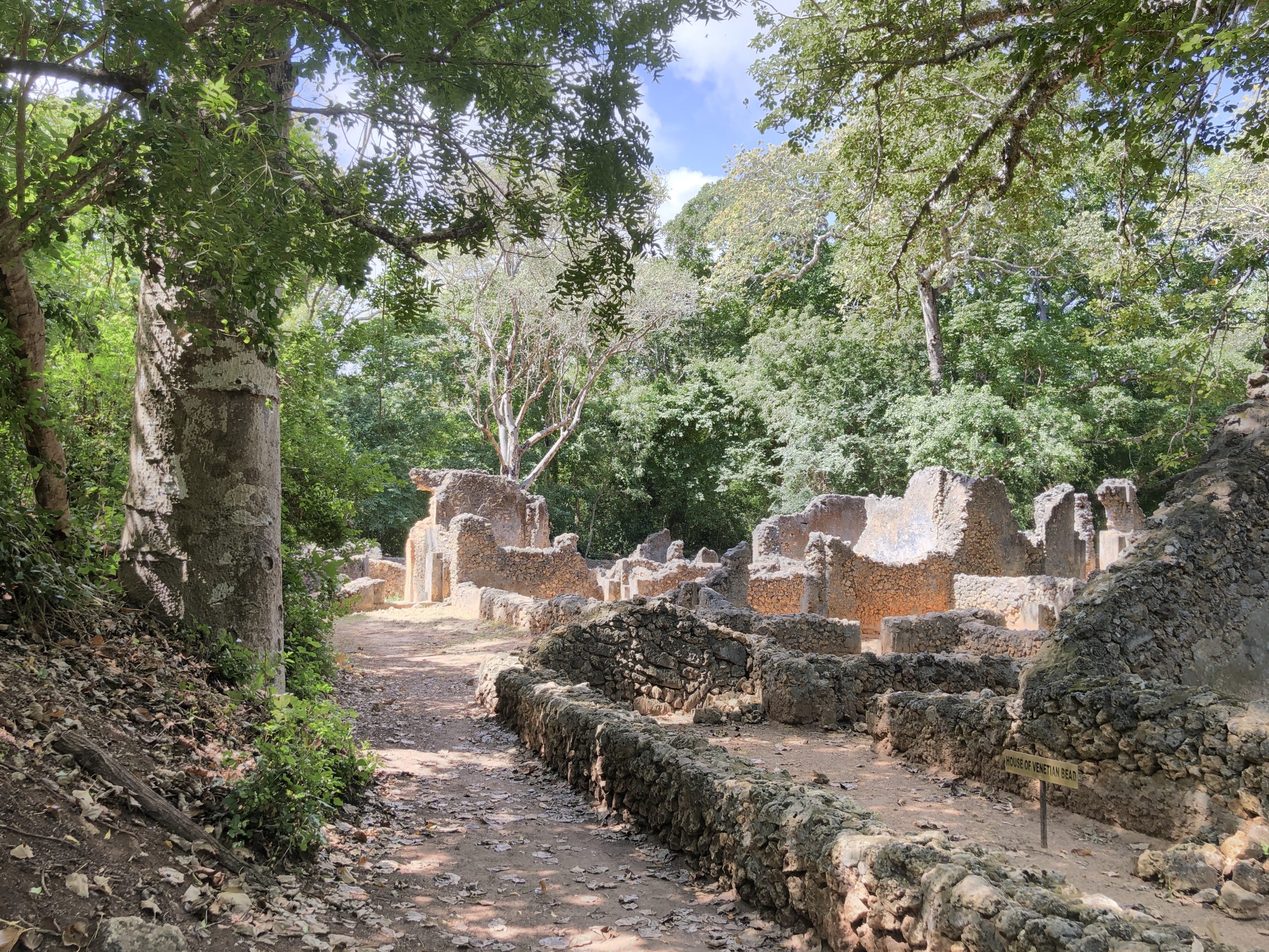
Gedi Ruins
Gedi is an abandoned Swahili town standing in a patch of coastal forest six and a half kilometres inland from the Indian Ocean, between Watamu and Malindi. In July 2024 it was inscribed on the UNESCO World Heritage List as The Historic Town and Archaeological Site of Gedi, and it is the most complete picture anywhere of how a Swahili city was actually laid out.
The inscription came at the 46th session of the World Heritage Committee in New Delhi, under cultural criteria two, three and four, with a property of 20.81 hectares and a buffer zone of 22.61 hectares. It made Gedi Kenya’s eighth World Heritage property. Much published material about the site predates that decision and still describes Gedi as unlisted.
Why an Abandoned Town Tells More Than a Living One
Every other Swahili town of comparable importance on this coast is still inhabited. Lamu, Mombasa, Malindi and Pate were built over, repaired and subdivided, so their medieval fabric survives in fragments under five centuries of later life.
Gedi was left. The last families went in the first half of the seventeenth century and nobody moved back in. The street grid, the drains, the house plots, the sunken courts, the wells and the two rings of wall stayed where they were and the forest grew over them. UNESCO’s assessment leans on exactly this: the abandonment and lack of subsequent occupation are what give the site its unusually high authenticity, with the remains in their original positions rather than under later floors.
The practical effect is that Gedi reads as a town rather than as a ruin. Walking it, the logic of where the wealthy lived, where everyone else lived, where the water came from and how the place was defended is legible on the ground in a way it is not at a site that never stopped being used.
How Old Gedi Is, and Where the Sources Disagree
This is worth stating plainly, because the two most authoritative sources give different answers and most travel writing quietly picks one.
UNESCO’s statement of Outstanding Universal Value describes Gedi as one of the most important and densely populated Swahili cities on the East African coast from the tenth to the seventeenth centuries. The National Museums of Kenya, which manages the site, says on its own Gede Museum page that the town traces its origin to the twelfth century and was rebuilt with new walls in the fifteenth and sixteenth centuries.
Both readings come from bodies with direct authority over the site, and the difference is a genuine open question about the earliest phase rather than an error by either. The peak is not in dispute: UNESCO singles out the fifteenth to seventeenth centuries, and the National Museums account puts the town at its height in the fifteenth. Anyone quoting one founding date for Gedi is choosing a side without saying so.
The Walls, the Streets and the Two Gedis
Gedi is defined by two rings of wall that wander with the ground rather than running in neat circles. Inside the inner wall sits the wealthy town: domestic, civic and religious buildings in coral stone and lime mortar, on a grid of streets and alleys. Between the inner and outer walls are the remains of far more modest housing, where the majority lived.
That division is the most informative thing on the site. Swahili towns are often written about as uniformly prosperous trading ports; the archaeology at Gedi shows a sharply stratified settlement, with the stone architecture and the imported goods concentrated in a small inner precinct.
The Great Mosque, the Palace and the Tombs
The Grand Mosque and the palace complex are the set pieces, both inside the inner wall, both coral rag with earth and lime mortar, both carrying carved decoration.
The tombs are where Gedi becomes unmistakably itself. Pillar tombs, a form particular to this coast, stand among the houses, and both tombs and mosques were embellished with carving and inset with Chinese porcelain. Setting imported glazed ceramic into a grave marker is a direct statement about where a family’s standing came from.
Excavation has produced luxury goods from China, Persia, India and Venice. They arrived through a trade running the other way in gold, ivory, timber, other minerals and enslaved people, and the UNESCO assessment names that last export alongside the rest rather than leaving it out.
The Water System Most Visitors Walk Straight Past
Gedi had no river and no spring. It ran on wells and on a water engineering system sophisticated enough that UNESCO cites it in two of the three criteria, and it is still readable on the ground in sumps, drains and the wells themselves.
Why Gedi Was Abandoned
No single cause is settled, and the National Museums of Kenya sets out several that overlap in the late sixteenth and early seventeenth centuries.
- The Wazimba raid along the East African coast in 1589.
- The removal of the Sheikh of Malindi and the Portuguese to Mombasa in 1593, which shifted the region’s commercial centre of gravity away from this stretch of coast.
- A falling water table, shown by the deepening of the Great Mosque well.
- Sustained pressure from the Galla, a nomadic group moving down from the north.
The honest answer is that a town under all four at once did not need a single catastrophe to empty.
The Forest Around the Ruins
Gedi sits in a remnant of the same coastal forest that survives on a much larger scale at Arabuko Sokoke, protected as part of the World Heritage buffer zone with Kenya Forest Service support. Baobabs and tamarinds stand over the walls, Sykes’s monkeys work the canopy, and the golden-rumped sengi is occasionally seen on the paths.
Guides sometimes offer to bring the monkeys down with bananas bought at the roadside. It is better declined: feeding habituates wild animals to people, the monkeys scratch, and it is the one part of a Gedi visit with nothing to do with why the place is protected.
The forest is not only scenery. The National Museums of Kenya records that the indigenous forest at Gede is a sacred site used for traditional rituals and sacrifices by the surrounding community. Visitors share the ground with a living practice: stay on the paths, ask before photographing any gathering, and treat an area a guide steers you away from as closed.
Visiting Gedi Ruins
The site is signposted from the Gede junction on the Mombasa to Malindi highway, the same turning used for Watamu, which is why the ruins and the beach are so often done on one day. The National Museums of Kenya gives the distances as about 16 kilometres south of Malindi and roughly 90 kilometres north-east of Mombasa.
A small museum at the entrance holds excavated material including trade goods, and a raised platform gives a view over the walls from above the canopy. Guides wait at the gate and are not included in admission. Taking one is the difference between a walk in a wood and an explanation of what the wood contains, because very little here is labelled in detail. The forest entrance and Mida Creek are both minutes away, so an early forest start, Gedi at midday and the creek on a falling tide makes a full day.
Admission is set by the National Museums of Kenya under the National Museums and Heritage (Admissions Fees) Regulations 2025, Legal Notice No. 79 of 2025, with revised rates effective from 7 May 2026. For Gede Ruins, as the notice styles it, the charge is KSh 200 for a Kenya and East African citizen adult and KSh 100 for a child, USD 6 and USD 3 for residents and visitors from the rest of Africa, and USD 8 and USD 4 for visitors from outside Africa. Those figures were checked on 21 September 2026.
Two things about that tariff are worth knowing before arriving. Ticketing is eCitizen only, through the National Museums payment portal; the site does not take cash, and this catches out visitors who arrive at a rural gate in Kilifi County expecting to pay at a window. And the fee is the standard heritage-site band, shared with Kariandusi, Olorgesailie, Thimlich Ohinga, Jumba, Takwa and Mnarani. World Heritage inscription did not change what it costs to walk in. On hours, the fee notice gives 08:30 to 17:30, Monday to Sunday including public holidays, as a general rule across National Museums facilities. Gede’s own National Museums page publishes no hours at all, and elsewhere in the estate individual site pages contradict the general rule, some closing earlier and at weekends. Telephone the Gede curator before committing to a long drive.
Allow an hour and a half for the ruins and the museum, longer with a guide willing to go slowly.
Gedi is one of a chain of Swahili sites on this coast that includes Mnarani to the south, Jumba la Mtwana beyond it and Takwa far to the north. The archaeological tours guide sets out how they are visited and in what order they make sense.
Questions Travellers Ask About Gedi Ruins
When was Gedi made a World Heritage Site?
In July 2024, at the 46th session of the World Heritage Committee in New Delhi, under criteria two, three and four. The property covers 20.81 hectares with a 22.61 hectare buffer zone, and the listing made Gedi Kenya’s eighth World Heritage property. The site had already been under legal protection since 1927 and is a National Monument under the National Museums and Heritage Act of 2006.
How old are the ruins exactly?
The sources differ on the beginning. UNESCO dates the town from the tenth century; the National Museums of Kenya traces its origin to the twelfth. Both agree the surviving walls largely date from a rebuilding in the fifteenth and sixteenth centuries, that the town peaked in the fifteenth to seventeenth centuries, and that the last families left in the first half of the seventeenth.
How long does a visit take, and is a guide necessary?
About ninety minutes covers the ruins and the small museum at a reasonable pace, longer with a guide. A guide is not required but is strongly worth it: interpretation on site is limited, the guides know which house is which and what was found in it, and admission does not include the service. Agree that fee separately before starting.
Is Gedi the same place as Gede?
Yes. Gede is the spelling of the surrounding village, of the National Museums station there and of the admission notice; Gedi is the spelling used in the World Heritage inscription. One site, two spellings.
4 Places to Visit in This Area
Other sites in Watamu, each with its own guide.
No operator on the marketplace currently lists a safari to Watamu.
See every Kenya safari