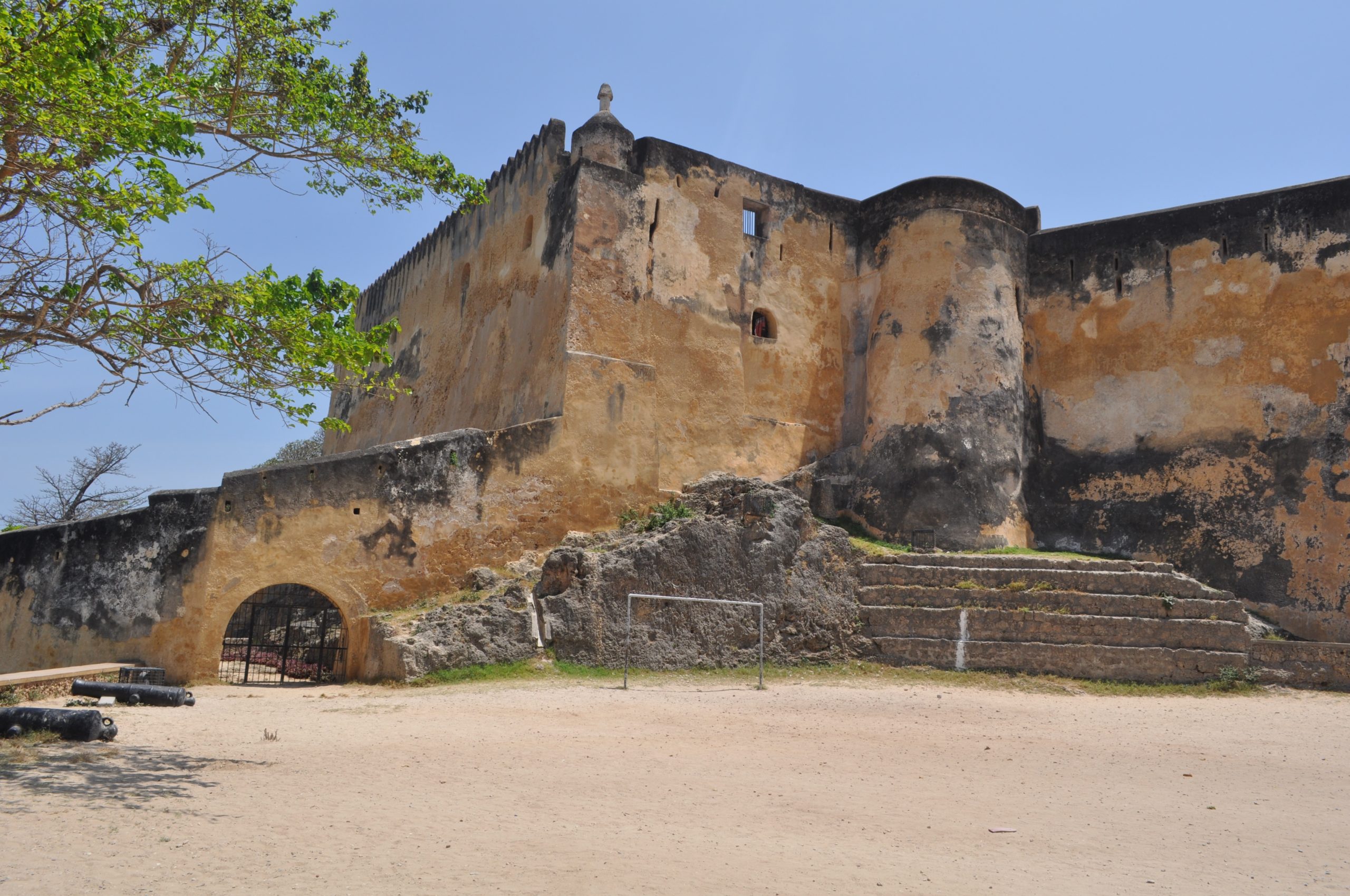
Fort Jesus
Fort Jesus is the reason Mombasa looks the way it does. A Portuguese fortress thrown up on a coral spur at the harbour mouth in the 1590s, it was fought over for three centuries by Portuguese, Swahili, Omani, Mazrui and British forces, and it is now one of Kenya’s eight UNESCO World Heritage properties. It is the most visited heritage site on the Kenyan coast.
What Fort Jesus Is and Why It Is a World Heritage Site
UNESCO inscribed Fort Jesus on the World Heritage List in 2011, under cultural criteria (ii) and (iv). The inscribed property is small: 2.36 hectares, taking in the fort itself, its moat, the immediate surroundings and the underwater archaeology in the sea directly in front of it. The buffer zone is 31 hectares, and the buffer zone is Mombasa Old Town, which is why the two sites are always visited together and why the Old Town has building rules that other Mombasa neighbourhoods do not.
Criterion (iv) recognises the fort as an outstanding example of the new kind of fortification that emerged from advances in artillery: low, angled, bastioned, built to absorb and deflect cannon fire rather than to tower over an attacker. Criterion (ii) recognises something less obvious. Because the fort changed hands repeatedly, it carries the physical traces of everyone who held it, and UNESCO names peoples of African, Arab, Turkish, Persian and European origin in the same sentence. This is not a Portuguese monument. It is a Portuguese building that four other powers rebuilt to suit themselves.
The Portuguese Fort, 1593 to 1698
Construction began in 1593 and the main work was finished by 1596, to designs by the Italian military engineer Giovanni Battista Cairati. The commission came from Goa: after Ottoman forces attacked the Portuguese at Mombasa in 1585, the Viceroy ordered a captain to build a fort here and to name it Jesus of Mombasa. The Portuguese on this coast understood themselves as agents of Christendom rather than of Portugal, sailing under the flag of the Order of Christ, which is how a harbour defence came to be named after Christ himself.
The plan is the thing to look at. A central court with bastions at the four corners, named São Filipe, São Alberto, São Matias and São Mateus, plus a rectangular gun platform projecting seaward over the channel. UNESCO’s citation notes that the proportions follow the Renaissance conviction that perfect proportion and geometric harmony are found in the human body, which is why visitors are so often told the fort is shaped like a man. Inside were a chapel, a cistern, a well and the captain’s house. All of that except the cistern was destroyed during the eighteenth century and survives as ruins.
It was not a quiet century. In 1631 the Sultan of Mombasa stabbed the Portuguese captain and took the fort; the Portuguese failed to retake it by force, and in 1632 the sultan abandoned it and they walked back in. That prompted a rebuilding between 1634 and 1639: landward curtain walls, raised bastion floors, wider gun ports, and an outer gate reached by a covered passage. The Sultan of Oman sacked the town of Mombasa in 1661 but did not risk the fort.
The Great Siege of 1696 to 1698
Omani raids on Portuguese possessions along this coast began in 1652, and by 1678 Fort Jesus was the last Portuguese stronghold on the northern part of the East African coast. In 1696 the Sultan of Oman laid siege to it. The siege lasted thirty-three months and it is the event that defines the fort’s history.
What killed the garrison was not the bombardment. Plague and starvation ran through the defenders through 1697, relief fleets from Goa arrived too late or not at all, and the fort finally fell to Omani forces in December 1698. The Portuguese came back once more, in 1728, when the garrison mutinied against its Omani masters, but they held it for only about eighteen months before the Omanis retook it in 1729. After that the Portuguese left the fort for good, and Portuguese power on this coast was finished.
One artefact of the siege is visible in the museum. The Santo Antonio de Tanna, a forty-two gun Portuguese frigate sent to relieve the fort, was bombarded and sunk by Omani forces at the entrance to the old port in 1698. It was excavated between 1977 and 1980 and the recovered material is displayed inside the fort, which makes Fort Jesus one of very few places where a shipwreck and the siege it failed to break can be seen in the same visit.
Omani, Mazrui and British Mombasa
The period after 1698 is the part most visitors are never told, and it is where the fort stops being a European story. In 1741 the Omani governor of the fort, al-Mazrui, declared independence from Oman, founding a dynasty that ran Mombasa as its own power. He was murdered by an Omani agent in 1746, whereupon his brother killed the assassin and took over.
The Mazrui held on for the best part of a century. In 1824 a Mazrui governor sought and obtained British protection; Britain withdrew it in 1826. Seyyid Said, Sultan of Oman and Zanzibar, regained the fort in 1828, Mazrui forces inside it withstood his bombardment in 1833, and the last Mazrui governor submitted to the Sultan in 1837. From then until 1895 the fort served as barracks, and British ships bombarded it in 1875 to put down a mutiny.
When the British protectorate was proclaimed on 1 July 1895 the fort became a government prison, and stayed one until 1958. The huts inside were cleared and cells were built. Its rescue came on 24 October 1958, when it was gazetted a national park; excavation followed, the fort opened to the public in 1960, it became a museum in 1962 with a grant from the Gulbenkian Foundation, and it was regazetted as a national monument in 1970. It now sits under the National Museums and Heritage Act 2006.
What There Is to See Inside
Allow two hours. The walls, the moat and the bastions are the architecture; the ramparts give the view over the channel and the Old Town; the Omani house in the northern corner, the cistern, the ruined captain’s house and the Portuguese inscriptions on the plaster are the fabric. Coral stone and lime mortar are still used traditionally for repairs, part of why the property was judged authentic.
The museum galleries hold excavated material not only from the fort but from Gedi, Manda and Ungwana, so this is effectively the interpretive centre for the whole Swahili coast. Among the ordnance the nomination dossier records 2,659 solid cannon balls, 50 hollow and 54 stone, alongside a bronze swivel gun dated 1677 recovered from the Santo Antonio de Tanna and later Scottish carronades. There is also a small permanent exhibition on the Sacred Mijikenda Kaya Forests here, which is the only museum treatment those sites get.
The fort was built to be walked, not to be level. Surfaces are uneven coral rag, there are steps and ramps without handrails, and the seaward side drops hard. Sensible shoes matter more here than at any other Mombasa sight.
Visiting Fort Jesus
The fort is on the southeastern edge of Mombasa Island, at the top of Ndia Kuu, and opens daily including weekends and public holidays. The fort’s own listing gives 8am to 6pm; the 2026 fees notice gives general museum hours of 8.30am to 5.30pm. The two do not agree, so confirm which applies before building a day around either.
Admission is set by statute, not by the museum. The National Museums and Heritage (Admissions Fees) Regulations 2025, gazetted as Legal Notice 79 of 2025 and effective from 7 May 2026, price Fort Jesus as follows, per person, adult and child, checked on 21 September 2026.
| Ticket | Kenyan and East African (KSh) | Residents and rest of Africa (USD) | Outside Africa (USD) |
|---|---|---|---|
| Fort Jesus | 550 / 300 | 9 / 6 | 17 / 8 |
| Fort Jesus and Butterfly House | 650 / 400 | 12 / 7 | 19 / 9 |
Ticketing is through eCitizen only and no cash is taken at the gate, so arrange payment before you arrive. An older and much lower schedule is still hosted on the museums’ own site and still turns up in search; it has been superseded by the 2026 notice.
Guides work the entrance and are worth taking, because the fort is four centuries of rebuilding and almost none of it is self-explanatory. Agree the fee and what it covers first. A weekly sound and light show runs in the evenings, and the courtyard hosts art exhibitions and Swahili cultural events, so this is a working venue as well as a monument.
Fort Jesus and the Old Town are done together in half a day on foot. Heritage tours in Kenya covers the wider coastal circuit, and the Mombasa guide has the city logistics.
Fort Jesus Questions
How long does a visit to Fort Jesus take?
Two hours covers the walls, the bastions and the museum galleries at a reasonable pace. An hour is enough if you only want the fort itself and the view from the ramparts.
Is Fort Jesus a UNESCO World Heritage Site?
Yes. It was inscribed in 2011 under criteria (ii) and (iv), and is one of Kenya’s eight World Heritage properties. Mombasa Old Town is its buffer zone rather than a separately listed site.
Who built Fort Jesus and who ended up with it?
The Portuguese built it between 1593 and 1596 to designs by Giovanni Battista Cairati. Omani forces took it in 1698 after a thirty-three month siege, the Mazrui ran it as an independent power from 1741, the Sultan of Zanzibar recovered it in 1837, and the British used it as a prison from 1895 to 1958.
Is there a shipwreck at Fort Jesus?
The Santo Antonio de Tanna, a Portuguese relief frigate sunk by Omani forces at the old port entrance in 1698, was excavated between 1977 and 1980. Material recovered from it is displayed in the museum, and the underwater site lies within the inscribed property boundary.
5 Places to Visit in This Area
Other sites in Mombasa, each with its own guide.
Safaris That Visit Mombasa
Every safari listed here that visits Mombasa. Each is sold and run by an independent tour company. This site lists them and passes on enquiries; it takes no booking and charges you nothing.
Open the full Mombasa listing