
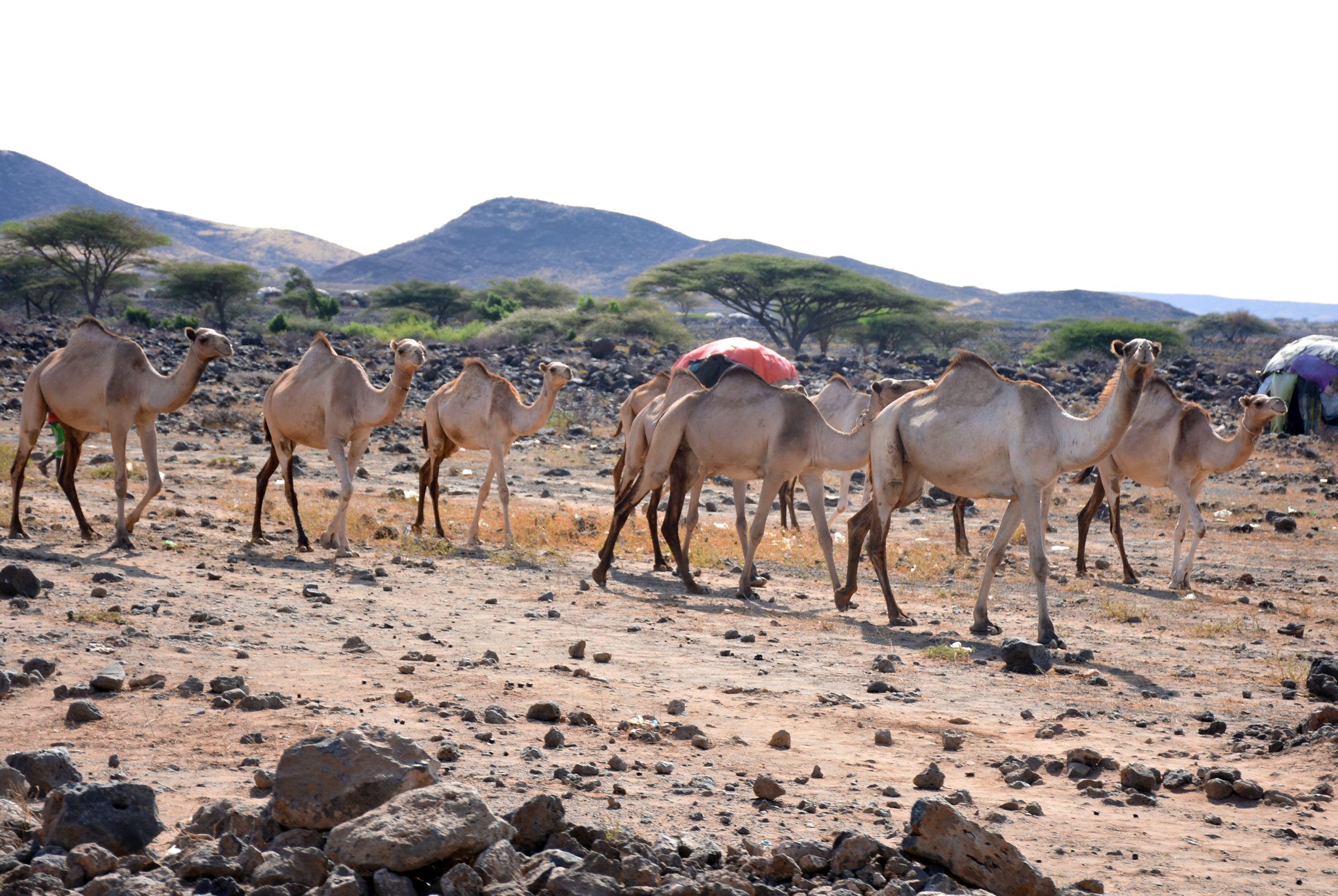
Marsabit National Park
Marsabit is a forested mountain standing alone in a desert. The park and reserve cover an extinct volcano whose upper slopes catch enough mist to hold a closed-canopy forest, three crater lakes and a population of elephants, in country that a few kilometres away supports almost nothing. The change from thorn scrub to dripping juniper happens over the space of a morning’s drive, and it is the whole point of the place.
The town of Marsabit sits on the same mountain, on the tarmac road that runs north from Isiolo to the Ethiopian border. That makes this the most reachable of Kenya’s far northern destinations and the natural staging post for anything further out.
The Mountain and the Mist Forest
Kenya’s nomination of the property for the World Heritage tentative list, submitted by the National Museums of Kenya in 2023 under natural criterion (x), describes an extinct Holocene shield volcano rising almost a kilometre above the surrounding arid plains. The park sits at 1,703 metres above sea level and the summit reaches 1,865 metres, while the plains around it lie between 300 and 900 metres. The volcano covers roughly 210,000 hectares and is elliptical, about 45 kilometres across from north-west to south-east and 70 kilometres from north-east to south-west.
That height is enough to change the weather completely. The nomination records temperatures between 6 and 26 degrees Celsius and annual rainfall between 600 and 900 millimetres, falling in long rains from March to May and short rains from October to December, against arid and semi-arid conditions all around. Juniper and wild olive clothe the slopes, with bamboo and moorland higher up and acacia woodland below. The forest is fed as much by condensation out of the cloud that sits on the mountain as by rain, which is why it is usually described as a mist forest.
The Craters and Lake Paradise
The mountain is pocked with volcanic craters, known locally as gofs, and three of them hold water: Lake Paradise, Lake Marsabit and Lake Horr. The Kenya Tourism Board records these as the only permanent surface water in the region, which explains why so much wildlife concentrates on a mountain that looks, from the plains, like an unpromising lump of forest.
Lake Paradise is the one everybody comes for, a still sheet of water inside a steep wooded crater, and it owes its name to the American film-makers Osa and Martin Johnson, who set out for East Africa in 1921, stumbled on the crater and gave the lake the name in the memoir Osa Johnson later wrote about the journey. There is a campsite deep inside the crater. Kenya Wildlife Service calls the lake the park’s most scenic and a popular filming location, and both descriptions are earned.
Ahmed and the Big-Tusked Bulls
Marsabit’s reputation rests on elephants with exceptional ivory, and on one elephant in particular. Ahmed was born in 1919 on Mount Marsabit and grew into the best-known elephant on the continent. In 1970, to protect him from poachers, President Jomo Kenyatta placed him under protection by presidential decree, an unparalleled step in Kenya and the only occasion an elephant has been declared a living monument. Two game warders watched him day and night.
He was found dead in 1974, aged 55, leaning against a tree and resting on his tusks. Those tusks, long assumed to be of record size, weighed 67.2 kilograms each. A mounted exhibit stands today at the National Museum in Nairobi. One of the park gates carries his name.
The park remains a refuge for big-tusked bulls, and that is the realistic expectation: not numbers, but occasional encounters with animals carrying ivory of a kind that has become rare across Africa.
Wildlife and Birds
The tentative list nomination gives population figures for the park and reserve of approximately 550 elephants, 3,000 buffalo and 800 greater kudu, notes that elephant and buffalo numbers have held steady across the previous decade, and records a 30 per cent decline in greater kudu attributed to drought and habitat loss. African wild dog, Beisa oryx and Grevy’s zebra are all present, and Kenya Wildlife Service also names leopard and reticulated giraffe among the sightings.
Birdlife is the quieter strength. The nomination puts the list at over 250 species, including 14 globally threatened ones, among them Egyptian vulture and hooded vulture, with flamingos breeding seasonally at Lake Paradise. Forest walking here is a real option rather than a token one, and the wider subject sits under forest walks in Kenya and birdwatching in Kenya.
Kenya Wildlife Service also promotes Marsabit for astro tourism and night wildlife safaris, on the strength of the expansive night skies and minimal light pollution. See stargazing in Kenya for what that involves and night game drives for how the published tariff works.
Park Fees at Marsabit
Marsabit sits in the Kenya Wildlife Service Special Interest band. Entry is per person per day.
| Category | East African citizen (KSh) | Kenya resident (KSh) | Non-resident (USD) |
|---|---|---|---|
| Adult | 500 | 675 | 40 |
| Child or student | 250 | 350 | 20 |
African citizens from outside East Africa pay USD 20 for an adult and USD 10 for a child. Camping at a public campsite is KSh 200 per night for an East African citizen adult and USD 20 for a non-resident adult; special campsites cost more and carry a non-refundable reservation fee of KSh 10,000 a week. A vehicle with fewer than six seats is charged KSh 600 a day. These figures are from the Kenya Wildlife Service conservation fee schedule and were checked on 21 September 2026.
Kenya Wildlife Service publishes no area figure for Marsabit National Park on its own park page. The square-kilometre numbers circulating online are not traceable to it, so this page gives the volcano’s extent from the World Heritage nomination and leaves the park boundary figure alone.
Getting to Marsabit
Kenya Wildlife Service gives the road distance from Nairobi by way of Nanyuki and Isiolo as 570 kilometres, with the A2 highway tarmacked the whole way to Moyale on the Ethiopian border. That makes Marsabit the only far northern destination in Kenya reachable on sealed road in a day’s hard driving, and the reason it functions as the gateway to everything beyond.
Three gates serve the park, Ahmed, Ajmarko and Karare, and Abdul Gate leads to park headquarters and the guesthouses. The nearest airstrip is in Marsabit town, four kilometres from Abdul Gate. Onward from here the tarmac ends: west across the Chalbi Desert through Maikona and Kalacha to North Horr, then down to Loiyangalani on Lake Turkana, or north through North Horr to Sibiloi. Both are four-wheel drive routes where travelling in two vehicles is the working norm.
The Singing Wells and the Communities of Marsabit
Marsabit County holds fourteen indigenous communities, among them the Rendille, Samburu, Turkana, Borana, Gabra, Burji, Konso, Waata, El Molo, Sakuye, Somali and Dassanach, and it shares a border stretch of some five hundred kilometres with Ethiopia. The Kenya Wildlife Service park page points visitors to the Marsabit Cultural Museum in town, which interprets all fourteen.
The singing wells around Marsabit Mountain are the cultural experience most associated with the area: herders forming a human chain down a deep well to lift water for their livestock, keeping time and keeping spirits up by singing as they work. It is a working practice rather than a performance, which is precisely what makes it worth seeing and precisely why it should be approached through a local guide with the herders’ agreement. The wider etiquette is covered under cultural tours in Kenya.
When to Visit Marsabit
The mountain is cool and often wet when everything around it is not, so the calculation here is the reverse of the rest of the north. The rains bring mist, cloud and slippery forest tracks; the dry months bring clearer views from the crater rims and easier driving, while wildlife concentrates on the permanent water. June to September and January to early March are the steadier stretches for both the mountain and the desert approaches beyond it.
Warm layers are genuinely needed here, which surprises people who have driven up through the heat. Route conditions in the wider north vary by season and circumstance, so check the travel advice published by your own government close to departure and take local guidance about specific roads on the day.
Questions Travellers Ask About Marsabit
Is Marsabit worth stopping for, or is it just a staging post?
It works as both. A night on the mountain breaks the long drive north, and the crater lakes, the forest and the chance of a big-tusked bull make a full day there worthwhile in its own right. Travellers heading no further north still get a mountain forest that exists nowhere else in the region.
How much is entry to Marsabit National Park?
It is in the Kenya Wildlife Service Special Interest band: KSh 500 for an East African citizen adult, KSh 675 for a Kenya resident adult and USD 40 for a non-resident adult, per person per day, with children and students at roughly half. Vehicles and camping are charged separately.
Can Marsabit be reached without a four-wheel drive?
The approach from Nairobi through Isiolo is tarmac the whole way, so reaching the town does not require one. Tracks inside the park and every route heading further north or west do.
Will I see Ahmed?
Ahmed died in 1974. A mounted exhibit stands at the National Museum in Nairobi. The park is still a refuge for large-tusked bulls, so the animals he was famous for are the ones to look for rather than the individual himself.
How long does it take to drive from Marsabit to Lake Turkana?
It is a full day of rough driving west across the Chalbi Desert through Maikona, Kalacha and North Horr to Loiyangalani, with no fuel after North Horr. Parties normally travel in two vehicles and carry water, spares and food for delays.
What should I pack for Marsabit?
Warm and waterproof layers for the mountain, which is cold and often wet, alongside everything the desert approach demands. Visitors who pack only for heat regret it within hours of arriving on the summit.
1 Place to Visit in This Area
Individual sites within reach of here, each with its own guide. Some are written up because the name circulates and the place does not, which is worth knowing before you plan a drive around one.
No operator on the marketplace currently lists a safari to Marsabit National Park.
See every Kenya safari