
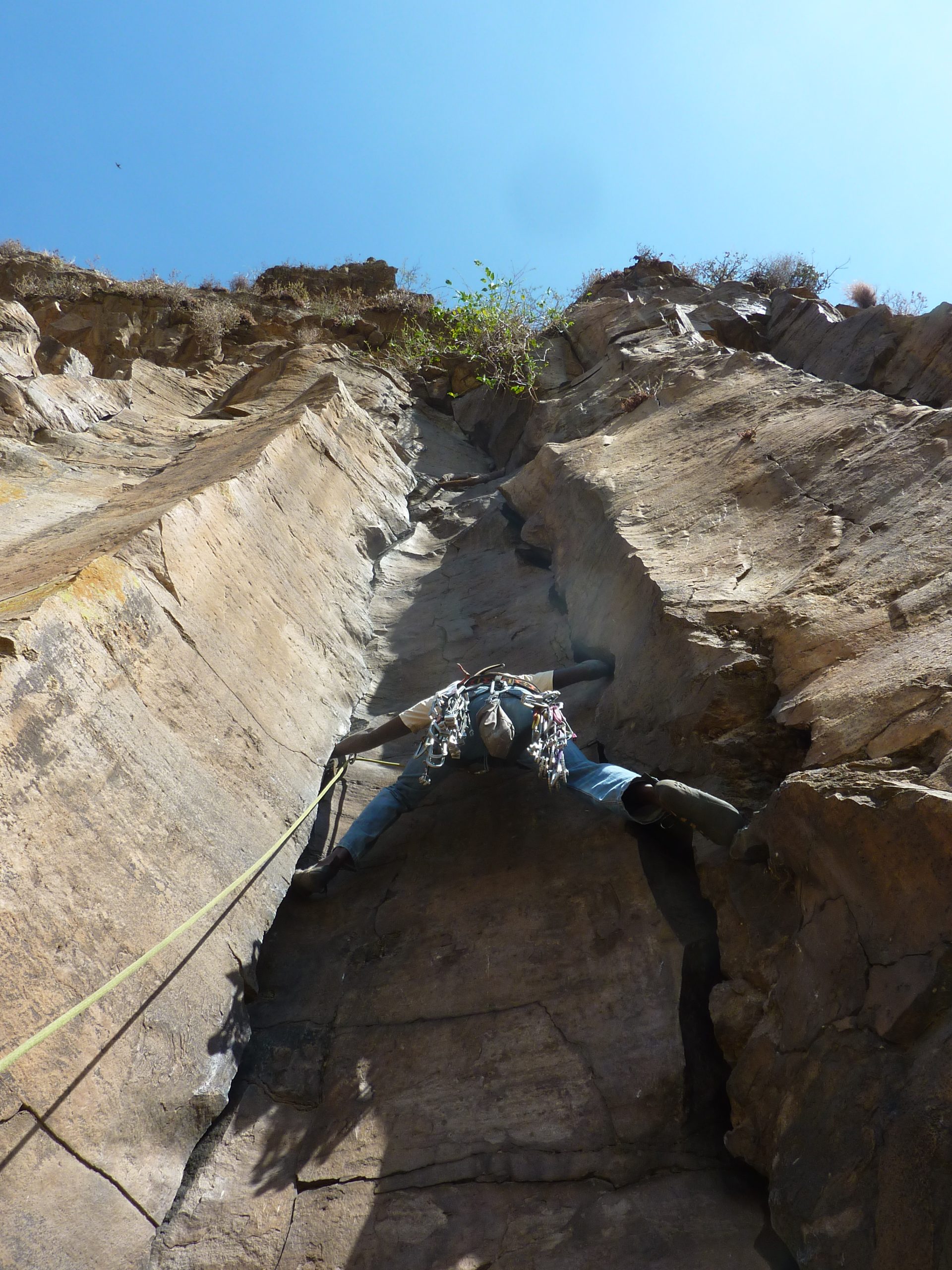
Hell’s Gate Gorge
Hell’s Gate Gorge is the slot canyon at the southern end of Hell’s Gate National Park, properly called Ol Njorowa and known locally as the Lower Gorge. It is the reason most visitors come, it is the most physically involving hour and a half in the park, and it is the only feature in this part of the Rift Valley that has killed visitors twice. Both facts belong on the same page.
What the Gorge Actually Is
The gorge is a narrow channel cut into soft volcanic rock by water leaving a much larger prehistoric lake that once filled the Naivasha basin. The park sits in the gap that outflow carved, and the gorge is the deepest and narrowest part of it. From the rim there is very little to see. The whole thing happens below ground level, which is why visitors who ride the park road and photograph the cliffs often leave without realising the gorge was there.
Inside, the walls close to a few metres apart, banded in red, ochre and grey, polished smooth at the level water normally reaches and rough above it. The floor is sand, boulders and shallow running water. Hot water seeps from the rock in places, staining it white and orange, and steam drifts out of cracks in the wall. This is the same geothermal system that feeds the power stations at the western end of the park, reaching the surface without any help.
Guides name the narrow places and the chambers, and the names vary with the guide. What does not vary is the shape of the walk: a descent from the rim on a rough path, easy walking on sand, then tighter sections with short scrambles and occasional wading.
The Flash Flood Hazard and Why It Is Different Here
Two groups have drowned in this gorge. On 22 April 2012 a church youth outing from Nairobi was caught by a flash flood in the gorge and seven people died. Kenya Wildlife Service suspended gorge visits afterwards and put in marked emergency exits along the length of the channel. On 1 September 2019 a second flood swept a party of thirteen walking the same gorge. Six bodies were recovered within a day and the seventh later, bringing that toll to seven as well. Six of the dead were visitors and one was their guide, and one body was carried far enough down the drainage to be recovered at Suswa.
The mechanism is what makes this gorge dangerous rather than merely steep. The catchment feeding it is large and lies in high ground well outside the park, in the country around Nyandarua and the escarpments above Nakuru. Rain falling there arrives in the gorge as a wall of water with no warning that anyone standing inside a slot a few metres wide can see. The sky above the gorge can be clear while the flood is already on its way. In the 2019 event, Narok, roughly fifty kilometres west, had taken around fifty millimetres of rain in the preceding twenty four hours.
The gorge is not dangerous in dry weather and it is lethal in wet weather, and the visitor standing at the descent point cannot tell the difference by looking up. That is the whole problem in one sentence.
What follows from it is short and non negotiable. Do not enter if it has rained anywhere in the catchment in the past day, if it is raining, or if there is weather building on the highlands. Ask the ranger post before descending rather than the person selling the walk. Learn where the marked exits are on the way in, because they are only useful to someone who noticed them. If water starts rising or discolouring, leave by the nearest exit immediately and do not go back for anything. And treat a closure as the system working. Kenya Wildlife Service closes the gorge in bad weather, and a guide who says no today has made the correct call.
Taking a Guide Through Ol Njorowa
A local guide is the standard arrangement at the descent point and should be treated as a requirement rather than an option. There are two reasons and only one of them is route finding. The gorge branches, the exits are not obvious from the floor and the scrambles are easier with someone who knows where the holds are. More importantly, the guides working here are the people who watch the weather upstream and who know where the marked escape routes leave the channel.
Guides are engaged on arrival and no advance booking is normally needed. Their fee is agreed locally and does not appear on any Kenya Wildlife Service schedule, so it is a charge to settle plainly at the start. Rates circulating on travel sites for this are published by no managing body.
Walking the Gorge and How Long It Takes
The usual version is an in and out walk to the hot springs section, which takes around an hour and a half at a normal pace with stops. The full traverse through to the Ol Karia end is a substantially bigger undertaking and a half day in its own right, and it is the version that most needs a guide and settled weather.
The walking is not technical but it is not a stroll either. Expect loose descent paths, boulder hopping, one or two short drops that need hands, wet rock where the springs run and sand that drags at the feet on the flat sections. Shoes with real grip matter more here than anywhere else in the park, because the polished rock in the water channel is genuinely slippery and sandals are the commonest cause of a turned ankle.
The hot seeps are worth understanding rather than touching. Geothermal water surfacing in this field arrives very hot, and the sensible treatment of a steaming crack in a rock wall is to look at it from a step back.
- Closed shoes with grip, not sandals
- More water than the walk appears to need, because there is no shade in the approach and none at the top
- Nothing valuable that cannot be carried on the body, since scrambling with a loose bag is awkward
- A check of the sky towards the highlands before descending, and again before going deeper
Getting to the Gorge From Elsa Gate
The gorge sits at the far end of the park’s internal road from Elsa Gate, roughly seven kilometres of flat unpaved track that most visitors ride by bicycle and some drive. Bicycles are left at the top of the descent. The ride itself is the classic Hell’s Gate day and is covered on the park page along with the cycling charge, which Kenya Wildlife Service prices as a separate activity.
Ordinary park entry applies and there is no separate gate for the gorge. Hell’s Gate sits in the scenic parks band of the Kenya Wildlife Service conservation fee schedule effective from 1 October 2025, which was checked on 21 September 2026. Entry per person per day is KSh 500 for an East African citizen adult and KSh 250 for a child or student, KSh 675 and KSh 350 for a Kenya resident, USD 50 and USD 25 for a non resident, and USD 20 and USD 10 for an African citizen. Fees are set by regulation and revised periodically, so confirm before travelling.
Park gates run from 6am to 6pm. Starting early matters here for a reason beyond light and crowds: highland rain in this region tends to build through the afternoon, so a morning descent is both cooler and statistically the safer half of the day. Fischer’s Tower stands beside the road on the way in and Olkaria Geothermal Spa is at the other end of the park, which is the usual order of a full day. Hiking in Kenya covers what Rift Valley altitude does to a walk that looks short on paper.
Questions Visitors Ask About Hell’s Gate Gorge
How dangerous is the gorge really?
Benign in dry weather and lethal in wet weather, with nothing in between. Flash floods killed seven people on 22 April 2012 and seven again on 1 September 2019. Nobody has been hurt in it by wildlife. The risk is entirely about water arriving from rain that fell out of sight upstream.
Is a guide compulsory for the gorge walk?
Guides are taken at the descent point as standard practice and should be treated as compulsory whatever the wording on the day. They read the weather upstream and they know where the marked escape routes leave the channel, which is knowledge no first time visitor has.
How long does the gorge walk take?
About an hour and a half for the usual in and out to the hot springs section, at a normal pace with stops for photographs. The full traverse to the Ol Karia end is a half day and needs both a guide and settled weather.
Can children do the gorge?
Older children steady on rough ground manage the shorter version well. It involves scrambling and short drops rather than walking, so it suits confident feet rather than small ones.
Is there a separate charge for the gorge?
Not from Kenya Wildlife Service. Ordinary park entry covers it and there is no separate gorge gate. The local guide’s fee is a separate arrangement settled at the descent point, and it is not on any published schedule.
What is the best time of day to walk it?
Morning. The light in a slot canyon is best when the sun is high enough to reach the floor, the air is cooler, and highland rain in this region generally builds through the afternoon. An early start at Elsa Gate leaves time for the ride out and the gorge before the weather has had a chance to change.
Why do the walls have hot water running down them?
Because the gorge cuts into the same geothermal field that supplies the power stations at the western end of the park. Hot water and steam reach the surface through cracks in the rock, staining the walls and leaving warm seeps along the floor.
2 Places to Visit in This Area
Other sites in Hell’s Gate National Park, each with its own guide.
Safaris That Visit Hell's Gate National Park
Every safari listed here that visits Hell's Gate National Park. Each is sold and run by an independent tour company. This site lists them and passes on enquiries; it takes no booking and charges you nothing.


5 Day Kenya Honeymoon Safari
by Insight Safari Holidays
Operator quotes on request
View Safari
7 Day Safari Kenya
by Insight Safari Holidays
Operator quotes on request
View Safari