
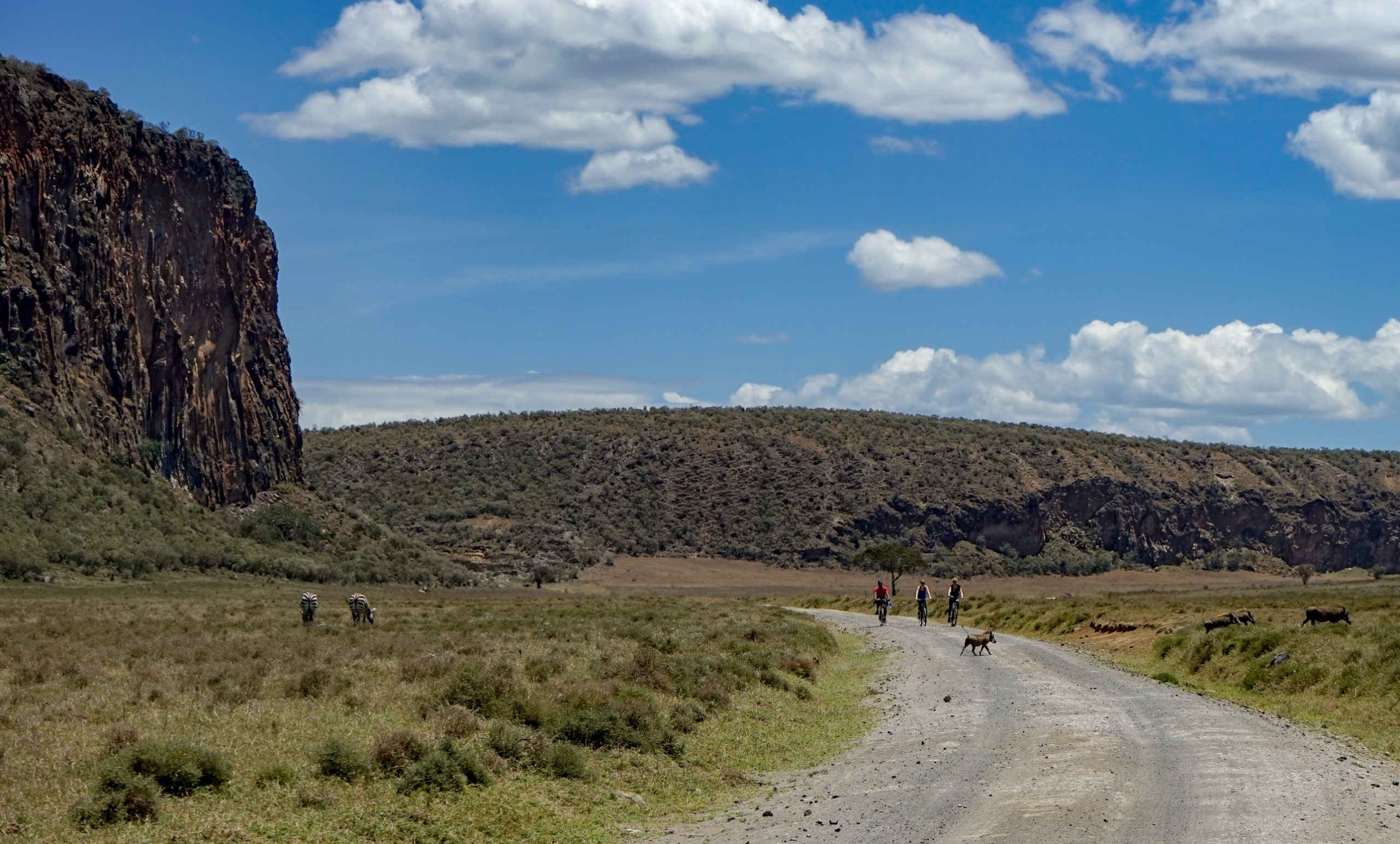
Hell’s Gate National Park
Hell’s Gate is the Kenyan national park a visitor can walk into, cycle through and climb in. That single permission, granted because the park carries no significant population of large predators, makes it unlike anywhere else in the country’s protected area system, and it is why a park of only 68 square kilometres near Naivasha draws the traffic it does.
What Makes Hell’s Gate National Park Different
The Kenya Wildlife Service gazetted Hell’s Gate in 1984 and records its area at approximately 68 square kilometres. It sits on the floor of the Great Rift Valley just south of Lake Naivasha, in a gap cut through volcanic rock by an ancient outflow from a much larger prehistoric lake. That gap is the park: red and ochre cliffs on both sides, a wide flat valley between them, volcanic plugs standing free of the rock walls, and steam venting from the ground at the western end.
Almost every other Kenyan park requires a vehicle and a closed door. Here the rules invert. Visitors walk the main valley, ride bicycles along the internal road, scramble down a slot gorge and climb the rock towers, and the grazing animals carry on grazing a few metres away. The reason is simply that the park holds no meaningful lion population. The Kenya Wildlife Service and park guides both note that shy predators including leopard, spotted hyena and serval are present and are seen at dawn and dusk, so this is a park without lions rather than a park without risk.
Buffalo are the animal to take seriously on foot here. They are numerous, they are not shy, and they account for far more incidents in walking parks than any predator.
Cycling in Hell’s Gate, the Ride Everyone Comes For
The classic Hell’s Gate day is a bicycle ride from Elsa Gate along the unpaved internal road towards the gorge, roughly seven kilometres of flat, dusty, corrugated track with cliffs rising on both sides. Zebra, giraffe, eland, buffalo, warthog, Thomson’s gazelle and olive baboon graze along the verges and largely ignore riders. It is an easy ride on a bad bicycle and a genuinely lovely one on a good bicycle.
Bicycles are hired at the gate and from guesthouses around Naivasha, and the condition of the gate fleet is the standard complaint. Brakes, tyres and saddles vary widely, there is no shade and the surface is rough, so anyone who cares about the machine brings one or hires through an operator that maintains a decent fleet. Cycling and mountain biking in Kenya covers the national picture and the other parks where riding is allowed.
The Kenya Wildlife Service charges cycling as a separate activity on top of park entry. On the conservation fee schedule effective from 1 October 2025, published by the Kenya Wildlife Service and checked on 21 September 2026, that charge is KSh 300 or USD 10 per day, exclusive of conservation fees. Motorcycles carry their own charge of KSh 500 or USD 10 per day. Hell’s Gate is one of only six places on the schedule where cycling is priced at all, which is the clearest statement there is of how unusual the permission is.
Hiking the Ol Njorowa Gorge and Its Hot Springs
The gorge is the other half of the day. Ol Njorowa, usually called the Lower Gorge, is a narrow slot cut deep into the rock at the southern end of the park, reached by leaving the bicycle at the top and descending on foot. Inside it the walls close to a few metres apart, hot water seeps from the rock in places, and the walking involves scrambling, hands on rock and occasional short drops.
Guides are taken at the descent point and are worth having for route-finding rather than ceremony, because the gorge branches and the exits are not obvious. The full traverse to Ol Karia and back is a substantial half day; the shorter in-and-out to the hot springs section is what most visitors do.
This gorge has killed people. In April 2012, seven young Kenyans drowned in a flash flood in the Ol Njorowa gorge, after which the Kenya Wildlife Service suspended gorge visits. On 1 September 2019 a flash flood swept a group walking the same gorge, killing seven, including five members of one family, a guide and one non-resident visitor; one body was carried far enough down the drainage to be recovered at Suswa. The catchment above the gorge is large and the rain that fills it can fall far out of sight of anyone inside the slot.
The practical rule follows from that. Do not enter the gorge if it has rained, is raining, or looks like raining anywhere upstream, and do not accept a guide’s assurance that it is fine when the sky says otherwise. The park closes the gorge in bad weather and that closure is the system working, not an inconvenience.
Rock Climbing at Fischer’s Tower and Central Tower
Fischer’s Tower is the volcanic plug standing beside the track shortly after Elsa Gate, about twenty-five metres of rough rock, and it is the most climbed feature in the park. Routes on it run from straightforward scrambles to genuinely technical lines, local climbing guides operate at its base with equipment, and it is where most visitors to Kenya do their first outdoor climb. Central Tower, deeper into the park near the head of the gorge, is the larger and more serious proposition.
The rock is volcanic, sharp and abrasive, and it eats hands and gear. Anyone climbing here should expect that and bring tape. Rock climbing in Kenya sets out the country’s wider climbing scene, of which Hell’s Gate is the most accessible part.
Beyond the towers the park carries hiking routes along the valley and up onto the cliffs, and the obsidian caves in the volcanic rock are a separate short excursion. Hiking in Kenya covers what to expect from a full day on foot at Rift Valley altitude.
Olkaria, Geothermal Steam and the Spa
The western end of Hell’s Gate is one of the most developed geothermal fields in Africa. KenGen states that the Olkaria geothermal project is situated within Hell’s Gate National Park, 120 kilometres from Nairobi, and the numbered stations built there since the first units were commissioned in the early 1980s, together with the wellhead plants, account for the bulk of KenGen’s geothermal capacity of roughly 771 MW.
The visible result inside the park is steam. Pipes run across parts of the landscape, plumes rise from well heads, and the roads on that side carry industrial traffic. Visitors arrive expecting untouched wilderness and find a working power complex, and reactions divide sharply. It is worth knowing in advance rather than discovering at the gate.
The Olkaria Geothermal Spa is the tourist-facing side of the same resource, a large open-air pool fed with hot mineral water drawn from the field, sitting inside the park boundary. It is a genuinely pleasant end to a dusty day on a bicycle and it charges its own admission separately from park entry.
Wildlife and Birds at Hell’s Gate
The grazing game is the point, because it can be approached on foot. Zebra, Maasai giraffe, eland, buffalo, Coke’s hartebeest, Thomson’s gazelle, warthog, olive baboon and rock hyrax are all routine, and the hyrax on the cliffs are the reason the raptors are there.
Birding is strong on cliff species in particular. The park holds over a hundred recorded species, and the cliffs carry Verreaux’s eagle, augur buzzard, swifts and vultures, with the Verreaux’s eagle hunting hyrax along the rock walls in full view of the track. For a birder this is one of the few places in Kenya where cliff-nesting raptors can be watched at eye level from the ground. Birdwatching in Kenya places it in the wider circuit.
Getting to Hell’s Gate and Which Gate to Use
The Kenya Wildlife Service route is the A104 from Nairobi to Naivasha, then Moi South Lake Road along the southern shore of Lake Naivasha, with Elsa Gate 25 kilometres from the Moi South Lake Road junction. Public transport runs along Moi South Lake Road, and matatus drop at the gate turn-off, which is the standard budget approach.
Elsa Gate is the main entrance and the start of the cycling route. Ol Karia Gate at the western end serves the geothermal area and the spa. Most visitors enter at Elsa, ride to the gorge and return the same way.
The park is a straightforward day trip from Naivasha town, and a long but feasible one from Nairobi. Anyone combining it with Mount Longonot should do the mountain at dawn and Hell’s Gate afterwards, not the other way round. The wider regional context sits on the Great Rift Valley page.
Park Fees and What a Day at Hell’s Gate Costs
Hell’s Gate sits in the scenic parks band of the Kenya Wildlife Service conservation fee schedule, alongside Mount Longonot, Mount Elgon, Ol Donyo Sabuk, Lake Elementaita Wildlife Sanctuary and Kakamega. On the schedule effective from 1 October 2025, published by the Kenya Wildlife Service and checked on 21 September 2026, entry per person per day is KSh 500 for an East African citizen adult and KSh 250 for a child or student, KSh 675 and KSh 350 for a Kenya resident, USD 50 and USD 25 for a non-resident, and USD 20 and USD 10 for an African citizen.
On top of entry sit the activity charges already noted: cycling at KSh 300 or USD 10 per day and motorcycles at KSh 500 or USD 10. Camping is charged per person per night at the non-premium rate, KSh 250 for an East African citizen adult at a special campsite and KSh 200 at a public campsite, with non-resident adults at USD 35 and USD 20. Public campsites at Naiburta and Oldubai and a special campsite at Endachata are listed by the Kenya Wildlife Service. Vehicle entry starts at KSh 600 per day for a car with fewer than six seats. Parking at Hell’s Gate is charged at KSh 1,000 for East African citizens and USD 30 for non-residents, and does not apply to visitors holding paid park tickets.
The geothermal spa and bicycle hire are separate again, and are not on the Kenya Wildlife Service schedule. Fees are set by regulation and revised periodically, so confirm the current position before travelling.
When to Visit Hell’s Gate and What to Bring
January to March and July to October are the reliable windows. The rains from mid-March into June and from October into December make the track heavy, the light flat and the gorge dangerous, and gorge closures during wet weather are common and correct.
There is no shade in the valley and no water on the route. That is the single most repeated piece of advice from people who have ridden it and the one most often ignored. Carry more water than seems necessary, take a hat and sunglasses, and expect fine volcanic dust in everything, which is why regular riders wear a buff over the face. Shoes with grip matter more than anything else if the gorge is on the plan, because the rock is smooth where the water runs.
Gates operate from 6am to 6pm and visitors vacate between those hours unless camping inside. Starting at opening buys cool air, soft light and an empty track, and the difference between 6.30am and 10am at Hell’s Gate is enormous.
Questions Visitors Ask About Hell’s Gate National Park
Can you really cycle inside Hell’s Gate?
Yes, on the internal road, unescorted. It is one of the very few national parks anywhere that permits it, and the Kenya Wildlife Service prices cycling as a named activity in six parks, of which Hell’s Gate is the best known. Bicycles are hired at the gate or brought in.
Is it safe to walk in Hell’s Gate?
Walking is permitted because the park has no significant lion population. Leopard, hyena and serval are present but rarely encountered, and buffalo are the real hazard on foot. The serious risk in this park is flash flooding in the gorge, not wildlife.
How dangerous is the gorge?
Dangerous in rain and benign in dry weather. Flash floods killed seven people in April 2012 and seven more on 1 September 2019, in both cases in the Ol Njorowa gorge. Rain falling out of sight upstream is what fills it. Do not enter if rain has fallen or is forecast anywhere in the catchment.
Do you need a guide for Hell’s Gate?
Not for the cycling route, which follows a single road. A guide is strongly advisable for the gorge, both for route-finding and because guides watch the weather, and essential for climbing unless bringing your own equipment and experience.
Can Hell’s Gate be done as a day trip from Nairobi?
Yes, though it makes for a long day. The park is about two hours from Nairobi via the A104 and Moi South Lake Road. Staying a night at Naivasha turns it into a relaxed day and allows an early start, which is when the park is at its best.
Are there power stations inside the park?
Yes. KenGen’s Olkaria geothermal complex sits within and beside the park, with steam pipes, well heads and plant visible from parts of the road. Visitors expecting untouched wilderness should know this before arriving.
How long does the full Hell’s Gate route take?
Riding from Elsa Gate to the gorge and back is roughly fourteen kilometres of easy flat track, two to three hours at a relaxed pace with stops. Adding the gorge descent and the hot springs section makes it a full day, and adding the spa afterwards fills the evening.
3 Places to Visit in This Area
Individual sites within reach of here, each with its own guide. Some are written up because the name circulates and the place does not, which is worth knowing before you plan a drive around one.
Safaris That Visit Hell's Gate National Park
Every safari listed here that visits Hell's Gate National Park. Each is sold and run by an independent tour company. This site lists them and passes on enquiries; it takes no booking and charges you nothing.


5 Day Kenya Honeymoon Safari
by Insight Safari Holidays
Operator quotes on request
View Safari
7 Day Safari Kenya
by Insight Safari Holidays
Operator quotes on request
View Safari