Tsavo East National Park Safari Guide
Tsavo East National Park is Kenya’s largest national park and the closest of the big safari parks to the Indian Ocean coast, covering roughly 13,747 square kilometres of flat, red earth country in Taita-Taveta County. Voi Gate sits 156 kilometres from Mombasa on the Nairobi highway, which is why most Tsavo East safaris are sold as short coastal trips rather than long overland ones. Below the Galana River lies the open triangle where nearly every game drive runs.
What a Tsavo East Safari Looks Like on the Ground
The Kenya Wildlife Service gazetted Tsavo East in April 1948, at the same time as its western neighbour. Together with Tsavo West National Park, the surrounding ranches and other protected ground, it forms the Tsavo Conservation Area, about 22,000 square kilometres of connected wildlife country and one of the largest such blocks anywhere in Africa.
Scale changes how a Tsavo East safari feels. This is semi-arid, low, wide country. The horizon does most of the work, and so do your binoculars. Where a Maasai Mara game drive delivers sightings in minutes because the vehicle density is high and the plains are small, Tsavo East asks for patience and rewards distance. You may drive a long stretch without meeting another vehicle. Several trip reports from self drivers describe exactly that, along with the punctures and the dead phone signal that come with it.
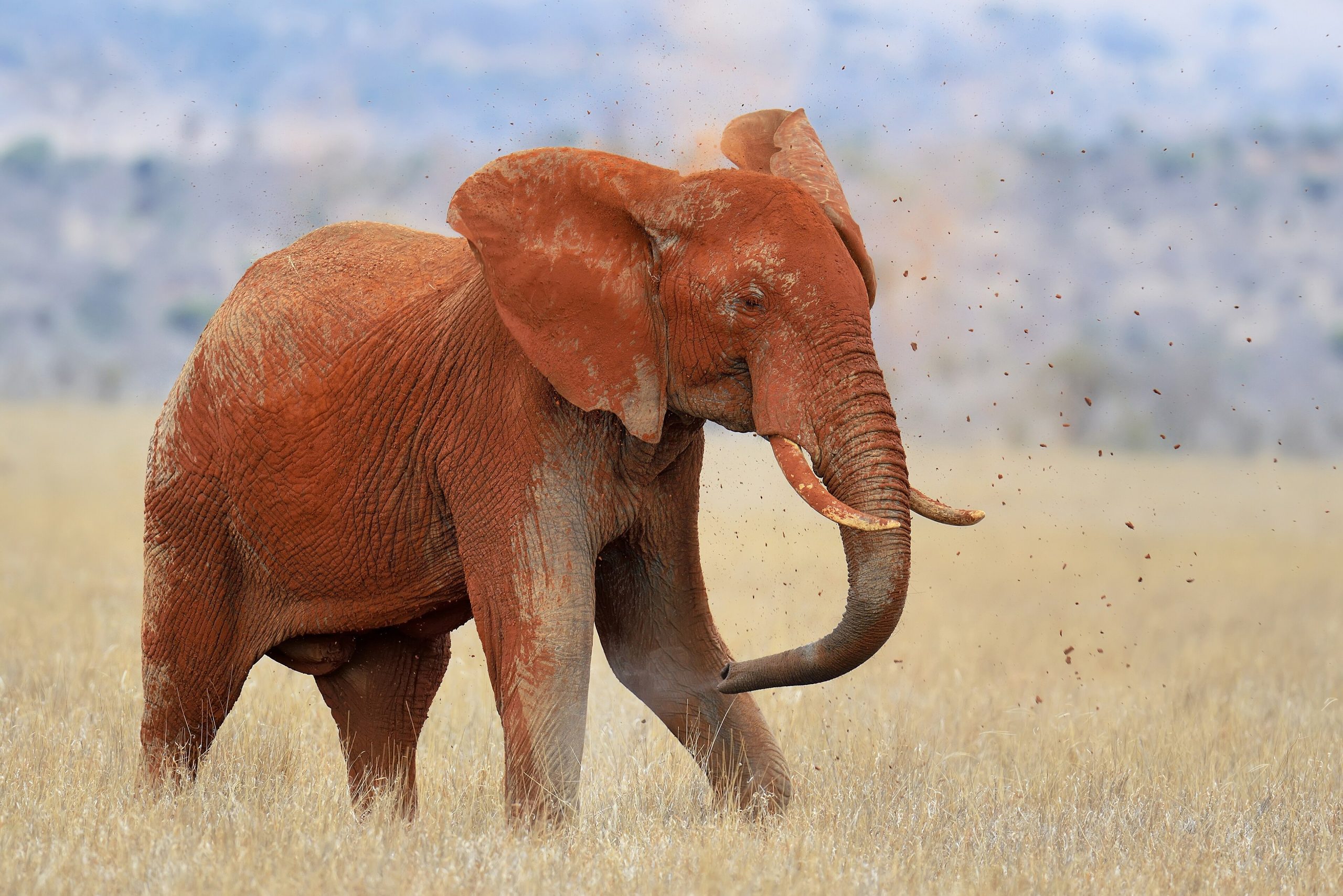
The soil is the other thing nobody forgets. Tsavo’s laterite is iron rich and it turns a deep ochre, and it gets on everything: the vehicle, the lens, the clothes and, most famously, the elephants.
Tsavo East or Tsavo West: Choosing the Right Park for Your Safari
The two Tsavos share a name, a gazettement date and a highway boundary, and almost nothing else about the safari day. Travellers who book one expecting the other are usually disappointed, so it is worth being blunt about the split before anything else.
Tsavo East is flat, open and dry. Sightlines run for kilometres, which suits long lens photography, big herds and anyone who wants their game viewing uncomplicated. Tsavo West is volcanic, hillier, greener in the wet and considerably bushier, which hides game but produces the scenery and the water features. If you want to see animals with the least fuss, Tsavo East. If you want country that looks like something, Tsavo West.
Red Elephants and Maneless Lions on a Tsavo East Game Drive
Elephants are the reason most people book a Tsavo East game drive safari, and the Tsavo Conservation Area holds the largest population in Kenya. An aerial total count run by the Kenya Wildlife Service and the Tanzania Wildlife Research Institute in February 2017 recorded 12,866 elephants across the Tsavo and Mkomazi ecosystem, of which 12,843 were on the Kenyan side. That count was 14.7 per cent above the equivalent survey three years earlier, a recovery from the poaching decades that is still the central conservation story here.
The red comes from behaviour, not biology. Elephants dust bathe and wallow, throwing the iron rich soil over themselves against parasites and sun, and Tsavo’s soil stains. Wash a Tsavo elephant and you get a grey elephant. Watch a herd come down to water and you can see the colour change over the course of an afternoon.
Lions here are the other draw, and Tsavo males frequently carry little or no mane. Sightings are never guaranteed and the open country cuts both ways: you can see a long way, but so can everything else, and lions spend the hot hours flat under whatever shade exists. Early and late drives matter more in Tsavo than in parks where the game is concentrated.
Beyond the headline species, the park lists buffalo, leopard, giraffe, hippo and crocodile on the rivers, along with the critically endangered hirola, an antelope with almost nowhere left to live. Over 500 bird species have been recorded. The park’s man eating lion history belongs to the railway crossing on the western side and is covered on the Tsavo West page rather than repeated here.
The Galana River and the Southern Triangle Where Tsavo East Safaris Run
Almost everything a visitor does happens in the southern part of the park, below the Galana. That triangle holds the gates, the lodges, the airstrips, the graded circuits and the water. The Tsavo and Athi rivers run in from the west and join to form the Galana, which then cuts east towards the coast, and the riverine strip is where the game concentrates once the seasonal pans dry out.
The vast area north of the Galana is a different proposition. It has been managed as a wilderness zone with very little tourism infrastructure, it was closed to visitors for years during the worst of the poaching, and access is still limited and permission based. Anyone reading a park map and planning a casual drive up to the plateau should check with the Kenya Wildlife Service first rather than assume the tracks are open.
Road surfaces are the practical constraint. Tracks run from graded murram to loose sand, and the sandy sections near the Galana are where two wheel drive vehicles come unstuck. A high clearance four wheel drive is the sensible minimum. Self drivers on the forums consistently make two points worth repeating: carry more than one spare, and do not count on a phone signal. Vehicle density is low enough that a breakdown can mean a long wait. If that prospect bothers you, a guided vehicle with radio contact solves it, and the self drive safaris guide covers the trade in more detail.
Tsavo East Attractions Worth Building a Game Drive Around
Four named sights anchor most southern circuits. Each has its own page on this site, so what follows is the orientation rather than the detail.
Lugard Falls sits on the Galana, where the river squeezes through water sculpted rock into a series of rapids. Mudanda Rock is a long whaleback of stone above a natural dam, with a walk up top that gives one of the few elevated views in a very flat park. Yatta Plateau runs along the western edge above the Athi, a phonolitic lava flow about 290 kilometres long and usually described as the longest in the world. Aruba Dam was built across the seasonal Voi River in the 1950s as a dry season water point.
One honest caveat about Aruba, because the guide pages have not caught up. The Voi River now flows seasonally, the reservoir has silted heavily and a rehabilitation programme launched in 2021 has not restored it. Treat Aruba as a seasonal pan that may or may not be holding water when you arrive, not as the dependable year round waterhole it is still described as. Ask at the gate. The full picture sits on the attraction page, and the wider list is indexed on the Kenya attractions hub.
Birdwatching Safaris Along the Tsavo East River Courses
Over 500 bird species have been recorded in Tsavo East, and the river courses do the heavy lifting. The Galana strip, the pans and whatever water Aruba is holding pull in waders, kingfishers, herons and skimmers, while the dry bush country carries the hornbills, rollers, starlings and the raptors that hunt the open ground. Vultures find the kills that the long sightlines let you spot in the first place.
Timing helps. The northern hemisphere migrants arrive from roughly October and stay into the early part of the year, so a Tsavo East birdwatching safari run in that window adds a layer of species the resident list does not carry. The broader picture across the country sits on the birdwatching in Kenya page.
Best Time to Visit Tsavo East for a Safari
Tsavo runs two rainy seasons and two dry ones, and the dry months are the straightforward answer for game viewing. Water concentrates the animals, the grass is short and the tracks are firm.
Two practical consequences fall out of that. In the dry months pack for dust rather than for rain: the ochre gets into camera bodies and lens mounts, and a dry bag or a sealed case earns its place. In the rains, ask your operator directly which circuits they can still run, because a lodge being open is not the same as the tracks around it being passable.
Getting to Tsavo East National Park for Your Safari
Road access is the normal route and the coast is the normal starting point. On the Mombasa to Nairobi highway, Bachuma Gate is 110 kilometres from Mombasa, Voi Gate 156 kilometres and Manyani Gate 191 kilometres. Mtito Andei Gate sits 233 kilometres south of Nairobi and 250 kilometres north of Mombasa. Coming from Malindi, the C103 tarmac road runs west to Sala Gate, which is the gate people arriving from the north coast use.
By air, Voi and Ithumba are the main airstrips, with Aruba, Satao, Sala, Sangayaya, Thabagunji, Lugard and Bachuma also in use. Charter flights from Nairobi, Mombasa or Diani cut a long hot drive to about an hour and are the usual choice for shorter stays.
The Standard Gauge Railway is the underused option. Trains run from Syokimau Terminus in Nairobi to Voi Station, and from Mombasa Terminus to Miasenyi Station, both within reach of the gates. It works well if your lodge can collect you, and badly if you were planning to drive yourself, since there is no vehicle at the other end.
Where Travellers Stay on a Tsavo East Safari
Accommodation splits into two groups. The Kenya Wildlife Service runs a public campsite at Ndololo and a set of special campsites including Makoka, Roka, Lugards, Epiya Chepeyo, Mbololo, Durusikale and Thabagunji, which are the low cost and self sufficient end of the range. Alongside them sit privately run lodges and tented camps inside the park, among them Voi Safari Lodge, Ashnil Aruba Lodge, Sentrim, Impala Safari Lodge, Ngutuni Lodge, Satao Camp and Galdessa.
Position matters more than category in a park this size. A camp near Voi or Aruba puts you inside the southern circuit and cuts dead driving; a camp near the Galana puts you on the river. This site does not rank properties or operators, and the operators listing on the page will tell you what is currently being sold and by whom. If you are considering camping, the camping safaris guide covers what KWS campsites do and do not provide.
Tsavo East National Park Safari FAQ
What are the Tsavo East National Park entry fees?
The Kenya Wildlife Service publishes daily conservation fees by visitor category. These are the official rates on the KWS Tsavo East park page, checked on 21 September 2026. They are park entry only and do not include a vehicle, a guide, accommodation or anything an operator charges.
| Visitor category | Adult | Child |
|---|---|---|
| East Africa Citizen | KES 1,000 | KES 500 |
| Kenya Resident | KES 1,350 | KES 675 |
| Africa Citizen | USD 40 | USD 20 |
| Non Resident | USD 80 | USD 40 |
Fees change. Confirm the current rate on the KWS site before you travel, and be wary of guide pages quoting figures that are years old.
How many days do I need in Tsavo East?
Two nights is the working minimum if you want more than a transit through the southern circuit, and it is what most coastal trips allow. One night gives you an afternoon drive and a morning drive, which in a park this large is thin. Three nights lets you reach Lugard Falls and the Galana without spending the whole day in the vehicle.
Can I drive myself around Tsavo East?
Yes, self driving is permitted and the park is popular with overlanders. Take a high clearance four wheel drive rather than a soft roader, carry at least two spare wheels, download offline maps because signage is sparse, and start early enough that a puncture does not leave you fixing a wheel at dusk. Phone coverage is patchy to absent across much of the park, and vehicle traffic is light enough that nobody may pass for a long while.
Is Tsavo East better than Tsavo West?
Neither is better, and they answer different questions. Tsavo East is the easier park for actually seeing animals, because the country is flat and open and the herds are large. Tsavo West is the better looking park, with volcanic hills, lava flows and permanent springs, and it holds the black rhino population. Travellers with three or more nights often do both, since only a highway separates them.
Will I see the Big Five in Tsavo East?
Elephant, buffalo, lion and leopard are all present, and elephant sightings are close to routine in the dry season. Rhino are the gap: Tsavo East is not where Kenya’s black rhino are concentrated, and the protected rhino population in the Tsavo Conservation Area sits on the western side. Treat a Big Five sweep as unlikely in Tsavo East alone, and treat leopard as a lucky day anywhere.
What should I pack for a Tsavo East game drive?
Dust protection first: a sealed bag or case for cameras, a cloth for lenses, and clothing you do not mind staining. Light colours help, and dark blue and black are worth avoiding because biting flies are drawn to them. Bring binoculars, because the long sightlines are useless without them. Sun cover, plenty of water and a first aid kit round it out. Single use plastic is prohibited in Kenyan national parks, so bring a refillable bottle.
What time do the gates open and close?
Gates open at 06:00 and close at 18:00. If you are staying inside the park overnight you are not bound by the closing time in the same way, but night driving is restricted and you should clear any evening movement with your lodge or with KWS. The speed limit inside the park is 40 km/h and off road driving is prohibited.
Can I combine Tsavo East with a beach holiday?
That is how a large share of Tsavo East safaris are actually built. Bachuma Gate is 110 kilometres from Mombasa and Sala Gate is reached on tarmac from Malindi, so a two or three night park stay slots into a coastal trip without a long repositioning drive. The relevant coastal bases are Mombasa, Diani Beach and Malindi.
Are there walking safaris in Tsavo East?
Walking is not the park’s main activity and it is not available everywhere, but short escorted walks and a walk up Mudanda Rock do feature in some itineraries. Anything on foot inside a national park requires a ranger or an authorised armed guide, and you arrange it through your camp rather than at the gate. The walking safaris in Kenya guide explains where foot activity is properly established.
Planning Around Tsavo East
Tsavo East works best as one leg of something larger. Paired with Tsavo West it becomes a full Tsavo circuit with two quite different halves. Paired with the coast it becomes a safari and beach trip with a short transfer. Paired with Amboseli, reached through Tsavo West, it becomes a southern Kenya loop that ends within sight of the Tanzanian border.
Whatever shape it takes, the constraint is distance. This is the largest national park in the country and the sights are far apart, so the itineraries that work are the ones that pick a sector and stay in it rather than trying to cross the whole thing. Operators who run Tsavo regularly build their days that way, and it is a fair question to ask when you send an enquiry.
4 Places to Visit in This Area
Individual sites within reach of here, each with its own guide. Some are written up because the name circulates and the place does not, which is worth knowing before you plan a drive around one.
Safaris That Visit Tsavo East National Park
3 of the 4 safaris listed here that visit Tsavo East National Park, from different operators where the listings allow it. Each is sold and run by an independent tour company. This site lists them and passes on enquiries; it takes no booking and charges you nothing.


7 Days Wildlife Safari in Kenya
by Kori Safaris Verified operator
Operator quotes on request
View Safari

3 Days Tsavo East and Tsavo West Safari
by Tranquil Safaris Verified operator
Operator quotes on request
View Safari
12 Days Best of Kenya Safari
by Kori Safaris Verified operator
Operator quotes on request
View Safari