
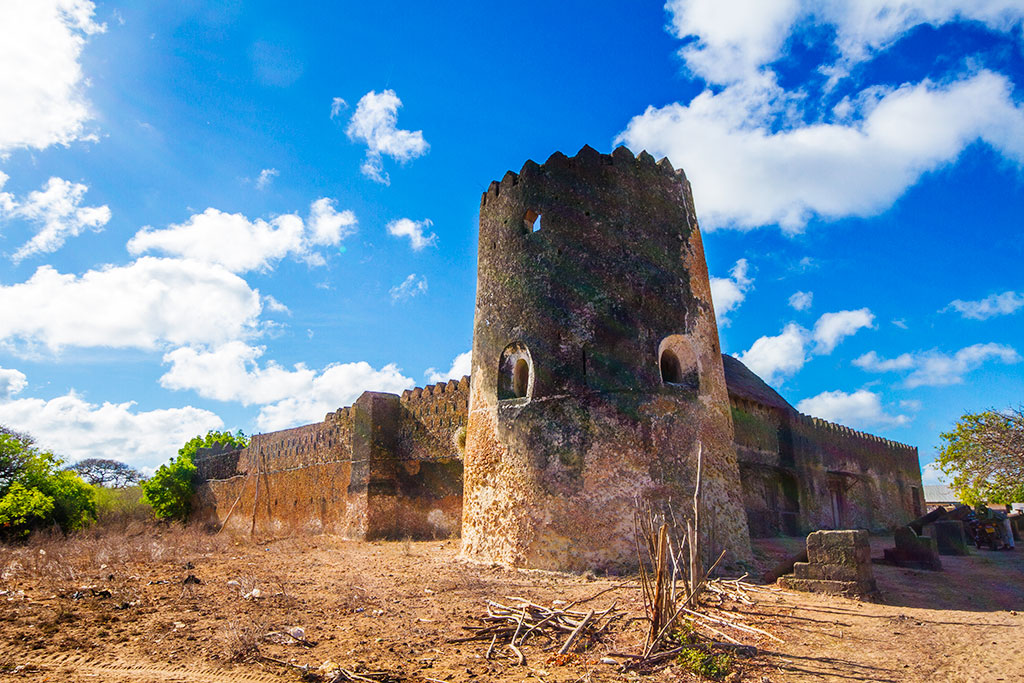
Siyu Fort
Travel advice affects this site. As checked on 21 September 2026, the UK Foreign, Commonwealth and Development Office advises against all travel to Lamu County except for Lamu Island and Manda Island. Siyu is on Pate Island, in Lamu County and not one of those exceptions, so the fort stands inside the advise against all travel area.
Check your own government’s current advice for Kenya before planning any travel here. Governments issue advice separately and revise it without notice, so a dated statement on any page, including this one, is a snapshot rather than a standing position. Check it again close to any departure.
With that stated plainly: Siyu Fort is among the most historically significant buildings on the Kenyan coast, Siyu is a living town, and the fort’s story is routinely told with the wrong century and the wrong enemy.
The Only Fort the Swahili Built for Themselves
The National Museums of Kenya puts it in one sentence: unlike Fort Jesus in Mombasa and the fort in Lamu, which were built by foreigners, the Siyu people built their own. Every other significant fortification on this coast was raised by an outside power to hold a town down. Siyu’s was raised by the town to keep one out.
It is built of coral with a small mosque inside it, and was gazetted as a National Monument in 1958 under gazette notice number 331. Oral tradition, the National Museums’ stated basis, attributes it to one of Siyu’s great leaders, Bwana Mataka, whose full name is given as Mohammed Ishaq bin Mbarak bin Mohamed bin Oman Famau. He also rebuilt much of the town, including a fine stone mansion for himself whose remains can still be seen.
Nineteenth Century, and Built Against Oman
A correction worth stating clearly. A great deal of travel writing dates Siyu Fort to the sixteenth century and describes it as a defence against the Portuguese. That is wrong on both counts. The National Museums of Kenya records it as a nineteenth century structure built to safeguard Siyu residents from Omani domination, and the sequence of events around Bwana Mataka fixes it in the eighteen hundreds. That dating is the one used here and on the Pate Island guide.
The chronology leaves little room for doubt. Omani pressure began in earnest with attacks in the late 1820s, and the fort is the response. In 1843 Bwana Mataka, together with the new sheikh of Pate, repudiated the sovereignty of Seyyid Said, Sultan of Oman and Zanzibar. That is a nineteenth century quarrel with a nineteenth century ruler, and a fort raised against Portugal two and a half centuries earlier would have had nothing to do with it.
The Campaigns of 1844 to 1863
What followed is the reason Siyu is remembered. Seyyid Said assembled an army of around two thousand men from Muscat, Baluchistan and Lamu, under his relative Seyyid Hamad bin Ahmed Al-Busaidy, known as Amir Hamad. It landed at Faza in early January 1844 and moved on Siyu on 6 January, where it was ambushed and driven back to Faza.
In 1845 Siyu inflicted on Seyyid Said one of the worst military defeats of his reign, and a further Omani expedition in the late 1840s was also repulsed. Siyu finally capitulated in 1863, after a siege of some six months under Sultan Majid, among the very last towns on the entire East African coast to fall under Zanzibari control.
Siyu the Town, Not Just the Fort
The fort is the surviving landmark, but Siyu was far more than a garrison. In the late eighteenth and early nineteenth centuries it flourished alongside Lamu with a population reported at more than twenty thousand, a major centre of Islamic scholarship and of a crafts industry built on leatherwork, woodcarving and the copying of manuscripts. Those cottage industries are still established in the village, which also holds the remains of numerous tombs and mosques.
Reaching Siyu
The fort lies some twenty five kilometres north east of Lamu town, on Pate’s north coast. There is no road to the island and no airstrip on it. Access is by boat from Lamu, up a long mangrove lined creek navigable only at high tide, so the trip is set by the tide rather than by the traveller. Onward movement between Pate’s settlements is on foot or by local boat.
The National Museums site page gives opening hours of 8.00am to 4.30pm Monday to Friday, closed at weekends and on public holidays, while the 2026 admission notice states longer daily hours across National Museums facilities, Monday to Sunday including public holidays. Settle which applies before committing to a tide, because a tide dependent journey to a site that turns out to be shut on a Saturday is an expensive mistake.
Admission is set by Legal Notice No. 79 of 2025, the National Museums and Heritage (Admissions Fees) Regulations 2025, with revised fees effective 7 May 2026 and checked here on 21 September 2026. Siyu sits in the notice’s lowest band: adult and child rates are KSh 100 and KSh 50 for Kenyan and East African citizens, USD 3 and USD 2 for residents and other African nationals, and USD 4 and USD 2 for visitors from outside Africa. Ticketing is through eCitizen at nmkpay.ecitizen.go.ke only, and the site does not take cash.
Weigh the journey against the travel advice at the top of this page, and check your own government’s current position on Lamu County before committing to anything. The Pate Island guide covers the practicalities of reaching the island, and heritage tours covers how the coast’s monuments relate to one another.
Questions About Siyu Fort
How old is Siyu Fort?
It is a nineteenth century building. The National Museums of Kenya records it as built by Bwana Mataka to protect Siyu from Omani domination, and the events it was built for, the Omani attacks from the late 1820s and the confrontation with Seyyid Said from 1843, are all nineteenth century. Sources dating it to the fifteen hundreds are repeating an error.
Can Siyu Fort be visited?
The fort is open to the public. However, Pate Island lies inside an area carrying an advise against all travel restriction from at least one government, covering Lamu County with only Lamu Island and Manda Island excepted. That position is dated and subject to revision, so check your own government’s current advice for Kenya before making any plan.
Is Siyu still inhabited?
Yes. Siyu is a working village on the north coast of Pate Island with established leather and woodcarving crafts, and it holds standing tombs and mosques as well as the fort. It is a fraction of the town of more than twenty thousand people reported there two centuries ago.
Siyu Fort sits on Pate Island, in the archipelago alongside Lamu and Manda Island. For the forts it is usually compared with, see Fort Jesus and Lamu Fort.
No operator on the marketplace currently lists a safari to Pate Island.
See every Kenya safari