
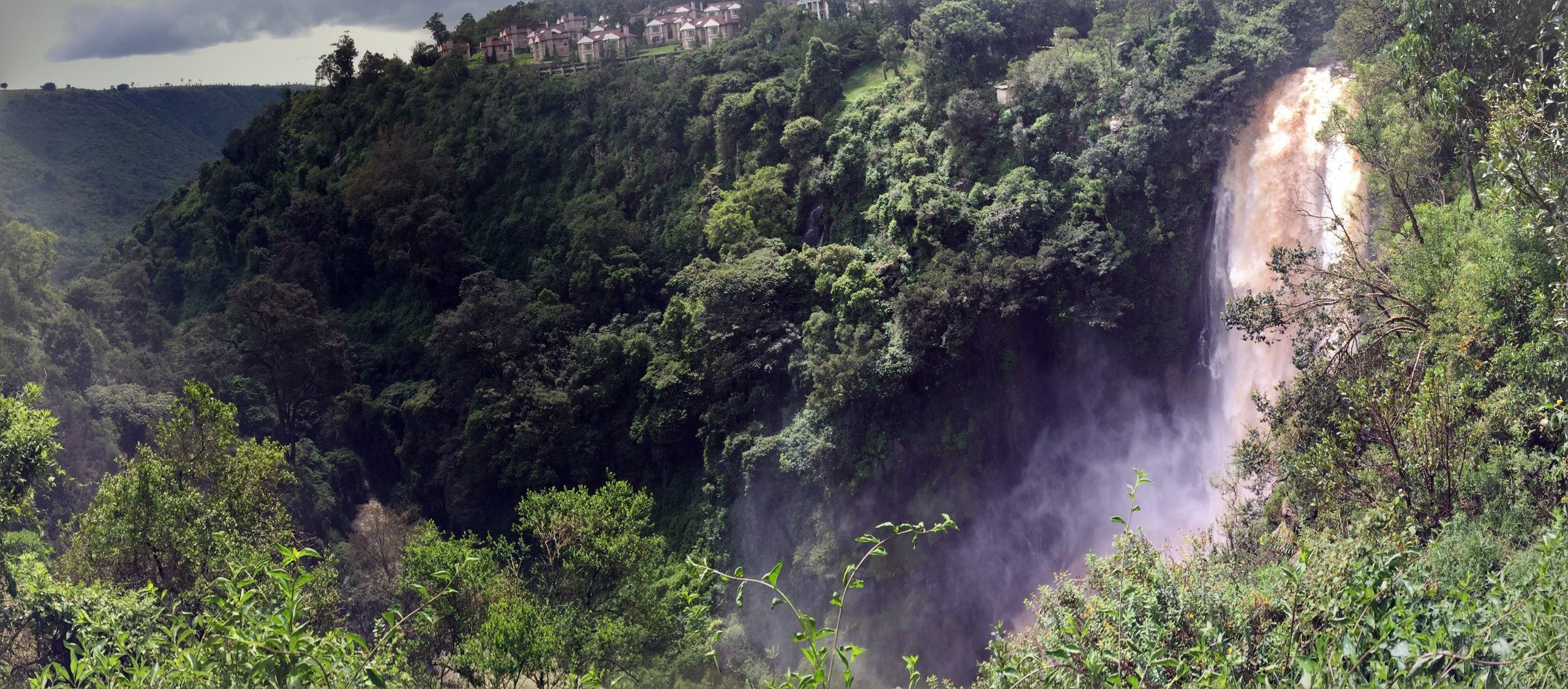
Thomson’s Falls
Thomson’s Falls is a 74 metre drop on the Ewaso Ng’iro river, three kilometres from the town of Nyahururu at around 2,360 metres, and it is the best known waterfall in Kenya. It is not in Nakuru. The falls are at Nyahururu, in Laikipia County, and they sit here under Nakuru because the city is the practical base most visitors reach them from.
Where Thomson’s Falls Actually Is
Nyahururu is the highland town on the boundary country between Laikipia and Nyandarua, north east of Nakuru on the road towards Laikipia. The falls are on its edge, a few minutes from the centre. This matters for planning because Nyahururu is not on the Rift Valley floor at all. It is one of the highest towns in the country and it is cold, wet and green in a way nothing down at Naivasha or Elementaita is.
The river is the Ewaso Ng’iro, the same drainage that runs north east across the Laikipia plateau and on into the dry country beyond. Here it is still a highland stream coming off the Aberdare catchment, and at this point it goes over the lip of a basalt step into a wooded gorge.
Joseph Thomson reached the falls in 1883 on the expedition that took him across Maasai country to Lake Victoria, and named them after his father. The Kenyan name for the town, Nyahururu, has long since become the more common way of referring to the place, and both names are used for the falls themselves.
What the Falls Look Like and When They Are Worth the Trip
The viewpoint is a few steps from the car park, behind a railing, on a terrace shared with curio stalls and men offering photographs. The drop is straight into a narrow wooded gorge and the volume varies enormously with the season. In flood the falls fill the gorge with spray and noise and the view from the top is genuinely impressive. In a dry spell the river thins to a ribbon down a black rock face and visitors who have travelled a long way for it are underwhelmed.
That variability is the single most useful thing to know before going. The falls are at their fullest during and just after the rains, from April into June and again from late October into December, which is the opposite of the advice that governs most Kenyan destinations. Anyone timing a trip specifically for this waterfall should go in the wet months and accept the mud.
The viewpoint is also not the best angle. The view that people travel for is from the base, looking up through the spray, and that means going down.
The Descent to the Base of Thomson’s Falls
A steep path drops from the terrace to the pool at the foot of the falls. It takes fifteen to twenty minutes each way and it is a scramble rather than a walk: loose earth, tree roots used as handholds, rock polished by feet, and everything near the bottom permanently wet from spray. It is not a hike and it is not a stroll. Closed shoes with grip are the difference between a good hour and a fall.
Two things about the descent are consistently under reported and both are worth stating plainly.
The path is slippery in a way that causes real injuries. Rain makes it worse, and the last section stays wet regardless of the weather because of the spray. Going down is harder than coming up. Local advice is to go slowly, use the trees, and turn back rather than commit to a section that looks doubtful.
The forested base has a robbery problem. It is the most photogenic spot and the most enclosed one, and the site carries signage warning about muggings and theft and recommending a guide. Commercial photographers working the falls have complained about it publicly. The practical answer is the one the site itself gives: do not go down alone, go in a group or with one of the guides at the top, and leave anything you would mind losing in the vehicle.
The falls also have a long and distressing record as a suicide site, reported in the Kenyan press over many years and acknowledged in the local policing of the place. It is not a reason to avoid visiting and it is a reason the security presence and the group advice exist.
The Hippo Pool and What Else Is There
Upstream of the falls is a hippo pool, and it is the one genuinely unusual thing about the site beyond the drop itself: hippos at this altitude are rare, and the pool is regularly described as among the highest in Kenya. It is a short walk or a very short drive from the falls and is normally visited with a local guide, since the approach runs along the river bank and hippos on land are dangerous animals.
The gorge below the falls is good for birds, with highland forest species along the water, and it is a pleasant hour for anyone carrying binoculars. Birdwatching in Kenya sets out the highland circuit this belongs to.
The lodge above the falls has been there since the colonial period and is the obvious place for a meal or a night, with the site’s curio market and the usual cluster of guides and photographers around the entrance. The site itself takes an hour or two, or a half day with the descent and the hippo pool.
Getting to Thomson’s Falls and What It Costs
From Nakuru the drive is north east through Bahati and the highland farming country, and Thomson’s Falls is the standard half day excursion from the city. Matatus run the route constantly and drop in Nyahururu town, from which the falls are a short boda boda ride. Coming from the other direction, Nyahururu sits on the natural road between the Rift and Laikipia and Nanyuki, so the falls work as a break in a longer drive rather than a dedicated trip.
The site is open through the day and a small gate charge applies, collected at the entrance. It is managed locally rather than through the national park system, which is why it does not appear on the Kenya Wildlife Service schedule and why the amount is not quoted here: the figures published on travel sites for this gate disagree with each other by a factor of several, none carries a date, and Laikipia County has not published a rate that can be checked. Expect a modest charge, expect it to be payable by mobile money, and confirm it at the entrance.
Take a warm layer. Nyahururu is high and the spray at the bottom of the falls is cold in any month. Waterfall hiking in Kenya covers the country’s other falls and the hazards common to all of them.
Questions Visitors Ask About Thomson’s Falls
Where exactly is Thomson’s Falls?
At Nyahururu, in Laikipia County, about three kilometres from the town centre and a half day round trip from Nakuru. It is frequently listed under Nakuru because that is the city most visitors base themselves in, but the falls are not in Nakuru County.
How high is Thomson’s Falls?
74 metres, in a single drop on the Ewaso Ng’iro river at an altitude of around 2,360 metres. That height is consistently given and makes it one of the highest single drop waterfalls in Kenya.
Can you walk to the bottom?
Yes, on a steep and slippery path that takes fifteen to twenty minutes each way. It is a hands on scramble rather than a trail, the last part is permanently wet from spray, and closed shoes with grip are essential.
Is it safe at the base of the falls?
Go in a group or with a guide from the top. The forested base is enclosed and the site carries signage about muggings and theft, so the standard local advice is not to descend alone and not to carry anything you would mind losing.
When is the best time to see Thomson’s Falls?
During and shortly after the rains, roughly April to June and late October to December, when the river is full. This reverses the usual Kenyan advice. In a dry spell the falls thin out considerably and the visit is much less impressive.
Is there an entrance fee?
A small charge is collected at the gate. The site is managed locally rather than by Kenya Wildlife Service, the published figures on travel sites contradict each other, and no official rate could be verified, so confirm the amount on arrival.
Are there really hippos there?
Yes, in a pool on the river upstream of the falls, frequently described as one of the highest hippo pools in Kenya. Visit it with a local guide rather than walking the bank alone.
How long should be allowed for a visit?
An hour or two for the viewpoint and the curio stalls. Half a day if the descent to the base and the hippo pool are included, which is the version worth doing.
2 Places to Visit in This Area
Other sites in Nakuru, each with its own guide.
Safaris That Visit Nakuru
Every safari listed here that visits Nakuru. Each is sold and run by an independent tour company. This site lists them and passes on enquiries; it takes no booking and charges you nothing.
Open the full Nakuru listing
