
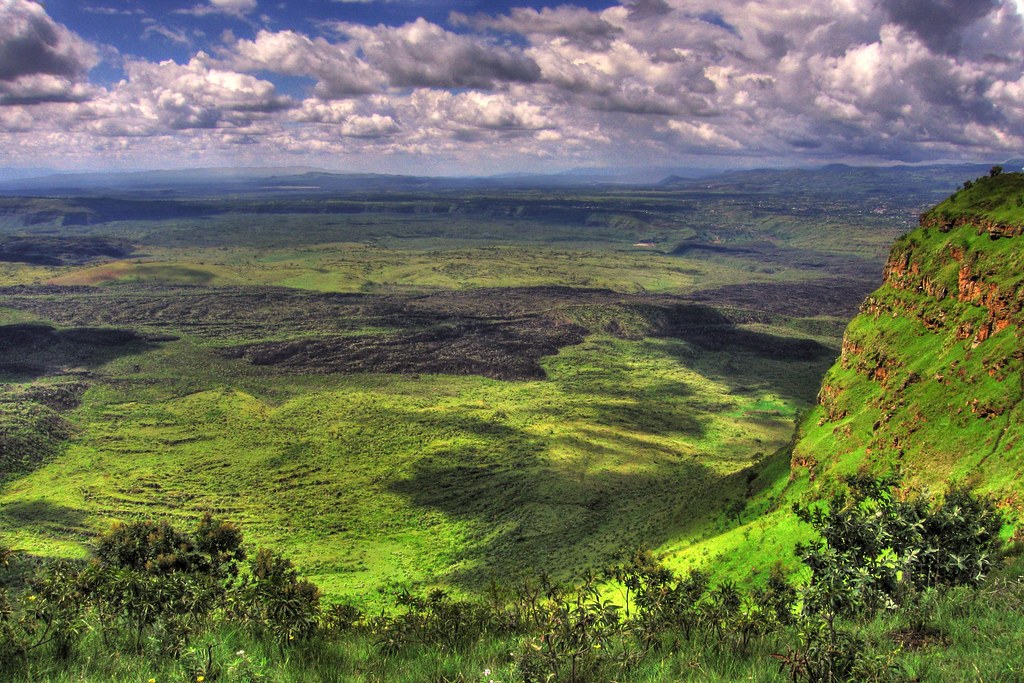
Menengai Crater
Menengai is the enormous volcanic caldera that fills the horizon north of Nakuru. It is the largest caldera in Kenya, the road to its rim viewpoint takes about twenty minutes from the middle of the city, and there is a national geothermal project drilling on its floor. Most visitors see the first of those things and are surprised by the third.
The Size of the Thing
The Kenya Forest Service, which manages the forest on and around the crater, gives Menengai as roughly 90 square kilometres with a diameter of about 12 kilometres and a depth approaching 500 metres, and places it among the largest calderas in the world. The Smithsonian’s Global Volcanism Program and the published geological literature describe a caldera of about 12 by 8 kilometres formed around eight thousand years ago, on a shield volcano whose high point stands at 2,278 metres.
Those numbers do not prepare anyone for the view. A caldera is not a crater in the sense of a bowl with a visible far side at a comfortable distance. From the viewpoint the opposite rim is a low ridge on the horizon and the floor below is a landscape rather than a feature, black lava flows in ropes and ridges, patches of bush, dust tracks, and steam standing up from the ground in several places at once.
One claim made about Menengai everywhere deserves a caveat. It is routinely called the second largest caldera in Africa and sometimes the second largest in the world. The first of those is what most reference sources say; the second is not supportable and should be ignored.
The Geothermal Field on the Crater Floor
The steam is not decorative. Menengai is one of Kenya’s major geothermal prospects and the Geothermal Development Company has been drilling on the caldera floor since 2009. The company states that the field is estimated to hold a potential of 1,600 MW, that the long term target is 465 MW of steam equivalent developed in five phases, and that 53 wells with a potential of 169 MW had been drilled by 2023. Phase one is 105 MW split between three independent power producers, of which the first plant connected to the grid in 2023 and a second in March 2026. Roads, water lines and a steam gathering system have been built across the floor to serve it.
This changes what a visit is. Menengai is not an empty volcano with a walking trail in it. It is a working industrial site inside a caldera that is also a forest reserve and a viewpoint, and the tracks on the floor carry drilling traffic. Visitors who descend find well heads, pipework and vehicles alongside the lava. Anyone whose picture of the place is untouched wilderness should adjust it before arriving rather than at the rim.
The view from the rim is unaffected. The development is on the floor and mostly at the northern and eastern end, and from the viewpoint it reads as steam plumes in a very large landscape.
What There Is to Do at the Rim and on the Floor
The rim viewpoint is the default visit and it is genuinely a five minute affair if that is all it is. A tarmac road climbs from the Nakuru side to a car park at the edge, there are curio stalls, and the view runs south over the city towards Lake Nakuru and, on a clear morning, much further down the Rift.
The walking is what justifies the trip. Routes run along the rim in both directions and down into the caldera on rough paths, and the descent and return is a half day of real effort at about 2,000 metres with no shade for most of it. The Kenya Forest Service makes guides available for hire at the gate and taking one is the normal arrangement for going below the rim, both for route finding and because the floor is large, hot and featureless once the rim is out of sight.
The forest itself is the other reason to come. Kenya Forest Service records over 169 species of flowering plants and 17 species of grasses on the reserve, with rock hyrax, baboon and vervet monkey on the ground, and raptors including Verreaux’s eagle along the cliffs. Camping and picnic sites and curio shops are on the reserve, plastic bottles are banned, and there is a 40 kph limit on the forest roads.
| What | Time needed | Notes |
|---|---|---|
| Rim viewpoint | Under an hour | Tarmac road, car park, curio stalls |
| Rim walk | Two to three hours | Exposed, no water on the route |
| Descent to the floor and back | Half day | Guide advisable, industrial traffic on the tracks |
| Camping | Overnight | Kenya Forest Service sites on the reserve |
The Name and the History People Come For
Menengai carries a great deal of oral history and it is worth separating what is tradition from what is record. The name is widely explained as deriving from a Maa word for the dead, and the tradition attached to it holds that a nineteenth century battle between Maasai sections ended with the defeated driven over the caldera rim. That account is consistently repeated and is a tradition rather than a documented event, and it is the reason the crater is sometimes translated as the place of corpses.
Two later layers sit on top of it. The caves in the crater walls are reported to have sheltered fighters during the independence struggle. And the southern side of the crater is used today by Christian groups who go there to pray and fast, sometimes for long periods, which is why a walker on the lower paths may come across people who are not there as visitors. That is worth knowing in advance, and the appropriate response is to leave them alone.
Getting to Menengai Crater and What It Costs
The crater rim sits roughly 10 kilometres north of Nakuru city centre and the drive takes about twenty minutes on tarmac. Boda bodas make the trip from the centre routinely and it is a short hop; taxis and tour vehicles use the same road. Access is through the Kenya Forest Service, at the Menengai forest station and the crater viewpoint gate, and entry is between 6am and 6pm unless camping.
A gate charge applies, paid to the Kenya Forest Service on arrival. Kenya Forest Service does not publish a rate for Menengai on its own site and the figures circulating on travel pages disagree with each other and are of uncertain vintage, so no figure is given here. Ask at the gate, and expect guide hire to be a separate arrangement.
Menengai works well as a first or last hour of a Nakuru day, and it pairs naturally with Lake Nakuru National Park on the other side of the city or with Hyrax Hill, which looks out over the same lake from the opposite direction. Hiking in Kenya places it among the country’s volcanic walks, and the Great Rift Valley page explains the geology it belongs to.
Go early. The view south is at its best in the first hours of the day, before haze builds over the city and the valley, and the walking is only pleasant before the sun is high.
Questions Visitors Ask About Menengai Crater
How long does a visit to Menengai take?
Anything from half an hour to a full day. The rim viewpoint is a short stop reached by tarmac. A rim walk is two to three hours and a descent to the caldera floor and back is a half day of exposed walking at altitude.
Can you drive to the top?
Yes. A tarmac road climbs from the Nakuru side to a car park at the rim viewpoint, which is why Menengai is the easiest of Kenya’s big volcanic features to see and the least demanding to reach.
Is it safe to walk down into the crater?
With a guide and an early start, yes. The hazards are heat, distance, no water on the route and the loss of landmarks once the rim is behind you, rather than wildlife. There is also drilling traffic on the floor tracks, so walkers should expect vehicles.
Is there really a power project inside the crater?
Yes. The Geothermal Development Company has been drilling on the caldera floor since 2009 and states that 53 wells with a potential of 169 MW had been drilled by 2023, with the first phase of 105 MW contracted to independent producers. Steam plumes, well heads and pipework are visible from the rim and close up on the floor.
Is Menengai the largest crater in Africa?
It is the largest caldera in Kenya and is generally described as the second largest in Africa. The claim that it is the second largest in the world circulates widely and is not supportable.
How far is Menengai from Nakuru?
About 10 kilometres from the city centre to the rim, roughly twenty minutes by road. It is close enough to do before breakfast from a bed in the city, which is the argument for staying in Nakuru rather than passing through.
Are there animals in the crater?
Rock hyrax, baboon and vervet monkey are routine on the reserve, with raptors along the cliffs, and Kenya Forest Service records over 169 flowering plant species in the forest. This is a forest and geology destination rather than a game destination.
2 Places to Visit in This Area
Other sites in Nakuru, each with its own guide.
Safaris That Visit Nakuru
Every safari listed here that visits Nakuru. Each is sold and run by an independent tour company. This site lists them and passes on enquiries; it takes no booking and charges you nothing.
Open the full Nakuru listing
