
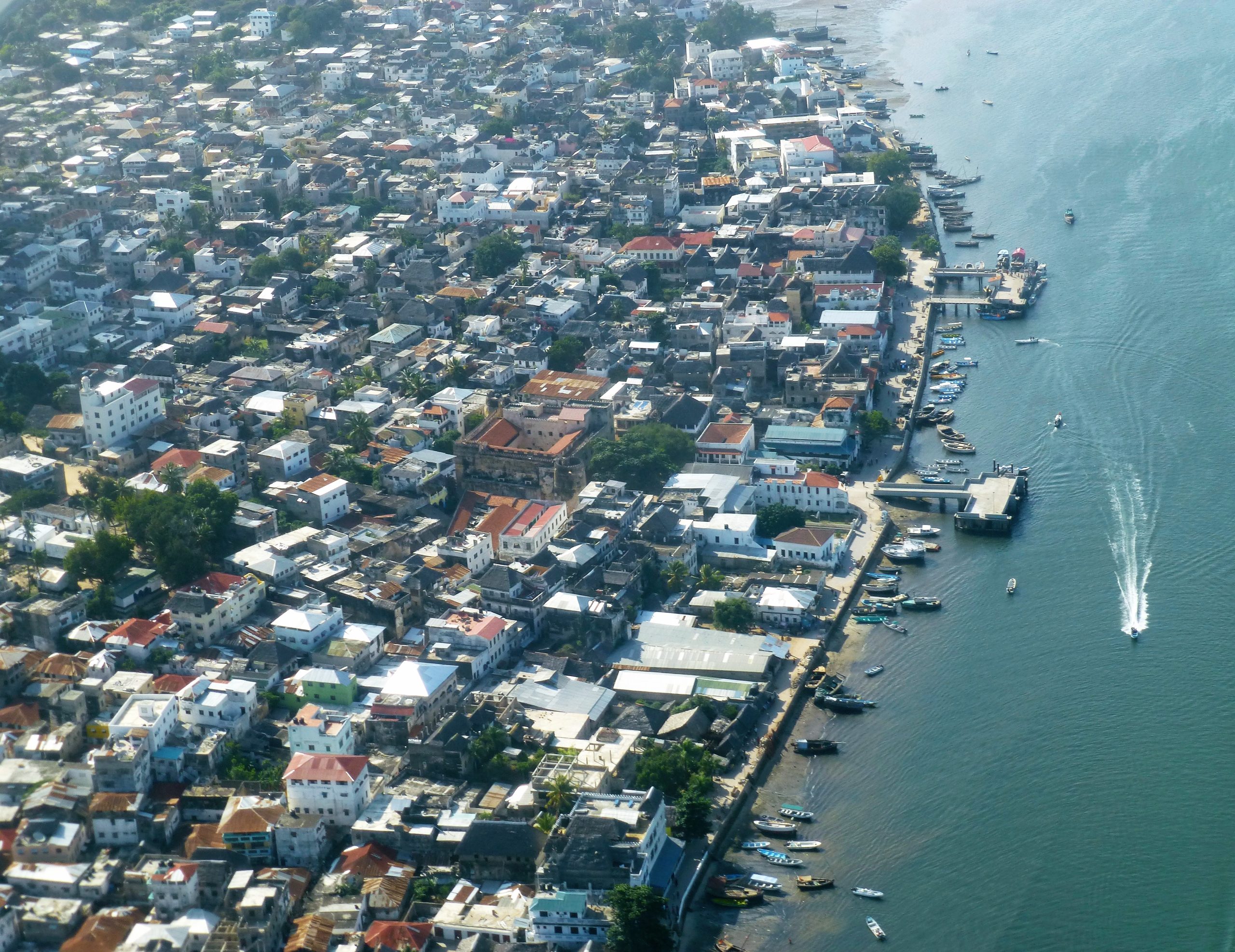
Lamu Old Town
Lamu Old Town is a UNESCO World Heritage property on the Kenyan coast, and it is the oldest and best preserved Swahili settlement in East Africa. What matters most about it is that it was never abandoned. Other Swahili towns along this coast emptied out and became archaeological sites. Lamu kept going, and the property inscribed in 2001 is a place where several thousand people live, work, pray and trade today.
This is a working town, not an open-air museum. The alleys are people’s front doorsteps, the carved doors belong to families, and the courtyards behind them are private homes. That is the starting point for everything below.
What UNESCO Inscribed in 2001
The property is listed as Lamu Old Town, dossier 1055, inscribed in 2001 under cultural criteria two, four and six. The inscribed core is 15.6 hectares, with a buffer zone of 1,200 hectares, and the World Heritage Centre’s own integrity statement describes the core as a collection of buildings on about 16 hectares. Nationally it was gazetted as a monument in 1996, five years before the international listing, according to the National Museums of Kenya curator responsible for the Lamu sites.
Criterion two rests on architecture and urban structure. UNESCO’s wording is that they graphically demonstrate cultural influences that came together over several hundred years from Europe, Arabia and India, worked through traditional Swahili technique into a distinct culture. Criterion four covers the growth and decline of the East African seaports and the interaction between Bantu, Arabs, Persians, Indians and Europeans, which UNESCO says finds its most outstanding expression here. Criterion six is about function rather than fabric: Lamu’s trading role and its pull on scholars and teachers gave it a religious importance across East and Central Africa, named in the citation through the annual Maulidi and cultural festivals, and it remains a centre for education in Islamic and Swahili culture.
Two and four are about buildings. Six is about the people in them, which is why a conservation problem in Lamu is never only a conservation problem.
The Town That Was Never Abandoned
UNESCO records Lamu as continuously inhabited for over seven hundred years. The National Museums of Kenya’s own material goes further, dating the town’s founding to the eighth century and describing it as a rich trading town by the fourteenth, exporting mangrove poles, ambergris and cereals to Arabia, Persia, India and China against Chinese porcelain and Persian rugs. Those are not the same claim, and this page gives both.
Continuity is also measurable in the buildings. UNESCO’s integrity assessment records that about 65 percent of the physical structures are in good condition, 20 percent need minor refurbishment and 15 percent may need total restoration, and states plainly that the majority of the town’s buildings are still in use. That last clause is the whole character of the place.
Coral Stone, Lime and Mangrove Poles
The building system is local and it is still in use. Walls are coral stone set in lime, roofs and floors are carried on mangrove poles cut from the creeks around the archipelago, and UNESCO describes the surviving buildings as carrying a long history of the development of Swahili building technology on exactly those three materials.
Approached from the water, the seafront reads as one continuous run of arcades and open verandas, which UNESCO singles out as giving a unified visual impression of the town from the sea. Step through a door and the vocabulary changes. Interiors carry painted ceilings, large wall niches called madaka, small ones called zidaka, and pieces of Chinese porcelain set into the plaster, which is trade history built into a wall.
The carved doors are the thing most visitors photograph, and they are the visible end of a living craft: woodcarving workshops still operate in the town.
Narrow Streets, Wards and Barazas
Lamu’s street plan is not accidental and it is not decorative. UNESCO traces the labyrinth pattern to Arab traditions of land distribution and urban development, and describes the town as organised into clusters of dwellings divided into small wards called mitaa, each a group of buildings housing a number of closely related lineages.
The authenticity statement adds the social spaces that hold the pattern together: the porches known as daka, the town squares, and the stone benches along the seafront called barazas, where the town’s public life happens in the open. The streets are also narrow enough to stay shaded for most of the day, which is why a hot island town is comfortable to walk at noon.
Walking the Old Town
The inscribed area is small enough to cross on foot in a few minutes, which is misleading. The interest is the density, not the distance, and the alleys genuinely confuse people on a first visit, so a guided walk on the first morning earns its place. Walks commonly run two to three hours, and Mkunguni Square in front of the fort is where most of them start. The usual circuit takes in Lamu Fort, the Lamu Museum on the waterfront, the market, Riyadha Mosque, the German Post Office, the Swahili House Museum, and workshops where woodcarving, silverwork and weaving are done. The National Museums of Kenya runs five thematic museums inside the World Heritage site itself.
Rooftops are the other reason to take a guide. The only elevated views over the roofscape and across to Manda are from the fort and from private terraces, and access to the second depends entirely on who is walking with you.
The town’s living culture is covered by the Swahili cultural experiences guide, and heritage tours covers how Kenya’s coastal monuments are usually strung together.
Who Manages the Property
Lamu Old Town is managed under the National Museums and Heritage Act 2006, which replaced the earlier National Museums Act and Antiquities and Monuments Act, alongside local government legislation. Construction inside the town is also subject to environmental management law and the 2006 Planning Act, which recognise archaeology as a material consideration.
The National Museums of Kenya has run a dedicated office for the site since 1986, originally the Lamu Stone Town Conservation Office and now the Lamu World Heritage Site and Conservation Office. A planning commission has existed since 1991, and a conservation plan balances development pressure against the town’s architectural values.
The streets themselves are public thoroughfares. The museums inside the property are separate ticketed sites run by the National Museums of Kenya, priced under Legal Notice No. 79 of 2025, and a combined ticket covers four of them. The Lamu Fort page carries the rates.
The Threats UNESCO Names
The World Heritage Centre is unusually blunt about what endangers this property, and none of it is about the buildings falling down. The gazetted buffer zone covers the Manda and Ras Kitau mangrove skyline and the Shela sand dunes, protected under forest and water legislation, though UNESCO notes the buffer zone has not been formally approved by the World Heritage Committee. Encroachment and illegal development on the Shela dunes is named as a threat to the town’s visual integrity and, because the dunes supply its fresh water, to its ultimate survival. Informal settlements in the setting, a proposed port and cruise ship berth, and oil exploration are the other issues a draft management plan was developed to address.
Read together with criterion six, the logic is consistent. A town listed partly for its continuing social and religious function can lose its listing qualities without a single building collapsing.
Custom in a Working Muslim Town
UNESCO’s citation describes Lamu as a conservative and close-knit society and treats that cohesion as part of what is protected. In practice: shoulders and knees covered in the old town and the markets, swimwear kept to the beach, care around photographing people, and restraint during Ramadan daylight hours. The Lamu guide sets out the rest, including transport and what the absence of cars means day to day.
Questions About Lamu Old Town
Is Lamu Old Town the same as Lamu Island?
No. Lamu Island is the island. Lamu town is the main settlement on it. Lamu Old Town is the World Heritage property inside that town, an inscribed core of 15.6 hectares, with a buffer zone of 1,200 hectares that reaches well beyond it to the Shela dunes and the Manda and Ras Kitau mangroves.
Why was Lamu Old Town given World Heritage status?
It was inscribed in 2001 under three cultural criteria: for architecture and urban structure showing several hundred years of influence from Europe, Arabia and India worked through Swahili technique; for expressing the growth and decline of the East African seaports and the interaction between Bantu, Arab, Persian, Indian and European peoples; and for its continuing religious and educational function in Islamic and Swahili culture, which the citation ties to the annual Maulidi and cultural festivals.
Are there ruins to see in Lamu Old Town?
Not really, and that is the point of the place. Lamu is a living town whose buildings are still lived in, which is what distinguishes it from the abandoned Swahili settlements elsewhere on this coast. For standing ruins, the nearest sites are Takwa on Manda Island and the larger sites on Pate Island.
Can visitors go inside the Swahili houses?
The houses are private homes. The Swahili House Museum exists precisely so that the interior of a traditional stone house, with its painted ceilings and wall niches, can be seen without anyone knocking on a family’s door. A guide can sometimes arrange access to a courtyard or a rooftop, but that is an invitation rather than an entitlement.
What is the difference between Lamu Old Town and Gedi?
Gedi is an excavated and abandoned Swahili town inscribed by UNESCO in 2024. Lamu is an inhabited one inscribed in 2001. The two listings sit either side of the same history, and seeing both is the clearest way to understand what happened to Swahili urban civilisation on this coast.
Lamu Old Town sits within the wider Lamu guide, alongside Shela, Manda Island and Pate Island. For the coast as a whole, start at Kenya Coast.
3 Places to Visit in This Area
Other sites in Lamu, each with its own guide.
No operator on the marketplace currently lists a safari to Lamu.
See every Kenya safari