
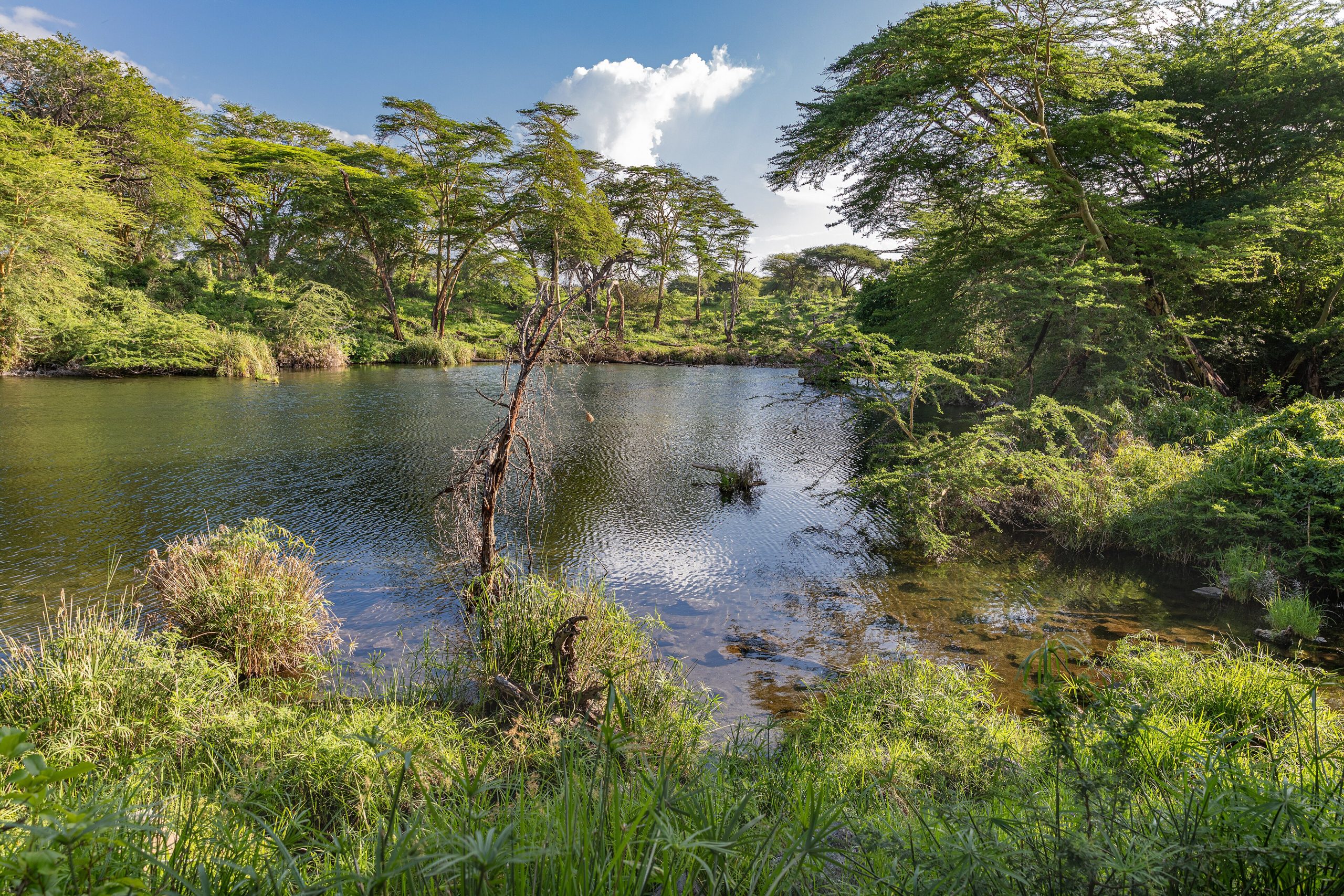
Mzima Springs
Mzima Springs is a set of clear pools in the north of Tsavo West National Park, surrounded by dry volcanic bush, fringed by raffia palms and fig trees, and holding hippo, crocodile and shoals of barbel. It is the best known feature of the park and the only one most visitors get out of the vehicle to see. What makes it worth understanding rather than simply photographing is where the water comes from.
Why the Water at Mzima Springs Is Clear
The springs are fed from the Chyulu Hills, roughly 50 kilometres to the north. The Chyulus are a young volcanic range built of lava and ash, and the rock is so porous that rain falling on them does not form rivers. It sinks. The water moves underground through the volcanic pile, filtering as it goes, and emerges at the foot of an old lava flow at Mzima.
The transit is not quick. Published accounts of the system put the underground journey at up to around 25 years. The rain that surfaces at Mzima this morning fell on the Chyulu Hills before most of the people watching it were paying attention to rainfall at all, and it arrives having been stripped of sediment by several dozen kilometres of volcanic rock. That is the whole explanation for the transparency, and it is a better one than the springs simply being fed by a clean stream.
The water surfaces, runs through a chain of pools for about two kilometres, and then disappears underground again. Downstream of the springs the surface flow ends and the dry bush resumes as though nothing had happened.
Figures for how much water Mzima discharges each day are widely published and they do not agree with one another. Kenya Wildlife Service describes the flow qualitatively on its own park page without giving a number, and the discharge figures circulating elsewhere differ by a factor of nearly two. None is used here.
The Upper Pool, the Lower Pool and the Walk
The visit is a loop on foot from the car park, and it is one of very few places in a Kenyan national park where walking is a normal part of the day rather than a special arrangement. The path runs along the upper pool, crosses towards the lower pool and comes back through the palms and figs.
It is short and level, and it is not a hike. Sturdy shoes are enough. What it is not is a casual stroll: hippo paths cross the trail, crocodile use the pools, and the walk is done with a Kenya Wildlife Service ranger. That escort is the reason the walk exists.
The vegetation along the water is worth as much attention as the wildlife. Raffia palm, doum palm and large fig trees form a corridor of genuine shade in a park that offers very little of it, and the contrast between that corridor and the lava country either side of it is the point of the whole place.
The Underwater Viewing Chamber
Mzima’s distinctive feature is a submerged viewing chamber reached by a short walkway and steps, built so that visitors can look sideways into the pool at hippo, crocodile and fish from below the surface. When it works, there is nothing else like it in Kenya.
It does not always work. Visitor accounts in recent years consistently describe the chamber as in need of repair, with limited visibility through the glass, and at times as closed for maintenance. Some describe the view as no more than a glimpse of a fish or two. Whether the chamber is open and whether the water is clear enough to see through it are both worth asking at Mtito Andei or Chyulu Gate before planning a visit around it, because the answer changes.
The surface viewing does not depend on the chamber. Hippo are visible from the bank, barbel shoal in the shallows where the water is clearest, and the fish are easier to see from above the water than from inside the tank on a bad day.
Hippo and Crocodile at Mzima Springs
Hippo are the animal Mzima is associated with, and the population has moved a great deal. Counts cited by conservation organisations working in Tsavo put around 70 hippo at the springs in 2003 and as few as five by September 2009, a collapse attributed to drought. Numbers have recovered since, but the history is worth knowing, because a guide page promising a certain sight is promising something the springs have not always delivered.
Hippo matter to the springs beyond being the attraction. They graze at night and return to the water, moving nutrients into the pools, and that input feeds the algae, invertebrates and fish that the rest of the system runs on. The clarity of the water is what makes this visible, which is why researchers have used Mzima specifically to study hippo behaviour that is impossible to observe in a muddy river like the Mara.
Crocodile are present and are generally seen on the banks rather than in the water. Vervet monkey and baboon are constant along the trail, and both have learned what a picnic looks like. Birds along the water include kingfishers, herons, fish eagle and a range of bee-eaters.
The Pipeline to Mombasa
Mzima is not only a wildlife site. Since the 1950s its water has been piped to the coast, and the Mzima pipeline still supplies part of Mombasa’s municipal water. Reporting on the Kenyan coastal water supply describes the original line as long past its design life, with actual delivery well below its nominal capacity because of leaks and deterioration, and a second Mzima pipeline has been proposed and delayed repeatedly over decades.
That matters to a visitor for one reason. The pools at Mzima are a municipal water source for a city of well over a million people as well as a place where hippo live, and the long-running concern over falling spring levels is about both at once. Standing at the upper pool, the thing to understand is that the Chyulu Hills, the springs, the park’s wildlife and the taps in Mombasa are all one system.
Visiting Mzima Springs
- Mzima sits in the north of Tsavo West, within an easy morning of Mtito Andei Gate, Chyulu Gate and the northern lodges. It is on the standard northern circuit and most itineraries include it.
- Go early. The walk is unshaded between the car park and the water, the light on the pools is better before mid-morning, and hippo are more likely to be out of the water at the start of the day.
- A ranger accompanies the walk. Arranging it is done at the site or through your camp rather than negotiated on the trail.
- Tsetse are a recurring complaint in this part of the park. Light colours help, and dark blue and black attract them.
- Single-use plastic is prohibited in Kenyan national parks, so bring a refillable bottle.
- Do not feed the monkeys, and do not leave food unattended at the car park.
Mzima Springs Questions
Is the underwater viewing chamber open?
It has been reported as needing repair, and at times closed, over a long period. Treat it as a bonus rather than the reason for the trip, and confirm the current position at the gate. The surface viewing is reliable whatever state the chamber is in.
Do I need a ranger to walk at Mzima Springs?
Yes. The walk is escorted by a Kenya Wildlife Service ranger, which is why it is permitted at all in a park where getting out of the vehicle is otherwise restricted to designated viewpoints.
How long does a visit take?
The loop itself is short. Allow an hour to ninety minutes at the springs to do it properly, more if the hippo are active or the birding is good, and factor the drive from wherever you are based in the park.
Will I definitely see hippo?
Usually, but not certainly. The population at the springs has fluctuated sharply, most dramatically during the drought years around 2009, and hippo submerge for long periods. Crocodile, barbel and the birdlife are more consistently visible.
Is Mzima Springs suitable for children?
The walk is short and flat, which suits most ages. The constraints are the ones that apply to any walk in a national park: children stay with the group and with the ranger, hippo and crocodile are genuinely dangerous, and the monkeys are bold around food.
Can the springs be visited as a day trip from Amboseli?
Chyulu Gate links Tsavo West directly to Amboseli, so the drive is possible, but it makes for a very long day and it means paying entry to a second park for a single stop. Most itineraries that include Mzima give Tsavo West at least one night.
Mzima Springs and the Rest of Tsavo West
Mzima is the water in a park otherwise defined by lava. It pairs naturally with the Shetani Lava Flow and Chaimu Crater near Chyulu Gate, which are the surface expression of the same volcanic system that delivers the water underground, and with Roaring Rocks for the overview. Seasons, access, fees and where to stay belong to the Tsavo West guide, and the national index of sights is on the Kenya attractions hub.
4 Places to Visit in This Area
Other sites in Tsavo West National Park Safari Guide, each with its own guide.
Safaris That Visit Tsavo West National Park
3 of the 5 safaris listed here that visit Tsavo West National Park, from different operators where the listings allow it. Each is sold and run by an independent tour company. This site lists them and passes on enquiries; it takes no booking and charges you nothing.


7 Days Wildlife Safari in Kenya
by Kori Safaris Verified operator
Operator quotes on request
View Safari

Kenya Classic: Amboseli, Tsavo & the Mara
by Ancient Africa Safaris Verified operator
From $9,400 per person
View Safari

3 Days Tsavo East and Tsavo West Safari
by Tranquil Safaris Verified operator
Operator quotes on request
View Safari