
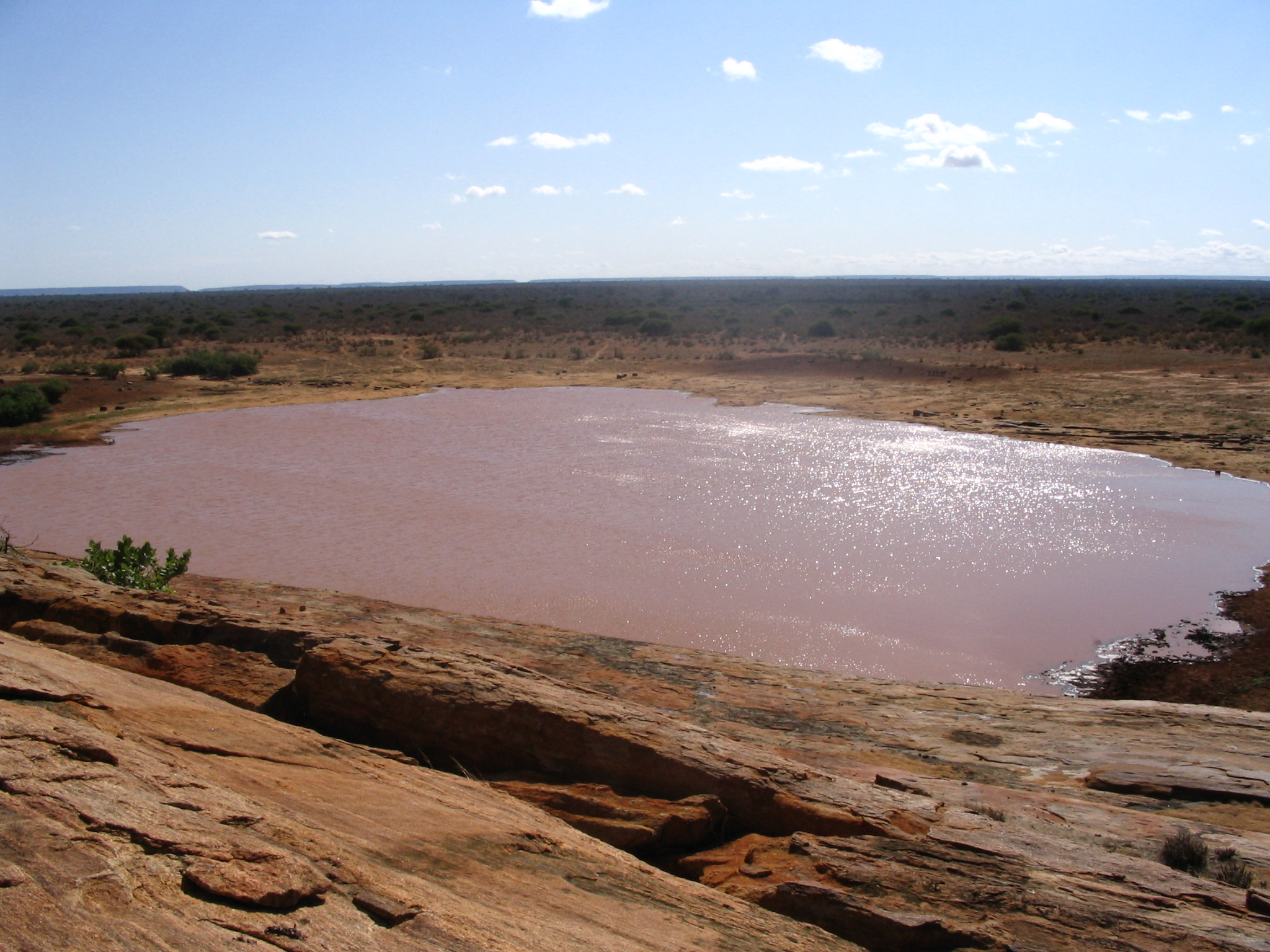
Mudanda Rock
Mudanda Rock is a long whaleback of stone standing out of the flat bush in the southern part of Tsavo East National Park. It does two things no other feature in this sector does: it harvests rainwater into a waterhole at its foot, and it gives visitors somewhere to stand above a park with almost no high ground. In the dry season the combination puts you looking down on elephants at water, on foot, which is as close to a guaranteed sight as Tsavo East offers.
What Mudanda Rock Is
The rock is an inselberg, an isolated outcrop of hard stratified rock left standing while the softer ground around it eroded away over a very long period. Published descriptions give its length as about 1.6 kilometres. That figure is sometimes reproduced as a height of 1,600 metres, including by at least one major reference work; it is a length, and the rock rises only modestly above the plain.
The surface is smooth and slopes, which is the whole point. Rain falling on a kilometre and a half of bare rock does not soak in. It runs off, collects along the base, and fills a natural dam on one side. In a park where the seasonal pans go dry and the rivers are a long way off, a catchment that size makes a reliable difference.
Elephants at the Waterhole
Through the dry months the waterhole below the rock pulls in elephant in numbers, along with buffalo, zebra, antelope and whatever predators are working the area. The Tsavo Conservation Area holds the largest elephant population in Kenya, and Mudanda is one of the places where that is obvious rather than theoretical.
Two things temper it. The first is that the waterhole is seasonal in its own right and has been reported to dry out in hard years, so the sight depends on there having been enough rain to charge it. The second is timing: animals come to water in the heat of the day and in the late afternoon, which is the opposite of the usual advice to game drive early. Mudanda rewards a mid-morning or afternoon stop more than a dawn one.
The red on the elephants is Tsavo’s iron-rich laterite rather than anything biological. They dust and wallow in it, and a herd arriving dusty and leaving wet visibly changes colour over an afternoon.
Walking Up Mudanda Rock
The walk to the top is short and does not need equipment, but it is a scramble on rock rather than a path, and the surface is slick where it is worn. It is one of the few places in Tsavo East where leaving the vehicle is normal.
From the top the view runs across flat bush in every direction, with the waterhole directly below. Elevation of any kind is scarce in this park, so the practical value is not the panorama so much as the angle: looking down at animals at water rather than across at them through scrub is a different kind of viewing, and it is far better for photography.
- Take water and a hat. There is no shade on the rock and it radiates heat well into the afternoon.
- Footwear with grip matters more than it sounds. Smooth rock with a dusting of grit is the surface that catches people out.
- Stay back from the edges above the waterhole. Elephant below will know you are there.
- Sound carries down. A quiet group sees more than a loud one.
- Walking anywhere in a national park is arranged through your camp or with a ranger rather than decided on the spot. The walking safaris in Kenya guide sets out where foot activity is properly established.
Reaching Mudanda Rock
Mudanda sits in the southern sector between Voi and Manyani, which puts it on the part of the park where nearly all game drives run and within easy reach of the main gates on the Nairobi to Mombasa highway. Unlike Lugard Falls, which is a day’s outing from the Voi end, Mudanda fits into a normal half-day circuit without restructuring the itinerary.
That accessibility is why it appears on almost every Tsavo East schedule, and why it is usually the first stop where anybody gets out of the vehicle.
Mudanda Rock Questions
How long is the climb?
A few minutes to the top for most people. It is a short scramble rather than a hike, and the constraint is heat and grip rather than distance or fitness.
Will there be elephants?
In the dry season, when the waterhole is holding water, very often, and sometimes in large numbers. In the wet season animals disperse because water is available everywhere, and the rock becomes a viewpoint rather than a wildlife hide.
What time of day is best?
Later than you would expect. Animals come to water through the heat of the day and into the afternoon, so a mid-morning or late-afternoon stop generally beats a dawn one here, which is the reverse of the rule for the rest of the park.
Is it safe to be out of the vehicle?
It is a designated place to do so, and the rock itself puts height between visitors and the animals at the water. The hazards are the ordinary ones: slippery rock, no barriers, heat, and the fact that this is a national park where game moves freely. Follow whatever your guide or the ranger says.
Does the waterhole ever dry up?
Yes. The dam is fed entirely by runoff from the rock, so a poor rainy season leaves it low or empty, and that has been reported more than once. Asking at the gate is worth the thirty seconds it takes.
Mudanda Rock in a Tsavo East Trip
Mudanda is the easiest of Tsavo East’s four named sights to include and the one most likely to produce animals. Taken with the Yatta Plateau on the western skyline and Aruba further east, it covers most of what the southern sector has to show beyond the game itself. Fees, gates, seasons and access belong to the Tsavo East guide, and the index of named sights across Kenya sits on the Kenya attractions hub.
3 Places to Visit in This Area
Other sites in Tsavo East National Park Safari Guide, each with its own guide.
Safaris That Visit Tsavo East National Park
3 of the 4 safaris listed here that visit Tsavo East National Park, from different operators where the listings allow it. Each is sold and run by an independent tour company. This site lists them and passes on enquiries; it takes no booking and charges you nothing.


7 Days Wildlife Safari in Kenya
by Kori Safaris Verified operator
Operator quotes on request
View Safari

3 Days Tsavo East and Tsavo West Safari
by Tranquil Safaris Verified operator
Operator quotes on request
View Safari
12 Days Best of Kenya Safari
by Kori Safaris Verified operator
Operator quotes on request
View Safari