
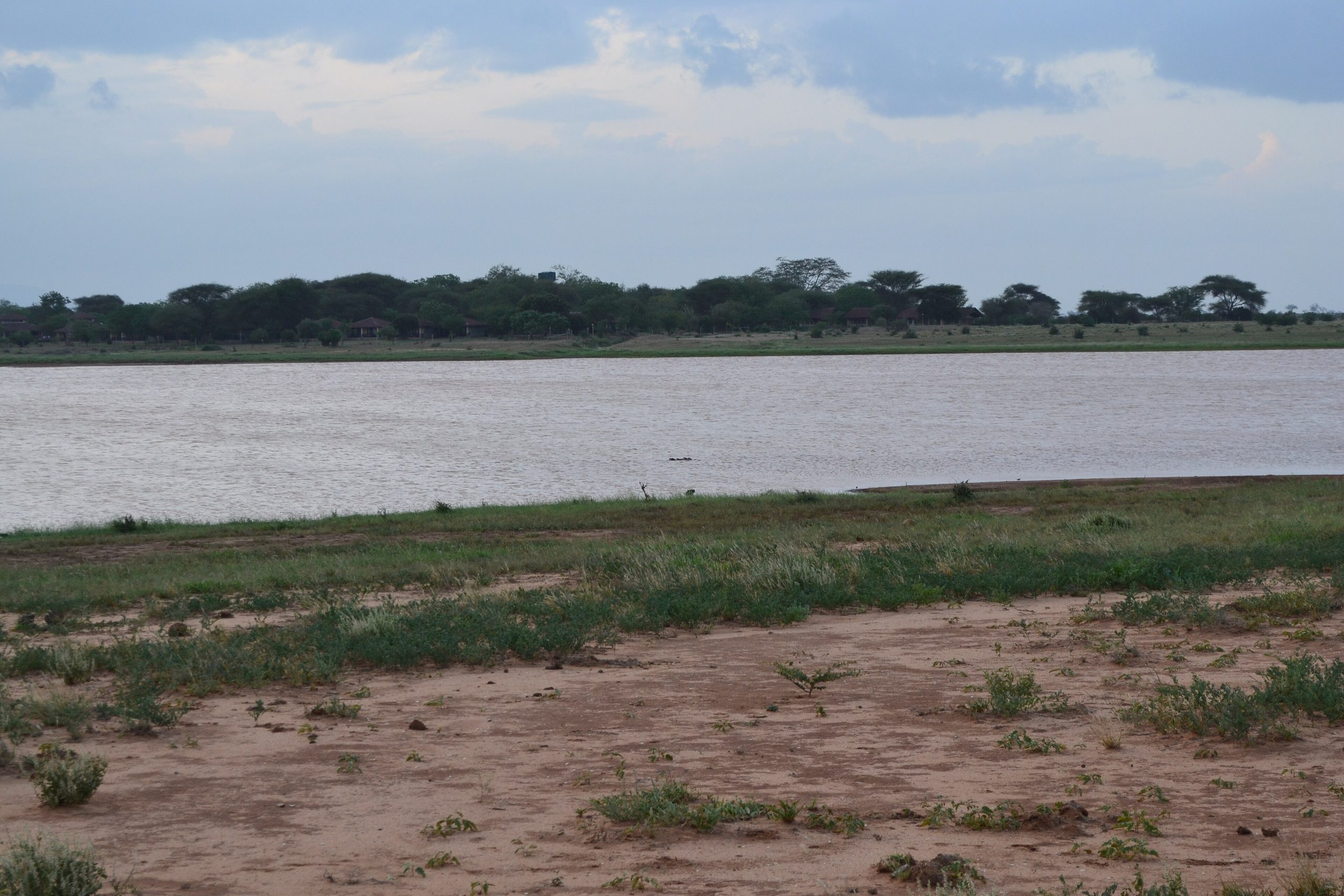
Aruba Dam
Aruba is a dam on the Voi River in the southern sector of Tsavo East National Park, built in 1952 to hold dry-season water for wildlife. For decades it was the most reliable game-viewing point in the park. It is not that now. The reservoir has silted heavily, the Voi River has become unreliable, and Aruba should be approached as a seasonal pan that may or may not be holding water rather than as the standing lake it is still described as.
Kenya Wildlife Service now lists the site among the park’s attractions as the Aruba Dam Game Viewing Point, without describing a reservoir. A rehabilitation programme launched in May 2021 has not restored it. Ask at the gate whether there is water before building a drive around it.
What Happened to Aruba
The dam was built across the seasonal Voi River, which rises in the Taita hills and runs through the park. Two things went wrong over seventy years. The first is siltation: a dam on a seasonal river carrying a heavy sediment load fills with sediment, and Aruba largely has, leaving a shallow pan with far less capacity to hold water through a dry season.
The second is the river. The Voi has been badly degraded upstream by sand harvesting, brick making and cultivation on the riparian land, and successive poor rainy seasons compounded it. Kenyan reporting has described the river as facing extinction. Conservation organisations working in Tsavo have documented wildlife in this sector relying on boreholes and maintained artificial water points through the dry months, which is not what a functioning dam downstream would require.
A rehabilitation programme launched in May 2021 has not turned the position around.
What to Expect on Arrival
It varies, and that variability is the honest description:
- After good rains there is water, and the old draw still works. Elephant, buffalo, zebra, antelope and a long list of waterbirds come to drink, and the open ground around the pan gives the clear sightlines Tsavo East is good for.
- In a poor year there may be mud, a shrunken pool or nothing at all, and the surrounding ground is dust.
Birds are the most consistent reason to go. Even a reduced pan attracts waders, herons, storks and kingfishers, and Tsavo East’s bird list runs to over 500 species with the water courses doing most of the work. The country-wide picture is on the birdwatching in Kenya page.
Reaching Aruba
Aruba sits east of Voi in the southern circuit where nearly all game driving happens, an easy inclusion from Voi or Manyani gate, with an airstrip of the same name. It is normally paired with Mudanda Rock, which is the more dependable of the two, because its catchment is a rock rather than a river with people on it.
Aruba Dam Questions
Is there water at Aruba Dam?
Sometimes. The reservoir has silted up and the Voi River is unreliable, so whether there is water depends on how recently and how heavily it has rained. This is a question for the gate on the day rather than for a guide page.
Is it still worth visiting?
As part of a southern-sector loop, yes, particularly for birds. As the centrepiece of a day, no, and a drive planned around the assumption of a full reservoir is likely to disappoint.
Why do guide pages still describe it as a reliable waterhole?
Because most of them have not been updated since it was one. The dam’s reputation was made over several decades and the decline is comparatively recent, so the older description has been copied forward.
Where should I go instead for animals at water?
Mudanda Rock in the same sector, which fills its waterhole from runoff off a kilometre and a half of bare rock rather than from a degraded river, and the Galana itself further north near Lugard Falls.
Aruba in Context
Aruba is a useful object lesson in what happens to a park when the catchment outside it changes. Fees, gates, seasons and access belong to the Tsavo East guide, and the index of named sights across Kenya sits on the Kenya attractions hub.
3 Places to Visit in This Area
Other sites in Tsavo East National Park Safari Guide, each with its own guide.
Safaris That Visit Tsavo East National Park
3 of the 4 safaris listed here that visit Tsavo East National Park, from different operators where the listings allow it. Each is sold and run by an independent tour company. This site lists them and passes on enquiries; it takes no booking and charges you nothing.


7 Days Wildlife Safari in Kenya
by Kori Safaris Verified operator
Operator quotes on request
View Safari

3 Days Tsavo East and Tsavo West Safari
by Tranquil Safaris Verified operator
Operator quotes on request
View Safari
12 Days Best of Kenya Safari
by Kori Safaris Verified operator
Operator quotes on request
View Safari