
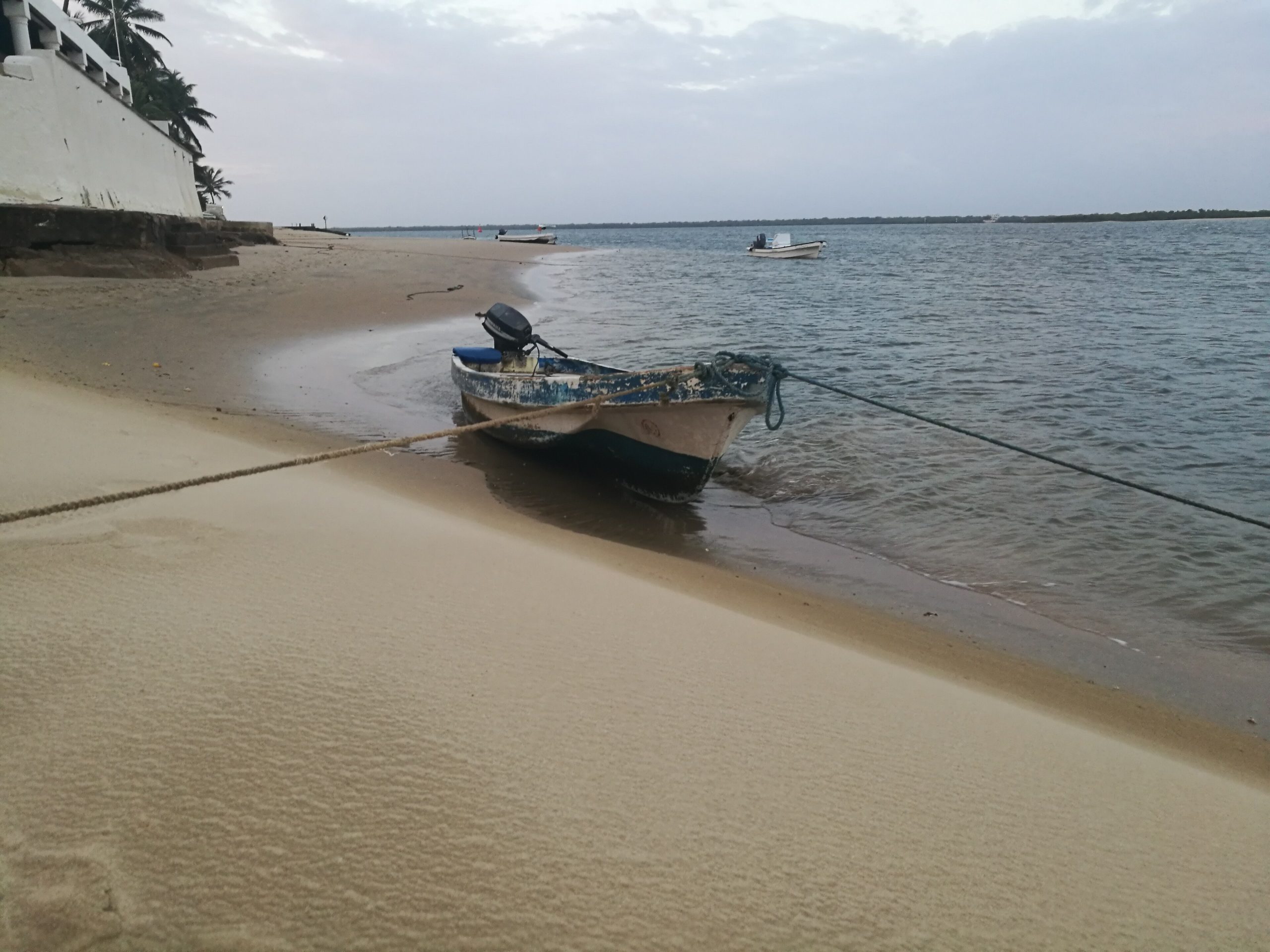
Shela
Shela is a village on Lamu Island, about 3.2 kilometres south of Lamu town along the shore, and it is where the beach is. Roughly forty minutes on foot or a few minutes by boat separates the two, and they are genuinely different places: Lamu town is a working Swahili settlement and a World Heritage property, Shela is a small village of restored stone houses standing at the head of a very long, very empty beach.
Travellers almost always arrive having to choose between them, and the choice is usually framed as beach against culture. That framing is broadly right, and the distance between the two is short enough that it does not have to be permanent.
Shela and Lamu Town, Forty Minutes Apart
The walk between them follows the shore, past the waterfront, the mangrove edge and the seafront houses, and it is one of the better walks on the coast. It is also tide dependent in places: on a rising tide the shore route narrows and people who set out without checking end up wading or paying for a boat back. Boats run the route constantly and cost very little.
What each end offers is different. Lamu town has the markets, the museums, the fort, Riyadha Mosque and the dense alleys of the old town, and no swimming beach. Shela has the beach, more space, quieter nights and most of the island’s holiday accommodation, and correspondingly less daily life.
Splitting a stay between the two works well and many people do it. Anyone choosing one should be clear about which they actually came for.
How Shela Came to Be There
Shela’s foundation is recorded as tradition rather than established by excavation, and the version set down in the standard 1969 guide to the archipelago runs like this. In the mid-fourteenth century the Sultan of Pate raided Kitau on Manda Island, and the people there fled across to Lamu town as refugees. About two hundred years later their descendants asked the Sheikh of Lamu for permission to build a town of their own. He agreed, on one condition: that no stone be used in the building of it.
The condition did not hold forever. Shela had a brief period of prosperity in the nineteenth century, when fine stone houses with elaborate decorative plasterwork went up, paid for by plantation agriculture worked by enslaved people. When that labour began to leave in the 1890s, the village declined sharply along with the economy that had built it. By the 1960s, fewer than 250 people lived there, and of roughly a hundred fine houses only about forty were occupied.
Everything Shela is now dates from the revival that followed: the same stone houses, bought and restored, and a village that is busy in season and very quiet out of it.
The Friday Mosque and the Village Mosques
Shela’s golden age was the stretch from 1829 to 1857, during which five of its six mosques were built. The Friday Mosque, put up in 1829, is the one people recognise, largely because of its tall conical minaret, which is unlike anything else in the archipelago and which shows up in every photograph of the village taken from the water.
These are working mosques in a conservative Muslim village, not monuments with opening hours. Visitors are expected to dress accordingly in the village, covering shoulders and knees, and to keep swimwear for the beach. The courtesy is returned without fuss.
The Beach That Runs Twelve Kilometres
The beach starts at the village and runs roughly twelve kilometres south-west towards Kipungani: wide, pale, open to the ocean and, for most of its length, completely empty. There is no reef-protected lagoon here in the south coast sense, so this is proper ocean swimming with surf and with currents, quite different from the flat water at Diani or Watamu.
It is exposed. There is no shade to speak of once you leave the village end, no facilities along it, and the sun on open sand at this latitude is punishing. Walking a long way down it and back is a genuine undertaking rather than a stroll, and water and cover are not optional.
The village end is where the swimming happens and where the few beachfront places sit. The further south you walk, the more the beach belongs to the dunes and the turtles.
The Dunes Are the Island’s Water Supply
Behind that beach stand the Shela sand dunes, and they are not scenery. Rain falling on the dunes filters down through the sand and collects as a lens of fresh water floating on top of the salt water beneath, and that lens is pumped, treated and supplied as drinking water to the island. More than 30,000 residents depend on it. It is the main freshwater source Lamu Island has.
The dunes do two other jobs at the same time. They are a wind break, and they absorbed a great deal of the force of the 2004 Indian Ocean tsunami before it reached the village.
That is why development on the dunes is a heritage and water-security question rather than a local planning one. The dunes are gazetted by the National Museums of Kenya and form part of the Lamu World Heritage buffer zone, alongside the Manda and Ras Kitau mangrove skyline. Sand harvesting, construction and beachfront building on them have all been the subject of repeated public objection from the county and from the museums service.
Turtles on Shela Beach
The long open sand behind the village is one of the most important turtle nesting beaches in the archipelago. Nest monitoring here has been running since 1992, and 2015 produced a record of twenty nests in a single season.
The threats are the ordinary ones for this coast: nets, plastic, and artificial light drawing hatchlings inland instead of out to sea. That last one is the reason beachfront lighting at Shela is a live issue and not a trivial one. The sea turtle watching guide covers the species, the seasons and how to behave around a nest or a hatching.
The Battle That Changed Lamu
Around 1812 or 1813, at Shela, Lamu defeated a larger combined force from Mombasa and Pate. The victory left Lamu frightened of the response rather than confident, and the town asked Oman for protection. Sultan Said bin Sultan of Muscat sent a governor and a Baluchi garrison, and construction of Lamu Fort began in 1813.
That is the short version, and the Lamu guide carries the rest of it. It is worth knowing while standing on the beach, because the battle that reshaped the politics of the entire archipelago was fought on this stretch of sand.
Staying at Shela Rather Than in Lamu Town
Shela is quieter, more spacious and more expatriate than Lamu town, and it holds most of the island’s beach accommodation, largely in restored stone houses let as whole properties. It has a small number of places to eat, a shop or two, and very little else, which is the attraction and also the limitation.
The practical points that catch people out are consistent. Everything except the beach is in Lamu town, including the market, the banks and the medical services, so a stay at Shela involves regular boat trips or walks. Boats leave when they are full rather than at a time. The village is very quiet outside the December to March season and out of season several places close. During the Maulidi festival and the Lamu Cultural Festival, accommodation across the whole island fills, Shela included.
Shela sits within the same travel advice position as the rest of Lamu Island. As checked on 21 September 2026, the UK Foreign, Commonwealth and Development Office advises against all travel to Lamu County except Lamu Island and Manda Island, and advises that travel to those two islands should be by air to Lamu Airport rather than by road. Because such advice is revised without notice, check your own government’s current advice for Kenya before travelling, and check it again close to departure.
Getting to Shela
Fly to Lamu Airport, which is on Manda Island, from Nairobi Wilson or from Mombasa. Boats run directly from the airstrip to Shela, which is usually quicker than going via Lamu town.
From Lamu town, walk the shore in about forty minutes with an eye on the tide, or take one of the boats that run continuously between the two. There are no cars on the island and no reason for one.
Questions Travellers Ask About Shela
Should you stay in Shela or in Lamu town?
Shela for the beach, space, quiet and most of the island’s holiday houses. Lamu town for the old town, the markets, the museums and the daily life of a working Swahili settlement, with no swimming beach on the doorstep. They are forty minutes apart on foot and many visitors split the stay rather than choosing.
Is Shela a separate island from Lamu?
No. Shela is a village on Lamu Island, at its southern end. Manda Island, where the airport is, and Pate Island further out are the separate islands in the archipelago.
Can you swim at Shela?
Yes, and unlike most of the Kenyan coast this is open ocean rather than a reef-protected lagoon, so there is surf and there are currents. The swimming happens at the village end of the beach. Further along there is no shade, no facilities and nobody about.
How long is the walk from Lamu town to Shela?
About forty minutes along the shore, covering roughly three kilometres. Check the tide before setting out, because parts of the route narrow or disappear on a rising tide and people regularly end up wading or taking a boat back. Boats run the route constantly and are cheap.
Why do the sand dunes at Shela matter so much?
They are the island’s fresh water. Rain filters through the dunes and collects as a freshwater lens above the salt water below, and more than 30,000 residents depend on what is pumped from it. The dunes also act as a wind break and absorbed much of the 2004 tsunami. They are gazetted by the National Museums of Kenya and sit within the Lamu World Heritage buffer zone.
When is Shela at its best?
The kaskazi months from November to March give the calmest sea and the best boat conditions, with the turn of the year the busiest. Late April through May is the coastal long rains and the quietest stretch of the year, when several places close. Festival weeks fill the whole island whatever the season.
Shela sits on the same island as Lamu, alongside Manda Island, Pate Island and Kiwayu Island in the archipelago. For the coast as a whole, start at the Kenya Coast.
No operator on the marketplace currently lists a safari to Shela.
See every Kenya safari