
Pate Island
Travel advice affects this destination. As checked on 21 September 2026, the UK Foreign, Commonwealth and Development Office advises against all travel to Lamu County except Lamu Island and Manda Island. Pate Island is in Lamu County and is not one of those exceptions, so it falls inside the advise-against-all-travel area.
Check your own government’s current advice for Kenya before planning any travel here. Governments issue advice separately and revise it without notice, so a dated statement on any page, including this one, is a snapshot and not a standing position. Check it again close to departure rather than only at the point of planning.
With that stated plainly: Pate is the largest island in the Lamu archipelago, it holds some of the most significant Swahili archaeology on the East African coast, and several thousand people live on it now. It was Lamu’s great rival for centuries, and for much of that time it was the more powerful of the two.
The Largest Island in the Lamu Archipelago
Pate lies north-east of Lamu and Manda, between Lamu and Kiunga, and it is larger than either. It carries several settlements rather than one: Pate town in the south-west, Siyu on the north coast, Faza further along that coast, Kizingitini and the landing at Mtangawanda.
Its people are largely Bajuni, the northern Swahili community of this stretch of coast and the Somali border region, and the island runs on fishing, mangrove cutting and small-scale farming rather than on anything to do with visitors. There is no tourism infrastructure of consequence. Faza is the island’s administrative centre and Kizingitini its largest fishing port.
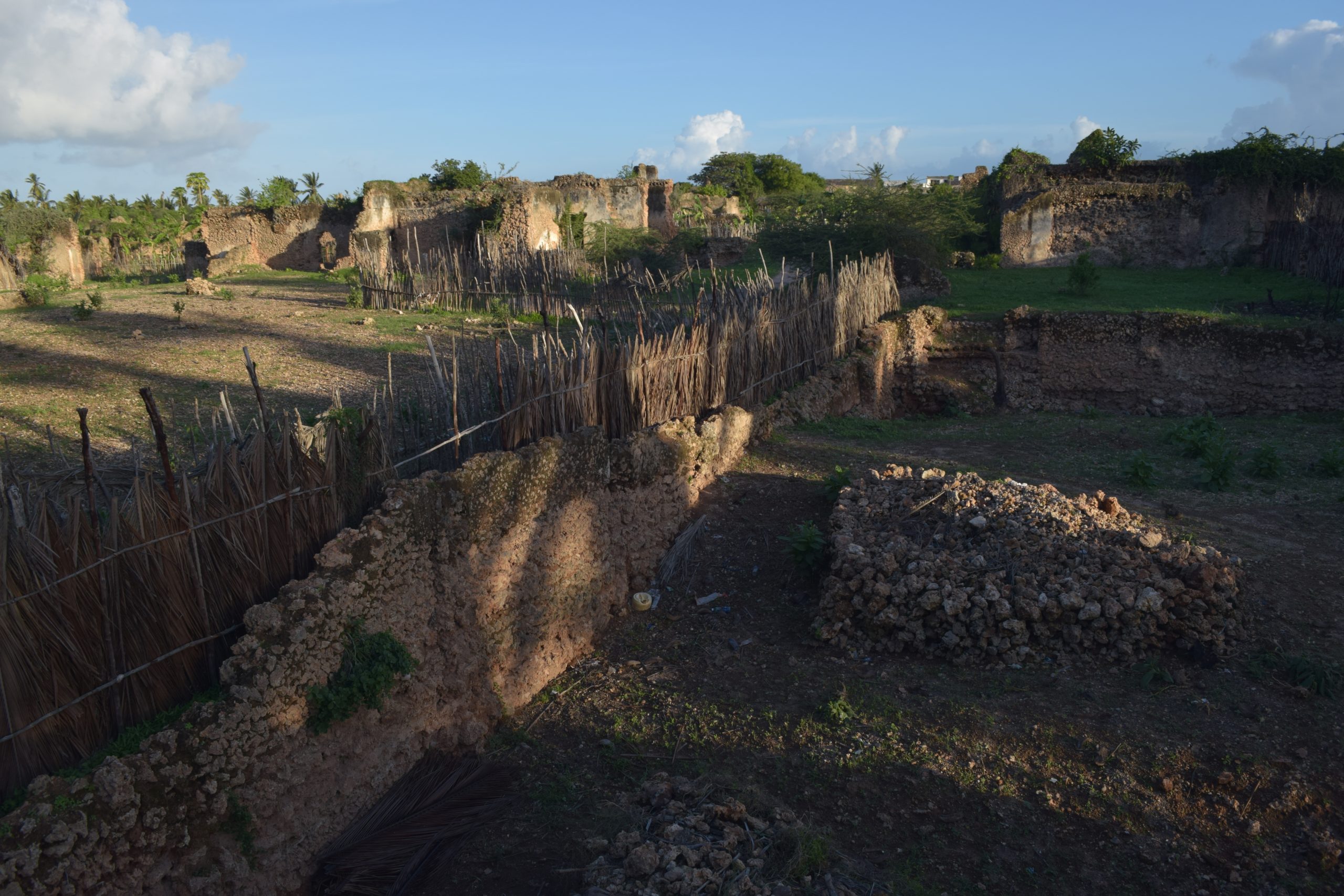
The character of the place, as everyone who has written about it agrees, is that very little has changed. The architecture at Faza is almost entirely Bajuni makuti-roofed housing. The standing remains elsewhere have been left largely as they were, without restoration and without visitor management.
Pate Town
Pate town sits in the island’s south-west. It was the seat of a sultanate that dominated the archipelago for long stretches of its history, warring repeatedly with Lamu and with Takwa on Manda, and it is the subject of the Pate Chronicle, one of the very few internal historical narratives produced on the Swahili coast.
What survives is unusual in both quality and quantity. The standing remains offer a view of Swahili domestic architecture and urban life from the seventeenth century onward, with fine houses carrying extensive and elaborate plasterwork. The town was also known for its fine cloth, jewellery and woodwork, and for the siwa, the great ceremonial horn of the Swahili city-states; examples from this coast are held at the Lamu Museum.
Pate declined as the creek silted and as Lamu and then Zanzibar took the trade, and the town today is a fraction of what the ruins imply.
Siyu and the Fort the Swahili Built Themselves
Siyu, on the north coast, is the island’s most remarkable site and one of the more remarkable on the whole coast. Siyu Fort is, by the National Museums of Kenya’s account, the only fort on the East African coast built by the local Swahili inhabitants rather than by the Portuguese, the Omanis or the British. It is coral-built, with a small mosque inside it, and it was gazetted as a National Monument in 1958.
It was built in the nineteenth century, under the town’s leader Bwana Mataka, whose full name is given as Mohammed Ishaq bin Mbarak bin Mohamed bin Oman Famau, and its purpose was to resist Omani control. In 1843 Bwana Mataka, together with the new sheikh of Pate, repudiated the sovereignty of Seyyid Said, the Sultan of Oman and Zanzibar. In 1845 Siyu inflicted on Seyyid Said one of the worst military defeats of his reign.
Siyu was also a centre of Islamic scholarship, craft and book production, with a reputation on this coast for leatherwork and for copying manuscripts.
A date to be careful with. A good deal of travel-sector writing dates Siyu Fort to the sixteenth century and describes it as built against the Portuguese. The National Museums record and the historical sequence both put it in the nineteenth century, built against Omani expansion. The nineteenth-century dating is the one used here.
Faza and Kizingitini
Faza, on the north coast, was known to the Portuguese as Ampaza and dates back at least to the fourteenth century. Its history is one of repeated destruction: it was nearly wiped out by the Pate army, resettled, and then destroyed again by the Portuguese in 1587. It is now the island’s administrative centre.
Kizingitini, further along the same coast, is the largest fishing port on the island and one of the more significant on this part of the Kenyan coast, working the northern grounds and the Kiunga waters.
Shanga, Dated to the Eighth Century
On the south-eastern shore of the island lie the ruins of Shanga, and for archaeologists this is the most important site in the archipelago. It was excavated over eight years from 1980, and the earliest settlement there is dated to the eighth century.
What makes Shanga matter is what the excavation found about religion. The evidence indicates that a small number of the local inhabitants were Muslim from probably the late eighth century onward, which is very early indeed for the East African coast and bears directly on how and when Islam arrived here and who adopted it. The remains at the site are extensive and varied, and they are entirely unmanaged.
The archaeological tours guide covers how Kenya’s early coastal sites relate to one another.
Reaching Pate From Lamu
There is no airstrip on Pate and no road to it. Access is by boat from Lamu, through the Mkanda channel to the landing at Mtangawanda in the south-west, from where tracks lead to the settlements.
A fast boat covers it in roughly 45 minutes. The local passenger launches and dhows that serve the island’s communities take considerably longer, commonly two to four hours, and they run to the tide and the weather rather than to a schedule. Onward movement between Mtangawanda, Pate town, Siyu and Faza is on foot or by local boat.
Anyone considering this journey should weigh it against the travel advice set out at the top of this page, and should check their own government’s current position rather than relying on any single account.
Questions About Pate Island
Can you visit Pate Island?
Pate lies inside an area that currently carries an advise-against-all-travel restriction from at least one government, covering Lamu County with only Lamu Island and Manda Island excepted. That position is dated and subject to revision, so the necessary step is to check your own government’s current advice for Kenya before making any plan, and again close to any departure.
What is Pate Island known for?
Swahili history, principally. The sultanate of Pate and its chronicle, the unusually well preserved standing architecture at Pate town, Siyu Fort as the only locally built fort on this coast, and the eighth-century site at Shanga, which carries some of the earliest evidence of Islam in East Africa.
How big is Pate compared with Lamu and Manda?
Pate is the largest island in the archipelago, larger than either Lamu Island or Manda. It also has the least infrastructure of the three, with no airstrip, no roads of consequence and no tourism industry.
How long does it take to get to Pate from Lamu?
About 45 minutes by fast boat through the Mkanda channel to the landing at Mtangawanda. Local passenger launches and dhows take longer, usually between two and four hours, and they run with the tide and the weather rather than to a timetable.
Who built Siyu Fort and when?
It was built in the nineteenth century by Bwana Mataka, the leader of Siyu, to resist Omani control, and it is the only fort on the East African coast built by the local Swahili inhabitants rather than by an outside power. It was gazetted as a National Monument in 1958. Dates placing it in the sixteenth century circulate widely and do not match the historical record.
Pate lies in the archipelago alongside Lamu, Shela, Manda Island and Kiwayu Island. For the coast as a whole, start at the Kenya Coast.
1 Place to Visit in This Area
Individual sites within reach of here, each with its own guide. Some are written up because the name circulates and the place does not, which is worth knowing before you plan a drive around one.
No operator on the marketplace currently lists a safari to Pate Island.
See every Kenya safari