
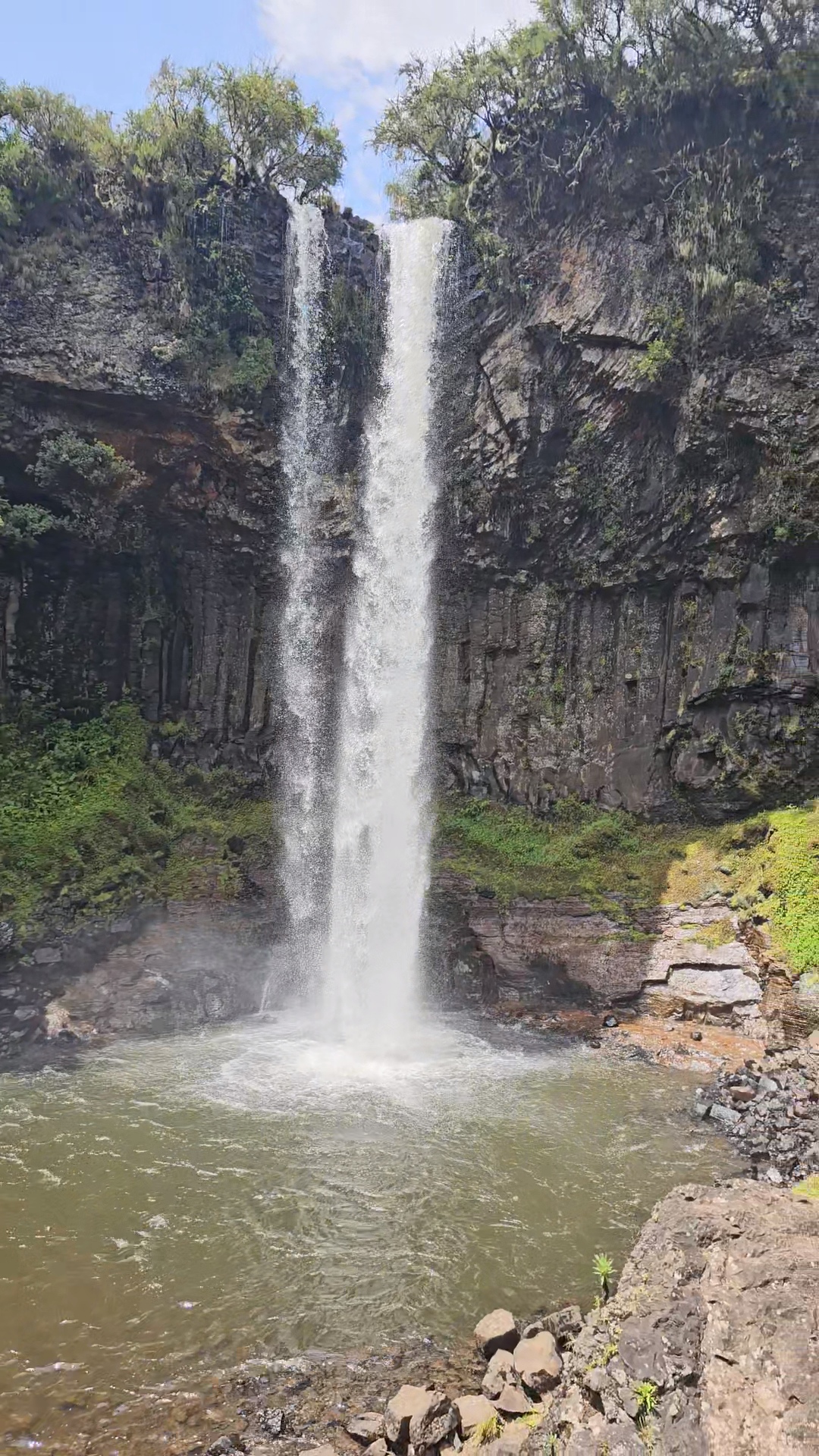
Aberdare National Park
The Aberdare is the park people are least prepared for. It sits on a volcanic range along the eastern wall of the Rift Valley, and instead of open savanna it offers dense montane forest, bamboo, giant heather and high open moorland cut by ravines and waterfalls. Kenya Wildlife Service describes it as cool and mist cloaked, which is accurate and is the single most useful thing to know before packing.
What an Aberdare Safari Actually Is
Game viewing here is not the open plains product. The forest is thick, sightings are brief and often at close range, and a vehicle can drive for an hour seeing nothing but bamboo. What the park delivers instead is landscape and atmosphere: a road climbing through four vegetation belts in a morning, waterfalls dropping off the eastern wall into forested gorges, and moorland at around 3,000 metres where the vegetation turns to tussock grass, giant lobelia and groundsel.
Kenya’s national Clearing House Mechanism for the Convention on Biological Diversity records the park as gazetted in 1950 and covering roughly 766 square kilometres, managed by Kenya Wildlife Service. It shares the range with much larger forest reserves managed by Kenya Forest Service, which is why the protected block on a map looks bigger than the national park itself.
The Salient and the Moorland: Two Different Parks
The Aberdare divides into two zones that ask for different plans. The eastern lower slopes, the area usually called the Salient, hold the forest, the waterholes and the two tree hotels. This is where large mammals are concentrated and where most short visits happen, reached from the Nyeri side.
Above and west of it lies the moorland, a high open plateau of grass, heather and streams reached by the road that crosses the park from the eastern gates up to the tops and down the western side towards Naivasha. The moorland is where the waterfalls, the peaks and the rock formations are, and where the weather does what it likes. Visitors who come only for the Salient never see it, and visitors who drive straight over the top often miss the wildlife entirely. A stay of two nights is what it takes to do both.
Wildlife in the Aberdare Forest and Moorland
Elephant and buffalo are the animals most reliably seen, usually at the floodlit waterholes after dark. Kenya’s Clearing House Mechanism also lists black rhino, leopard, spotted hyena, olive baboon, black and white colobus, warthog and bushbuck as present, with giant forest hog, bongo, golden cat, serval, African wild cat, civet and blue duiker recorded as rare sightings. The bamboo belt is the classic mountain bongo habitat, and the animal is genuinely scarce; anyone travelling in the hope of seeing one should treat it as a long shot rather than an itinerary item.
The park has a long association with melanistic leopards, which are photographed here from time to time. They are ordinary leopards with a coat colour variant, not a separate animal, and sightings are rare enough that no responsible plan should depend on one.
Birding is the quieter strength. The same source records over 250 species, including Jackson’s francolin, sparrowhawks, goshawks, eagles, sunbirds and plovers, and the altitudinal banding means the list changes as the road climbs. The park appears on most serious highland birdwatching circuits alongside Mount Kenya.
Treetops, The Ark and the Tree Hotel Idea
The Aberdare invented a product that the rest of Kenya copied: a lodge built above a floodlit waterhole and salt lick, where guests watch animals come to the water through the night rather than driving out to look for them. Nyeri County’s own heritage documentation records that Treetops was designed and built by Eric Sherbrooke Walker, opening in 1932 as a two roomed tree house, on a spot where animals already congregated to drink and take salt. His stated idea was that visitors would shoot with cameras rather than rifles.
Treetops is where Princess Elizabeth acceded to the throne. The county record puts it plainly: she climbed into the tree on 5 February 1952 and came down the following day as Queen Elizabeth II, after the death of her father King George VI. The original structure was destroyed by fire during the Mau Mau emergency in the 1950s and the lodge was rebuilt across the waterhole, where it stands now with 36 rooms.
Treetops closed when the pandemic ended Kenyan tourism and stayed shut for several years. It reopened in August 2024 after a refurbishment under a new proprietor, having been run by the same company since 1978. Anyone working from an older guidebook or an older blog post will find both the closure and the reopening missing from it, and reports disagree on the exact closure year, so confirm the current position before planning around it.
The Ark, the other tree hotel inside the park, works the same way from a set of tiered viewing decks above its own waterhole. Both properties are reached by transfer from a base hotel rather than driven to directly, and both are effectively a single overnight experience rather than a touring base. This site does not rank properties or recommend one over the other.
Waterfalls, Peaks and Rock Formations
Karuru Falls is the headline feature and Kenya’s highest waterfall, dropping in three stages into a forested gorge on the moorland, a descent usually published as about 273 metres although the Kenya Wildlife Service park brochure gives 300 metres. Gura Falls comes off the facing wall of the same valley, and the two can be seen from viewpoints looking at each other. Both sit on the moorland road rather than in the Salient, which is the practical reason so many visitors miss them.
Satima Peak, at 4,001 metres, is the highest point of the range and the third highest summit in Kenya. Mount Kinangop, the second peak, reaches 3,906 metres. Walking to either is covered under mountain climbing in Kenya rather than here, because it is a trekking objective with its own logistics.
Kenya Wildlife Service also names the Dragon’s Teeth rock formations, the Twin Peaks volcanic outcrops and the Mau Mau Post Office tree, a large mugumo fig that fighters used as a message drop during the independence struggle, leaving notes in holes in its trunk. The falls themselves belong to a wider waterfall hiking circuit in the central highlands, and the forest belt supports forest walks where an armed escort is required rather than optional.
The Fence That Changed the Aberdare
The single most consequential thing to happen to this ecosystem in fifty years is a fence. Rhino Ark, the conservation trust behind it, records that construction of the Aberdare fence was completed on 28 August 2009, took 21 years, runs to nearly 410 kilometres and cost approximately KSh 800 million. Teams of fence attendants, 114 of them in the Aberdares, patrol and repair it daily.
The purpose was not to keep visitors out but to separate elephants and buffalo from the smallholder farms pressed right against the forest edge, and to slow logging, charcoal burning, snaring and encroachment. It also changed what a visitor sees. The forest boundary is now a hard line, cultivation runs up to it, and the wildlife inside is effectively an enclosed population. The same trust has since fenced Eburu forest and is working on a longer fence around Mount Kenya.
Getting to Aberdare National Park
Kenya Wildlife Service puts the park 150 kilometres from Nairobi, with tarmac approaches from Nyeri and Naro Moru on the eastern side. Park headquarters is 15 kilometres from Nyeri town on the Nyeri to Nyahururu road, near Mweiga. The road that crosses the park climbs from the lower slopes to the moorland and connects on the western side with a road from Naivasha, which KWS gives as 87 kilometres from Nairobi. Mweiga airstrip is the nearest strip, on the opposite side of the road from headquarters.
Inside the park the surface is a different matter. Approach roads are tarmac to the gates; beyond them the tracks are gravel and dirt, the moorland loop floods at every low point in wet weather, and the final climbs to the tree hotels are steep forest tracks. Trip reports from visitors who have driven it converge on the same advice: high clearance four wheel drive, and a willingness to turn back. KWS’s own visitor advice for this park includes carrying additional fuel if staying longer, which is unusual enough to be worth taking literally. Anyone planning to drive themselves should read the self drive safaris guide first.
Best Time to Visit and What to Take
The Aberdare is wet. Rain is possible in any month, the long rains from March to May and the short rains in October and November are heavier, and the moorland tracks are at their worst then. January to February and July to September are the drier windows and give the best chance of clear views from the tops, though mist can close in within minutes at any time of year.
Cold is the other thing people underestimate. KWS’s packing advice for this park names warm clothing because temperatures drop rapidly at night, along with walking boots, maps and a compass. A lodge lounge at 2,000 metres in the rain is a different proposition from the same lounge in Amboseli, and the tree hotels are watched from open decks after dark.
Aberdare Park Fees and Rules
Aberdare sits in the wilderness band of the Kenya Wildlife Service conservation fee schedule published in October 2025, alongside Meru and Kora. Park entry is KSh 800 per adult per day for East African citizens and USD 70 for non resident adults, with camping charged separately per person per night. These figures come from the Kenya Wildlife Service schedule and were checked on 21 September 2026; fees are set by regulation and do change.
Gates open at 6am and close at 6pm, and visitors must be out between those hours unless spending the night inside. The speed limit is 40 km/h, off road driving is prohibited, and single use plastic is not allowed in national parks. Accommodation inside the park runs from KWS self catering houses and the public campsites at Reedbuck on the moorland and Ruhuruini, through a string of special campsites, to the privately run lodges. Camping here is cold, wet work and rewards proper equipment.
Where the Aberdare Fits in a Kenyan Itinerary
The park sits directly between Nairobi and the Mount Kenya region, which is why it so often becomes a night on the way north rather than a destination in itself. That works, and it undersells the place. A fuller version pairs the Aberdare with Nyeri for the highland heritage sites, crosses the moorland to the Rift for Lake Nakuru or Naivasha, or continues north to Nanyuki and the Laikipia conservancies. For travellers whose interest is the highlands rather than the savanna, the Aberdare and Mount Kenya together make a better week than either does alone.
Aberdare National Park Questions
Is the Aberdare worth visiting if the trip already includes the Maasai Mara?
Yes, but not for the same reason. Anyone expecting Mara style game viewing will be disappointed, because the forest hides animals and the moorland holds few of them. The case for the Aberdare is contrast: montane forest, bamboo, high moorland, waterfalls and cold mountain weather, none of which appear anywhere on a savanna circuit. Travellers who enjoy it most treat it as a landscape and forest destination that happens to hold elephants.
Do you need a four wheel drive in Aberdare National Park?
For the Salient in dry weather a high clearance two wheel drive can manage. For the moorland, the crossing road and anything at all in the rains, four wheel drive with high clearance is the sensible minimum. The moorland tracks flood at low points and the forest climbs are steep and slippery. Carrying extra fuel is advised by the park authority itself.
Can you see the Big Five in the Aberdare?
All five species occur, including black rhino and leopard, but seeing them is another matter. Elephant and buffalo are common and regularly seen at the waterholes. Rhino, leopard and lion are present in low numbers in thick cover and are seen rarely. The park is a poor choice for anyone whose goal is a species checklist and a good one for anyone who wants forest.
What is the difference between staying at a tree hotel and staying elsewhere?
A tree hotel is a fixed overnight experience rather than a base. Guests arrive in the afternoon from a partner hotel outside the park, watch a floodlit waterhole through the evening and night, and leave after breakfast. There is little or no game driving attached. A visitor who wants to explore the moorland, the falls and the crossing road needs either a self catering house, a campsite or a lodge outside the gates as well.
How cold does it get in the Aberdare?
Cold enough that the wildlife authority lists warm clothing as essential kit. The Salient sits around 2,000 metres and the moorland above 3,000, and night temperatures on the tops fall close to freezing. Rain and mist make it feel considerably colder. A fleece, a waterproof shell and a warm hat are worth packing even in the dry months.
Can you walk or hike inside the park?
Not freely. This is a national park holding elephant and buffalo in thick cover, so walking happens with a ranger escort arranged through park management, not on a whim. The long walks on the range, including Satima and Elephant Hill on the eastern edge, are covered under hiking and mountain climbing, and some of them start from forest stations outside the park boundary rather than at a park gate.
How many days does the Aberdare need?
One night covers a tree hotel and nothing else. Two nights allow a tree hotel plus a full day on the moorland for the falls and the viewpoints, which is the version most people wish they had planned. Three nights make sense only for birders, photographers or anyone combining the park with walking on the range.
3 Places to Visit in This Area
Individual sites within reach of here, each with its own guide. Some are written up because the name circulates and the place does not, which is worth knowing before you plan a drive around one.
No operator on the marketplace currently lists a safari to Aberdare National Park.
See every Kenya safari