
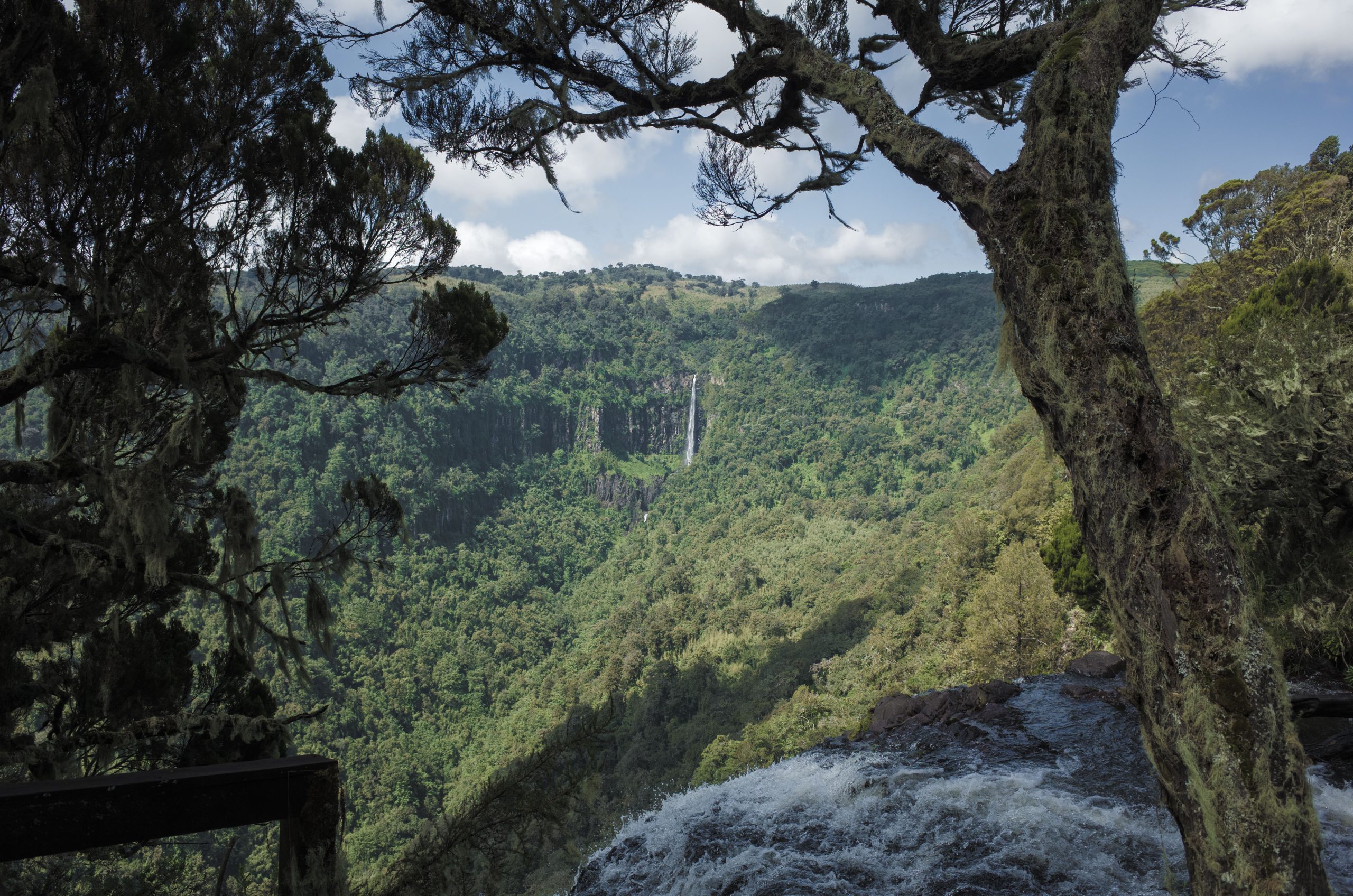
Karuru Falls
Karuru is the tallest waterfall in Kenya and the headline feature of the Aberdare moorland. It drops off the edge of the high plateau in stages into a forested gorge, with Gura Falls coming off the facing wall of the same gorge, and the two can be seen looking at each other. Both sit on the moorland side of the park rather than in the Salient, which is the practical reason most visitors never see either.
How High It Actually Is
Two figures are in circulation and they do not agree. Kenya Wildlife Service’s own Aberdare park brochure describes Karuru’s ice-cold water as dropping an impressive 300 metres. Almost every other published account gives 273 metres, usually broken down as three stages of 117, 26 and 130 metres, which adds correctly to 273.
Neither figure can be dismissed. The 300-metre number comes from the managing body, which is normally the strongest source available; the 273-metre number is the one with a stage-by-stage breakdown behind it and is the figure the rest of the literature has settled on. The honest position is to quote both and name the source of each, which is what the Aberdare guide does as well.
Kenya’s tallest-waterfall title has also moved between Karuru and Gura over the years. Older publications sometimes give Gura the crown; current tourism and park references give it to Karuru. Kenya Wildlife Service’s brochure calls Karuru magnificent and Gura outstanding without ranking them, which is probably the most defensible thing anyone has written on the subject.
Three Stages into the Gorge
What makes Karuru unusual is that it is not a single sheet of water. The stream drops in three distinct steps, and the middle one is short enough that from the viewpoint the falls read as a long upper plunge, a break, and then the main drop to the plunge pool far below. The gorge it falls into is forested, steep and generally full of mist, so the bottom of the falls is often invisible from the top even on a clear day.
The setting is moorland: tussock grass, giant heather and open sky right up to the lip, then a sudden edge. The change from flat wet plateau to a several-hundred-metre drop happens within a few paces, which is why the viewpoint is railed and why walking to the edge elsewhere is a bad idea.
Gura on the Opposite Wall
Gura Falls torrents off the far side of the same gorge, as Kenya Wildlife Service’s brochure puts it. The two are usually treated as a pair because that is how they are experienced: one viewpoint gives a sight of both, on opposite walls, with the gorge between them. Gura is generally described as the shorter drop of the two, though it is the one older references sometimes rank first.
Reaching the Viewpoint
Karuru is on the moorland road that crosses the park, not in the forested Salient where the tree hotels and most of the game viewing are. A short walk from a parking area leads to the viewing platform on the cliff near the top of the falls.
Getting to that parking area is the real work. The approach roads to the Aberdare gates are tarmac; everything inside the park is gravel and dirt, the moorland tracks flood at every low point in wet weather, and Kenya Wildlife Service’s own advice for this park includes carrying reserve fuel. High-clearance four-wheel drive is the sensible minimum, and turning back is a legitimate outcome. The park has eight gates, named by KWS as Ark, Treetops, Kiandongoro, Mutubio, Rhino, Ruhuruini, Shamata and Wandare; which one to use depends on which side of the range the day starts. Anyone driving themselves should read self drive safaris first.
The Other Falls on the Same Circuit
Karuru is normally done as part of a circuit rather than on its own, because the moorland road passes several falls within a short distance of each other.
- Gura Falls, off the opposite wall of the Karuru gorge, seen from the same area.
- Chania Falls, a sheer drop reached by a steep path with a makeshift staircase and handrail down to the water.
- Magura Falls, which cascade across the mouth of Queen’s Cave, about ten minutes on foot from the road.
Together they make a full day, and the day is what the moorland side of the Aberdare is for. The wider circuit belongs with waterfall hiking in Kenya.
When to Go
The falls are most powerful during and just after the rains, March to May and October to November, which is also when the tracks are worst and the mist thickest. The drier windows of January to February and July to September give firmer roads and better odds of seeing the drop, with less water going over it. A party that drives four hours to a viewpoint and sees cloud has had a normal Aberdare day.
Cold is the other thing to plan for. The moorland sits above 3,000 metres and Kenya Wildlife Service lists warm clothing as essential kit for this park because temperatures drop rapidly after dark.
Questions About Karuru Falls
Is Karuru really Kenya’s highest waterfall?
It is the one current park and tourism references name as the tallest, at either 273 or 300 metres depending on the source. Gura, on the opposite side of the same gorge, is sometimes given the title in older publications. Kenya Wildlife Service’s brochure describes both without ranking them.
Can you walk to the bottom of the falls?
No. The viewpoint is a platform near the top, on the cliff edge, and the gorge below is steep, forested and inside a national park holding elephant and buffalo. Chania and Magura, on the same circuit, are the falls where a path does lead down towards the water.
Do you need a four-wheel drive to reach Karuru Falls?
For the moorland, effectively yes, and in the rains without question. Approach roads to the gates are tarmac, but the tracks inside the park are unsurfaced, steep in places and flood at low points. Kenya Wildlife Service advises carrying reserve fuel for longer stays, which is unusual enough to take literally.
How long does the waterfall circuit take?
Plan a full day from a base inside or just outside the park. The falls are close to each other in distance and slow to move between on moorland tracks, and Chania in particular involves a steep descent and climb on foot. Two nights in the Aberdare is what it takes to combine the moorland falls with the forest and the waterholes.
2 Places to Visit in This Area
Other sites in Aberdare National Park, each with its own guide.
No operator on the marketplace currently lists a safari to Aberdare National Park.
See every Kenya safari