
Safari packing lists are long because they are written to be complete rather than to be carried. Most of them are also written for nowhere in particular: the same list, with the same nine shirts, appears under a Kenyan heading, a Botswanan one and a Tanzanian one.
Six constraints actually decide what a Kenyan safari bag contains. Four of them are unfamiliar to people who have travelled a great deal elsewhere, and one of them is a law.
1. If there is a bush flight, the bag chooses itself
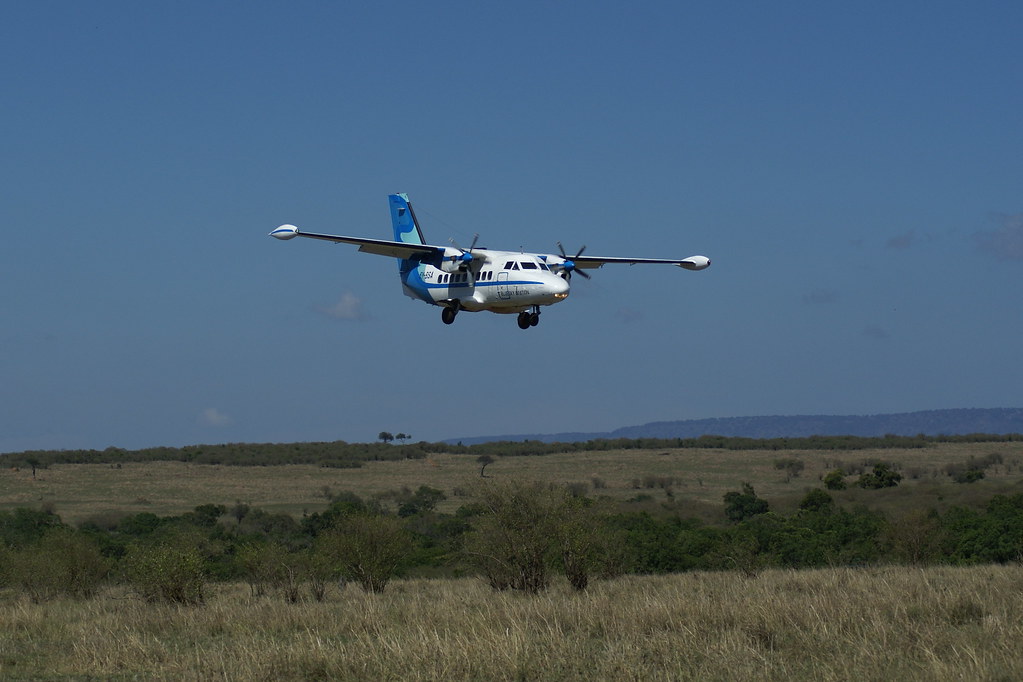
The moment an itinerary contains a light aircraft, the case you own is probably the wrong one. Light aircraft operate to strict weight limits and most require soft-sided bags, because a hard shell will not fit the hold profile at all — it is a shape problem before it is a weight problem.
The allowance itself is set by whoever operates the aircraft rather than by any national rule, which is why you will find different figures quoted with equal confidence on different websites. Do not pack against a number you read somewhere: ask your operator for the allowance on your specific flights and pack against that. The guide to getting around Kenya goes into how the flying circuit works. Travellers who are combining a safari with an international flight home routinely leave a hard case in storage in Nairobi and carry a soft bag around the circuit, which solves the problem completely.
2. Laundry changes the arithmetic
Most camps and lodges wash clothes daily and return them the same afternoon, frequently at no charge. That single fact halves a packing list: on a ten-night trip you are packing for three or four days, not for ten.
Two caveats worth knowing rather than discovering. Many camps will not launder underwear, by convention rather than policy, so a little travel soap covers it. And on a fly-camping or mobile-camp night there may be no laundry at all, so read the itinerary for where the trip is actually sleeping.
3. Pack for the swing, not the average
Kenya sits on the equator and almost none of its safari country is at sea level, which produces a daily temperature range that catches people out badly. The Maasai Mara is roughly 1,500 to 1,800 metres. A pre-dawn game drive in an open vehicle in July is cold — not brisk, cold — and by eleven the same day is hot enough to drive everything into the shade.
The answer is layers you can shed in the vehicle rather than a warm coat or a cool shirt: a fleece or light down layer, a windproof over it for the open sides, and a hat. The camps supply blankets for the drive and most vehicles carry them, but arriving with nothing of your own for the first morning is a mistake.
Two adjustments to that. If the trip includes Mount Kenya, the Aberdares or any night above about 2,500 metres, you need genuinely warm clothing rather than a layered compromise. If it ends on the coast, you need almost the opposite: humidity, not altitude, and light cotton or linen. The guide on when to visit covers what each season does to those numbers.
4. Colour: what matters, and what does not
The neutral-colours advice is repeated everywhere as though it were a dress code. It matters in exactly one situation and is largely cosmetic in the others.
On foot it matters. A walking safari relies on not being conspicuous, so muted greens, browns and khaki do real work. In a vehicle, animals respond to the vehicle’s shape and sound rather than to your shirt, and your neat khaki outfit is doing nothing that a blue one would not.
Two colours are worth avoiding for practical reasons rather than aesthetic ones. Dark blue and black attract tsetse flies, which is a considerable nuisance in the bushed country where tsetse occur. White shows red dust within about an hour of the first dirt track. And military camouflage is best left at home entirely: several countries in the region restrict civilian use of it, and it buys nothing on a game drive.
5. The plastic bag rule is a law, not a preference
This is the genuinely Kenya-specific item, and it is the one most likely to catch an experienced traveller who packs in supermarket carriers out of habit.
Kenya banned plastic carrier bags in 2017 in one of the strictest such laws anywhere, and single-use plastic is separately banned across the Kenya Wildlife Service estate — every national park and reserve KWS runs. The enforcement is aimed at manufacturers and traders rather than at visitors, and nobody is going to search your suitcase, but the practical consequences are real: do not arrive with your packing organised into plastic carrier bags, and do not carry single-use plastic bottles into a park, because you can be asked to leave them at the gate.
Pack in fabric stuff sacks, dry bags or the zip cubes you may already own, and carry a refillable bottle. Camps refill them and many now provide them, which is the same reason the ban exists.
6. Optics beat lenses, for most people
The single most under-packed item on a first safari is a pair of binoculars, and the most over-packed is a long lens bought a fortnight before departure.
One pair of binoculars between two people does not work. The sighting lasts ninety seconds, the person holding them is describing it, and the other person is watching them describe it. Two modest pairs are worth more than one good one. Around 8×42 or 10×42 suits a vehicle: more magnification than that is hard to hold steady when the engine is running and impossible when it is not switched off.
If you are taking a camera, the practical constraints are dust and a beanbag rather than focal length. Sensor-cleaning in the field is awkward, so change lenses as little as possible; a beanbag or a rolled fleece on the window ledge is steadier than any monopod you can use inside a vehicle.
Power, documents and the medical bag
Kenya uses the three-rectangular-pin Type G socket at 240 volts, the same as the United Kingdom, so British plugs go straight in and most other travellers need one adapter. Camps off the grid run on solar or a generator, which often means power at set hours and sometimes 12 or 24 volt charging points in the tent rather than mains. A power bank charged during the day removes the problem, and two short cables are more use than one long one.
Carry any prescription medicine in its labelled packaging, with a copy of the prescription, in your hand luggage rather than the bag that is going into an aircraft hold. On vaccination requirements and what is and is not mandatory for Kenya, follow the guide to Kenya travel requirements rather than a packing list, including this one — those rules are set by the Ministry of Health, they change, and they are not a packing question.
What you can leave behind
A safari wardrobe, if you were planning to buy one. Camps are informal, nobody dresses for dinner, and the multi-pocketed bush shirt is an aesthetic choice rather than equipment. A mosquito net, because beds that need one have one. Hiking boots, unless the trip actually includes a mountain; a walking safari is done comfortably in trainers or light walking shoes, and boots are a kilogram you will carry for one morning.
The trip you are packing for is mostly sitting still in the cold at six in the morning and in the heat at four in the afternoon, looking at things a long way off. Pack for those two hours and the rest takes care of itself.