
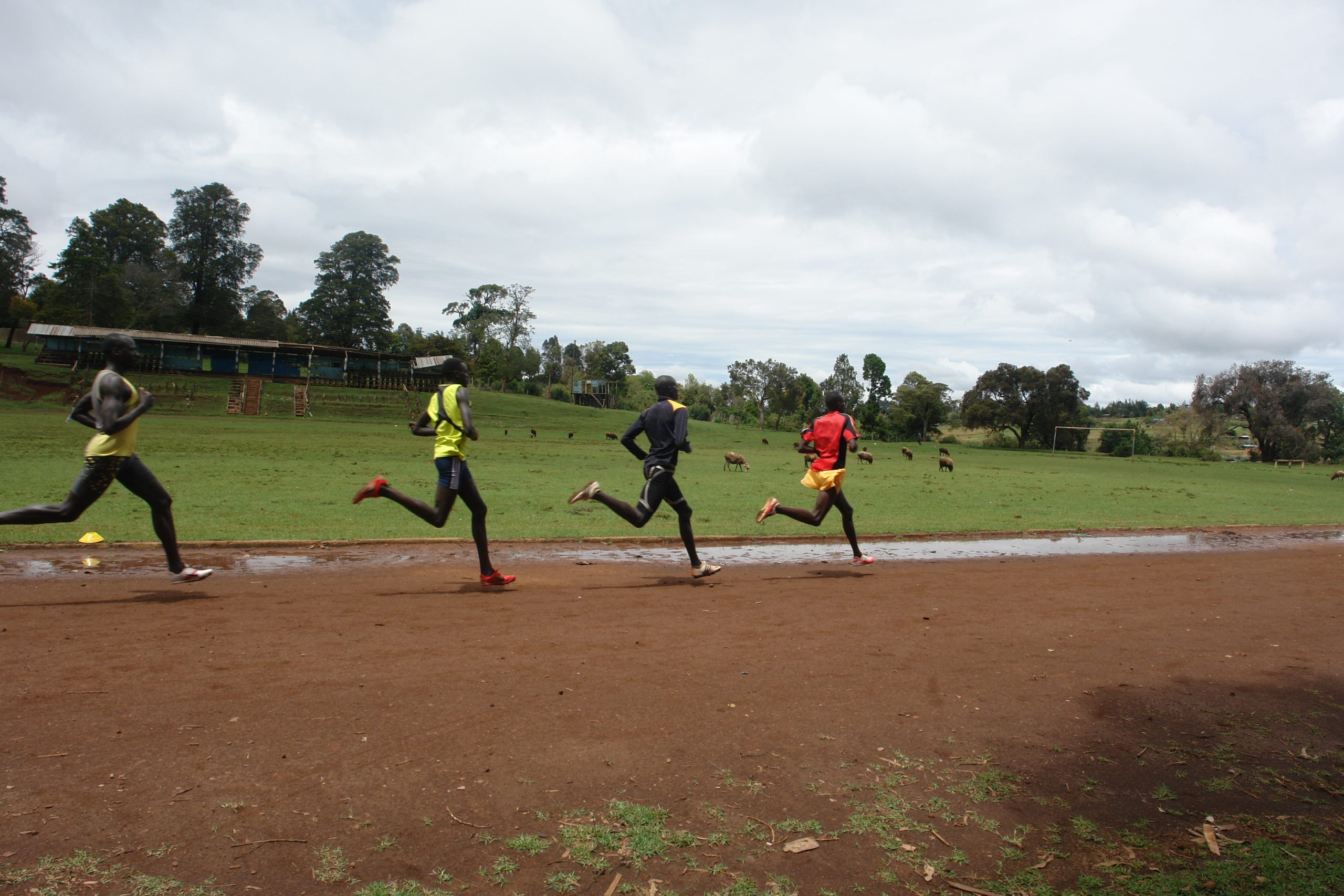
Iten
Iten is a small market town on the lip of the Elgeyo Escarpment in western Kenya, about 2,400 metres above sea level, with a sign across the main road announcing the Home of Champions. World Athletics records its population as 42,000. It is, by some distance, the most internationally significant small town in Kenya, and it looks like none of that.
What makes Iten worth travelling to is the combination of an extraordinary sporting culture and an extraordinary edge. The town sits where the highlands stop. A few minutes’ walk from the main street the ground falls away more than a kilometre into the Kerio Valley.
Where Iten Is
Iten is the administrative centre of Elgeyo-Marakwet County, on the western wall of the Great Rift Valley. Eldoret, the nearest city and the region’s transport hub, lies a short drive down the road, and Kamariny Stadium sits about four kilometres from town at roughly 2,355 metres, around 36 kilometres from Eldoret.
North and west of the town the ground rises again into the Cherangani Hills; east it drops into the Kerio Valley and climbs the far side into the Tugen Hills. That geography is the entire reason Iten exists as it does. The escarpment gives a thousand metres of altitude change within a few kilometres, the red murram roads run in every direction, and the climate barely shifts through the year.
The Home of Champions, and What the Title Rests On
Iten’s status is not a marketing slogan invented by a tourist board. World Athletics awarded the town a Heritage Plaque in 2019 in the Landmark category, an award made for an outstanding contribution to the worldwide history and development of the sport of track and field athletics and of out-of-stadia disciplines. The citation turns on St Patrick’s High School in Iten, which over three decades produced a long line of world-class distance athletes. The plaque itself was unveiled in the town in February 2025 by the county governor, the president of Athletics Kenya and Paul Tergat, with Ezekiel Kemboi, Moses Kiptanui, Mary Keitany, Sifan Hassan, Lornah Kiplagat, Janeth Jepkosgei and Brother Colm O’Connell among those present.
Worth getting right, because travel copy gets it wrong constantly: the designation Iten holds from World Athletics is the Heritage Plaque, a historical recognition. Claims that the town is a World Athletics “Centre of Excellence” do not hold up against World Athletics’ own published records, and that phrase should be treated with suspicion wherever it appears.
The living side of the reputation is the training culture itself: the group runs that leave before dawn, the weekly fartlek session, the camps and guesthouses built around visiting athletes, and the High Altitude Training Centre founded by Lornah Kiplagat. How that culture works, what a training block looks like, which camps take visitors and which do not, is covered in full under running and high-altitude training in Kenya. This page is about the place; that one is about the thing the place does.
The Escarpment Edge and the View
The single best thing in Iten for a visitor who has never run a step is the edge. The escarpment falls away east of the town and the view runs out across the Kerio Valley to the Tugen Hills, with the valley floor more than a thousand metres below. UNESCO’s tentative list nomination for the Marakwet furrow irrigation system, which runs along this same wall further north, puts the valley floor at 1,200 metres and the escarpment rising some 1,500 metres above it.
That wall of air is also why Iten and the escarpment above the Kerio Valley are Kenya’s paragliding centre. The Kenya Tourism Board describes the valley as a premier paragliding destination with numerous take-off points, a prevailing north-to-south wind and a steady easterly flow, and typical flights of one to two hours covering ten kilometres or more. Several world records have been set over this valley. The flying itself is covered on the Kerio Valley page.
What There Is to Do in Iten Besides Run
Honesty helps here. Iten is a working town with very little built for visitors and almost nothing that would qualify as a sight. The attractions are the setting, the roads and the daily life.
- Walk or ride the murram. The same dirt roads that carry the runners are excellent for walking and, increasingly, for riding. See cycling and mountain biking in Kenya.
- Sit on the escarpment. The viewpoints along the rim are the reason most non-running visitors stay a second night, and the light in the late afternoon is the payoff.
- The market. Iten is a produce town for the farms on the plateau and the valley below, and the market is where the two economies meet. See local market tours in Kenya.
- Drop into the valley. The descent east from Iten into the Kerio Valley is one of the more dramatic short drives in Kenya, from cool highland farmland into hot thorn country in under an hour.
Visitors expecting a wildlife destination will be disappointed, and it is better to say so plainly. The nearest serious game country is a long way off. Iten is a place for altitude, air, landscape and running culture.
Where Iten Fits in a Wider Trip
Iten works as a standalone trip for anyone coming to train, and as a two or three night stop within a western Kenya loop for everyone else. Reasonable pairings within reach include the Kerio Valley immediately below, the Cherangani Hills to the north, Kakamega Forest and Mount Elgon to the west, and the Rift Valley lakes on the road back east.
Combining a training block with a safari itinerary works, but as two separate legs rather than one. The driving distances involved make anything else a poor use of the days.
Getting to Iten
Eldoret is the gateway. It has an international airport with domestic connections from Nairobi, and Iten is a short drive up the escarpment road from there. Driving the whole way from Nairobi takes most of a day. Matatus and boda bodas connect Eldoret with Iten and with the smaller towns along the escarpment, which is how most people actually move around the county.
No four-wheel drive is needed to reach the town. It becomes useful only for the descent into the Kerio Valley in wet weather and for the tracks up towards the Cherangani forests.
When to Visit Iten
Elgeyo-Marakwet’s weather is stable through the year and altitude rather than season is what catches visitors out. Mornings at 2,400 metres are genuinely cold before sunrise, and the equatorial sun through the middle of the day is fierce despite the temperature.
The practical constraint is rain rather than heat. The long rains from mid-March into June and the short rains from October into December make the murram heavy and the escarpment descents slippery, though life and training continue through both. June to early October and January to February are the driest stretches.
Staying in Iten
Accommodation runs from guesthouses and athlete camps through to a handful of hotels on the escarpment edge with views over the Kerio Valley. Most of it is built around visiting runners rather than around tourists, which means simple rooms, early breakfasts and other guests who go to bed at nine. That suits some travellers precisely and others not at all.
Arrangements here are made through people rather than through booking systems, particularly for local coaching or a guide-runner, and a phone call or a message usually achieves more than a website. Facilities in town are limited enough that technical kit is easier to bring than to buy.
Questions Travellers Ask About Iten
Do I have to be a runner to visit Iten?
No, but it helps to know what the town is. Iten has no museums, no wildlife and very few conventional sights. What it has is the escarpment, the roads, the light and an unusual culture going on around any visitor who stays. Travellers who want that will enjoy it. Travellers who want a sightseeing list will not.
How high is Iten?
World Athletics puts the town at some 2,400 metres above sea level. Kamariny Stadium, a few kilometres away, sits at roughly 2,355 metres. Anyone arriving from sea level should expect to feel the altitude for the first week.
Is Iten a World Athletics Centre of Excellence?
That claim circulates widely and does not stand up. What World Athletics has awarded Iten is a Heritage Plaque in the Landmark category, granted in 2019 and unveiled in the town in February 2025. It is a historical recognition, and it is the designation worth quoting.
How long should a visit to Iten be?
Two or three nights is enough for anyone who is not training, and it covers the escarpment, the market and a drop into the Kerio Valley. Runners coming for a training block normally stay two to four weeks, because anything shorter is spent adapting to the altitude.
Can I get to Iten by public transport?
Yes. Matatus run from Eldoret, which has an airport with connections from Nairobi, and boda bodas cover the shorter hops along the escarpment. Nothing about reaching Iten requires a private vehicle.
What is there to do with children in Iten?
Not a great deal that is organised, though the escarpment viewpoints, the market and the drive down into the Kerio Valley all work well for families. It is better treated as a stop within a wider western Kenya trip than as a destination for children in its own right.
No operator on the marketplace currently lists a safari to Iten.
See every Kenya safari