
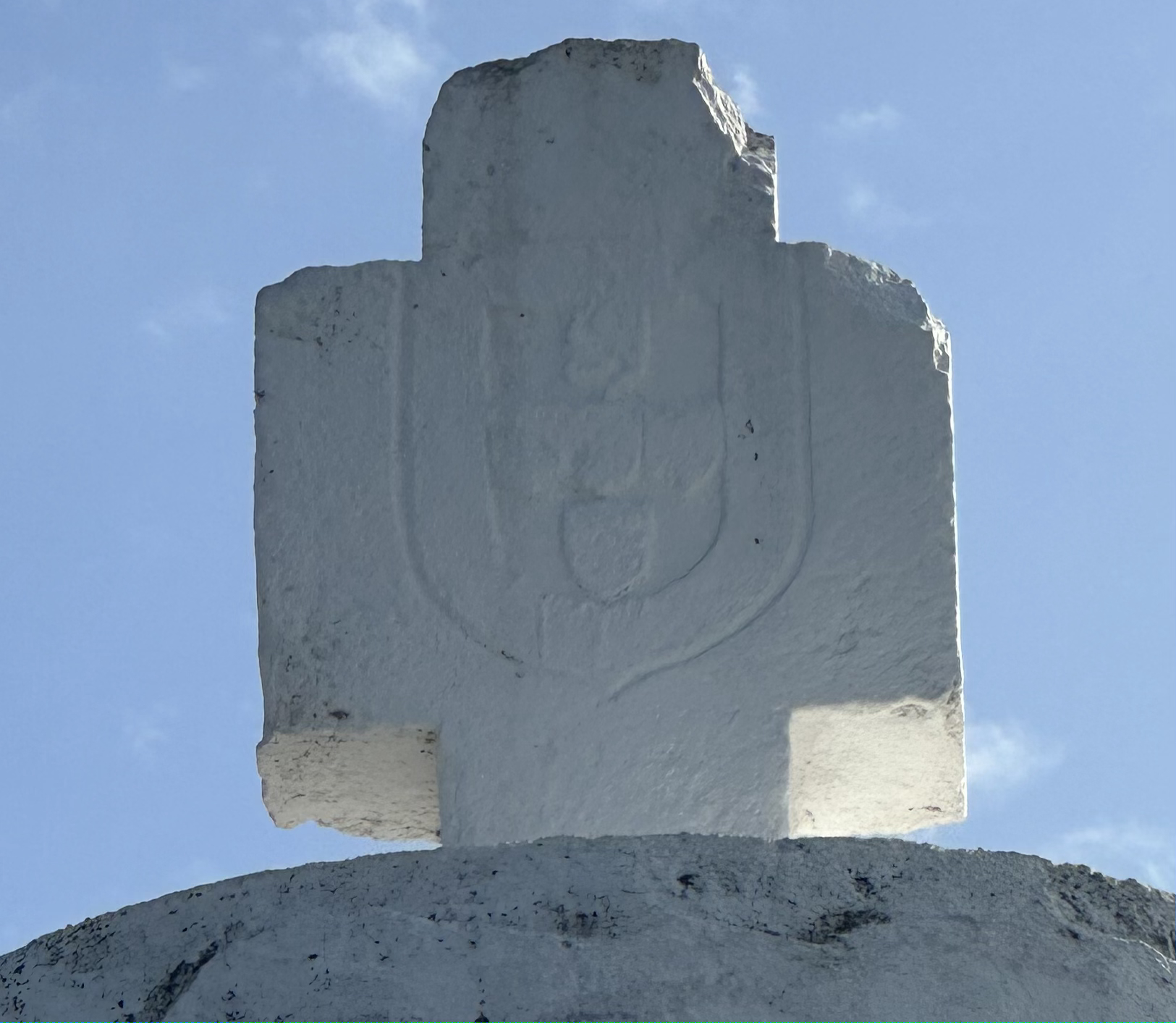
Vasco da Gama Pillar
On a coral headland at the southern end of the Malindi seafront stands a pale column carrying a stone cross with the Portuguese coat of arms. The Vasco da Gama Pillar is the oldest standing European monument in East Africa and, according to the National Museums of Kenya, the only known original padrão surviving anywhere on the African coast. It takes fifteen minutes to see and about an hour to understand.
What a Padrão Was For
Portugal spent the fifteenth century pushing further down the African coast, and its ships carried limestone pillars to plant at the places they reached. These were padrões: part claim, part navigational mark, part record that a crown’s ships had been here. Several were placed at various points along the African coastline. This is the only original one still standing.
The stone is Lisbon limestone, not local coral, and the National Museums account explains why in a very practical way: slabs of it appear to have been carried in the ships as ballast. Examination of the stone has confirmed it as Portuguese limestone, with fossils matching the beds around Lisbon. The coat of arms is still faintly readable on it.
1498, 1499 and the Sequence Most Accounts Compress
The dates are worth separating, because the pillar is routinely described as having been put up on da Gama’s arrival, and it was not.
In 1497 King Dom Manuel appointed Vasco da Gama to command a fleet of four ships bound for India. The fleet left Portugal on 8 July 1497 and anchored off Malindi on Easter Sunday, 15 April 1498. The visit lasted nine days. The fleet was well received, with fresh water, fruit and vegetables supplied, and the Sultan provided a pilot, named in the National Museums account as Ibn Majid, to guide the ships across the Indian Ocean to Calicut. Da Gama himself, by that same account, declined to go ashore.
The pillar came later. On the return voyage in 1499 the fleet called again, and this time the sailors were permitted to erect a cross-topped pillar bearing Portugal’s arms on high ground near the Sultan’s palace, above what is now the jetty, most likely as a leading mark for future shipping.
Why It Had to Be Moved
It did not stay there. The National Museums of Kenya records that the Christian symbol caused serious discontent among Malindi’s Muslim population and the pillar was taken down.
What happened next is the interesting part. A small Portuguese community had by then established a trading post in the town, and after representations from it the Sultan permitted a pillar to be raised at the present headland site to carry the cross. Read that way, the monument is not a marker of conquest but the product of a negotiation, granted by a Swahili ruler on his own terms after the first attempt had been withdrawn for offending the town. The standard explanation for why Malindi accommodated the Portuguese at all is its long rivalry with Mombasa down the coast, where the same fleet had been rebuffed.
The Concrete Cone Nobody Mentions
Exposed on a headland above the sea, the pillar weathered badly, and in 1973 Captain Malcom of HMS Briton arranged for a protective concrete cone to be built around it. That cone is what visitors actually see. The original pillar is inside it and the limestone cross on top is the genuine article, so photographs of the monument show a twentieth-century casing carrying a fifteenth-century cross, which explains why the proportions look odd to anyone expecting a Renaissance column.
Visiting the Pillar
The pillar was gazetted as a National Monument in 1935 and is managed by the National Museums of Kenya as part of the Malindi Museum group of sites, alongside the Portuguese Chapel, the House of Columns and the Heritage Complex. Malindi Museum is the sensible first stop for context.
The headland has been eroding, and the National Museums has reinforced the sea wall, paved the formerly sandy access road and built a washroom block at the site. Getting there is a short walk or tuk-tuk ride from the seafront.
Admission is set by the National Museums of Kenya under the admissions fees regulations that took effect in May 2026. That notice prices Malindi as one entry and does not list the pillar separately from the museum station that runs it, so ask at Malindi Museum how the four sites are ticketed rather than working from a figure on a travel page. Ticketing across National Museums sites is eCitizen only and cash is not taken. The notice gives 08:30 to 17:30, Monday to Sunday, as a general rule; individual site pages elsewhere in the estate depart from it, so confirm locally.
Allow fifteen to twenty minutes for the monument, and longer if the view along the bay detains you, which it usually does. Late afternoon is the best light and the least heat.
Anyone visiting the pillar, the chapel and the museum in sequence is doing the town’s Portuguese layer properly; the heritage tours guide places it in the wider Swahili coast picture.
Questions Travellers Ask About the Pillar
Is the Vasco da Gama Pillar worth visiting?
For a quarter of an hour and the story behind it, yes. It is a small monument and anyone expecting a major site will be underwhelmed. What earns the walk is that it is the only surviving original Portuguese padrão on this continent, and that a Swahili sultan permitted it there on terms of his own after the first attempt had been removed.
When was it actually erected?
The cross was raised on da Gama’s return voyage in 1499, not on his first arrival in April 1498. Its original position was near the Sultan’s palace; it was taken down after objections and later re-erected at the present headland site with the Sultan’s permission.
Is it made of coral?
No, although the cliff it stands on is coral. The pillar is Lisbon limestone, apparently carried in the ships as ballast, and examination has confirmed the stone as Portuguese. The concrete casing added in 1973 is a later protective measure.
How long does a visit take?
Fifteen to twenty minutes at the monument. Combined with the Portuguese Chapel and the museum it makes a comfortable half day on foot in the town.
Can you climb it or go inside?
No. It is a solid monument on an open headland, fenced and maintained, and the visit is a walk up to it and the view over the bay. There is nothing to enter.
Who was the pilot da Gama took on here?
The National Museums of Kenya names him as Ibn Majid, the navigator who guided the fleet from Malindi to Calicut. The identification has been debated by historians, so it is worth knowing that it is the account given by the body that manages the monument rather than a settled fact.
4 Places to Visit in This Area
Other sites in Malindi, each with its own guide.
No operator on the marketplace currently lists a safari to Malindi.
See every Kenya safari