
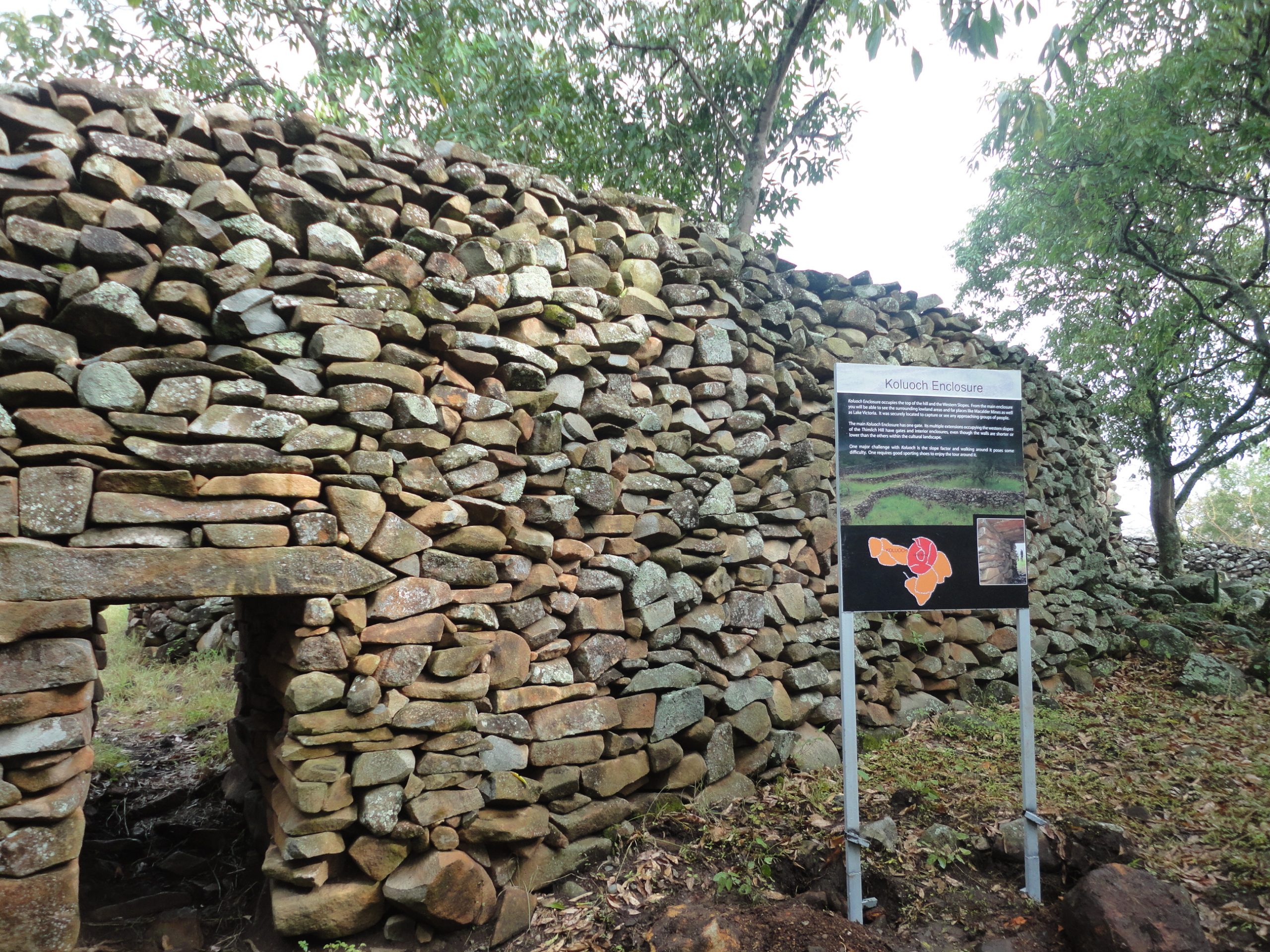
Thimlich Ohinga
Thimlich Ohinga is a complex of drystone enclosures standing in scrub forest northwest of Migori, built without mortar of any kind, and it is one of Kenya’s eight World Heritage properties. It is also the least visited of them.
The walls are not ruins in the usual sense. They stand, they are walkable, and the technique that holds them up is the reason the site was inscribed.
Where Thimlich Ohinga Is
The site sits on a gentle slope 46 kilometres northwest of Migori town, near the old Macalder mines, in Migori County on the southern side of the Lake Victoria basin. The National Museums of Kenya gives the distance from Kisumu as about 181 kilometres.
The name is Dholuo and means a frightening dense forest, describing the thicket the enclosures were found standing inside rather than the enclosures themselves. Ohinga is the enclosure, Ohingni the plural. There were once many across this part of the basin; Thimlich Ohinga is the one that survived intact.
What Was Inscribed, and Under Which Criteria
UNESCO inscribed Thimlich Ohinga Archaeological Site on the World Heritage List in 2018, under cultural criteria three, four and five. The property covers 21 hectares with a buffer zone of 33 hectares, which makes it one of the smallest World Heritage properties in Africa by area.
The three criteria are worth separating, because each says something different about what is being protected:
- Criterion three recognises the site as exceptional testimony to settlement traditions in the Lake Victoria basin, including the interrelations between enclosures built close to one another.
- Criterion four recognises the building technology itself: undressed drystone construction using irregular stones in a three-phase design.
- Criterion five recognises Thimlich Ohinga as the best-preserved surviving example of a distinctive form of pastoral settlement.
UNESCO dates the tradition from the sixteenth century to the mid-twentieth, and describes the settlement as probably built in the sixteenth century CE. The National Museums of Kenya adds that construction was probably begun by Bantu-speaking communities before the Luo arrived in the area, that successive groups of different linguistic origin occupied and modified the enclosures across the following centuries without destroying the original fabric, and that decline set in during the early twentieth century, when most other Ohingni were abandoned.
Kenyan protection came long before the international listing. The site was gazetted a national monument in 1981, and research by the National Museums of Kenya began in the 1980s. It is protected under the National Museums and Heritage Act, Cap 216 of 2006.
How the Walls Are Built
This is the detail the site turns on, and it is worth understanding before walking in, because otherwise the walls read as a heap of stones.
Each wall is built in three phases. An outer face and an inner face are built separately, and a middle phase of packed stone is laid between them, holding the two faces together. The stones are undressed, irregular in shape and size, and placed in an interlocking arrangement that produces stability without mortar or cement of any kind. UNESCO records the walls as standing between 1.5 and 4.5 metres high with an average thickness of one metre.
Inside and against the walls are the features that show what the enclosures were for: buttresses supporting the structure, low entrances, inner livestock enclosures with drainage vents at the base to let water and sludge out of the kraals, an industrial area where iron was worked, and house pits marking where people lived.
The property comprises four larger enclosures, all of which have extensions built onto them. The main one is Kochieng. The others are Kakuku, Koketch and Koluoch.
What the Enclosures Were For
The short answer from UNESCO is security for people and livestock. The more interesting one is that the Ohingni also defined social units and relationships in a lineage-based system: who enclosed alongside whom, and how the extensions were added, record a social structure as much as a defensive need.
UNESCO places the site inside a specific historical moment, a period of increased human mobility in the basin driven by social, economic and environmental pressure, with successive occupation by groups of different linguistic origin between the sixteenth and seventeenth centuries. The enclosures are the physical record of that movement, which is rare. Migration usually leaves nothing standing.
Restoration, and Being Honest About What Is Old
Thimlich Ohinga has been restored, extensively, and UNESCO’s statement of authenticity is unusually candid about the consequence. The Ohingni became ruins after abandonment; over recent decades they have been largely restored, and selected walls were added to mark the boundary between the site and the forest. UNESCO notes that this new work is not always easily distinguishable from the historic structures, and recommends minimum-intervention conservation and continued training of younger apprentices in traditional maintenance.
A visitor is therefore looking at a mixture of original fabric, centuries of traditional repair and recent restoration, with no reliable way to tell them apart by eye. That is not a criticism of the site. It is the standard condition of a drystone monument that was maintained by the people who used it and then rebuilt by the institution that inherited it, and a guide is the only way to get any of that detail.
The Site as a Living Place
Thimlich Ohinga is not only an archaeological property. UNESCO records that it serves as a meeting venue and remains a location for community rituals, particularly at times of crisis, and that the legal protection is reinforced by traditional rules and taboos maintained by elders, which also protect the surrounding flora and fauna.
That matters for how a visit is conducted. The forest around the walls is part of what is protected, the elders are part of the protection system, and the site is in use. Ask before photographing people, stay on the paths the guide uses, and take a lead on behaviour from whoever shows you round.
Visiting Thimlich Ohinga
The site is managed by the National Museums of Kenya and is open daily, including weekends and public holidays, from 08:30 to 17:30.
Admission is set by regulation. The museums service’s notice, issued under Legal Notice No. 79 of 2025, the National Museums and Heritage (Admissions Fees) Regulations 2025, revised the rates with effect from 7 May 2026. Thimlich Ohinga sits in the same band as Gede, Olorgesailie and Kariandusi: KSh 200 for a Kenyan or East African citizen adult and KSh 100 for a child, USD 6 and USD 3 for residents and visitors from the rest of Africa, and USD 8 and USD 4 for visitors from outside Africa. These figures were checked on 21 September 2026. Tickets are bought through the government eCitizen platform and the site does not take cash, so payment needs arranging before arrival. An older 2020 rate card is still online and still turns up in search results; it has been superseded.
The approach is the practical obstacle. The usual line runs from Migori through Suna and on towards Macalder, crossing the Migori River, then onto rough local track for the last stretch. The surface is stony, it deteriorates in the rains, and some sections are hard going in an ordinary saloon car. Motorcycle taxis are how most people arrive. The dry months from June to October make the drive straightforward; the long rains do not.
Take a guide. Four enclosures sitting in forest with a handful of interpretation panels give up almost nothing to an unaccompanied visitor, and the resident guides are trained by the museums service to read the wall phases, the drainage vents and the house pits out loud. Sturdy shoes matter, because the ground inside the enclosures is uneven stone throughout.
The site can be combined with Ruma National Park in the Lambwe Valley and with the southern lakeshore around Mbita and Rusinga Island. The current management plan, adopted in 2017 and running to 2027, anticipates a picnic site, a campsite and an eco-lodge, and UNESCO has said any such development should be evaluated by a heritage impact assessment first. Nothing should be assumed to be open until it is.
The wider subject of Kenya’s prehistoric and archaeological sites, and how visits to them are arranged, is covered under archaeological tours in Kenya and heritage tours in Kenya.
Questions Travellers Ask About Thimlich Ohinga
Is Thimlich Ohinga really a World Heritage site?
Yes. It was inscribed on the World Heritage List in 2018 under cultural criteria three, four and five, with a property area of 21 hectares and a 33 hectare buffer zone. It is one of eight World Heritage properties in Kenya.
How old is it?
UNESCO describes the settlement as probably built in the sixteenth century CE, within a drystone building tradition that persisted in the Lake Victoria basin from the sixteenth century to the mid-twentieth. The National Museums of Kenya considers initial construction to have been the work of Bantu-speaking communities before Luo arrival in the area.
How long does a visit take?
Two to three hours on site covers the four enclosures at a walking pace with a guide. The travelling time from Migori is the larger part of the day, and from Kisumu it is a full day out and back.
Can I get there without a four-wheel drive?
In the dry season, often yes, with care and high clearance. In the rains the final track is the problem rather than the main roads. Local motorcycle taxis run the last stretch year round and are how most visitors actually arrive.
Is there anywhere to stay at the site?
Not at present. The management plan anticipates a campsite and an eco-lodge, but these should be confirmed rather than assumed. Migori town has the nearest choice of accommodation, and the southern lakeshore around Mbita and Rusinga is the more pleasant base if the trip takes in more than this one site.
What is the difference between Thimlich Ohinga and the other stone enclosures in the region?
Scale and survival. Enclosures of this kind were once widespread across the Lake Victoria basin and most were abandoned and dismantled or collapsed. Thimlich Ohinga is the largest and best preserved, which is precisely the basis on which UNESCO inscribed it.
Why do so few people visit?
Distance and road surface. It is a long way from any conventional safari circuit, the last stretch is rough, and the site has had little promotion relative to its status.
1 Place to Visit in This Area
Other sites in Lake Victoria in Kenya, each with its own guide.
No operator on the marketplace currently lists a safari to Lake Victoria.
See every Kenya safari