
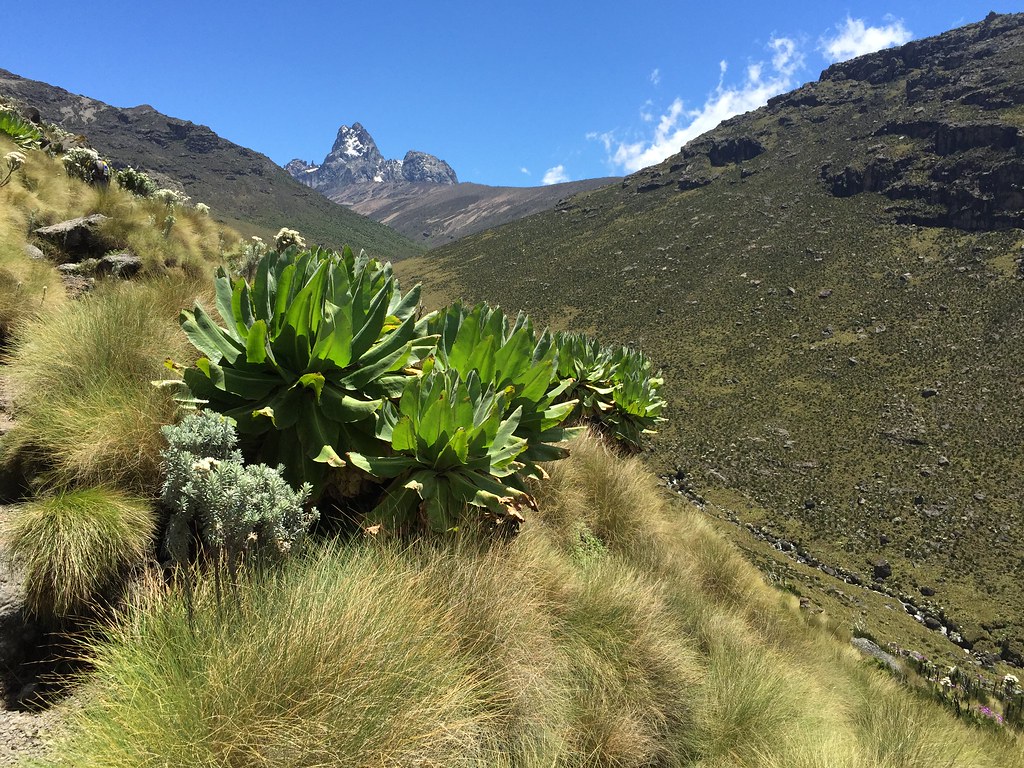
Batian Peak
Batian is the true summit of Mount Kenya, 5,199 metres on the Kenya Wildlife Service figure, and it is a rock climb. No path reaches it, no trekking route touches it, and no amount of fitness substitutes for the ability to lead multi-pitch rock at altitude. That single fact is what separates this page from Point Lenana, and it is the thing most itineraries blur.
The Summit Block
Mount Kenya’s outer cone eroded away long ago. What stands today is the hard volcanic plug at the centre of the old volcano, which is why the top of this mountain is a pair of steep towers rather than a dome. Batian at 5,199 metres and Nelion at 5,188 metres sit about 140 metres apart across a notch called the Gates of Mist. Point Lenana, the walking summit, is a shoulder well below them.
Both towers are named after Maasai laibons, as is Lenana. The rock is generally sound, the exposure is serious and the weather changes fast, which makes the summit block a proper alpine environment sitting on the equator.
Two Ways to the Top
The usual line is not a route on Batian at all. Most parties climb Nelion by the standard route on its south-east side, bivouac or overnight at the top, then cross the Gates of Mist to Batian and reverse the whole thing. That standard route is the line Percy Wyn-Harris and Eric Shipton took on 6 January 1929, it runs to roughly fifteen pitches, and it is described in alpine terms as D to TD. The mountain climbing in Kenya guide sets out the route structure and the grades.
The direct alternative is the North Face Standard Route, which reaches Batian itself from the north side. Climber-maintained route records give it as Grade V, around 23 pitches and roughly 790 metres of climbing, with no bolted anchors anywhere on it. It is pure traditional climbing: a party builds its own belays, carries double ropes for the rappels, and descends either by reversing the route or by traversing the Gates of Mist and abseiling down Nelion.
Neither option is a guided walk with a rope for reassurance. Both are long days at altitude on committing ground, where the retreat is as involved as the ascent and the weather window is measured in hours. A party that has not led at the grade before arriving in Kenya is not a party that should be on either line.
The First Ascents
Halford Mackinder, César Ollier and Joseph Brocherel reached Batian on 13 September 1899, which was a remarkable piece of climbing for its date and its equipment. Nelion held out for another thirty years. Wyn-Harris and Shipton climbed it on 6 January 1929, and the line they found is still the way most people go.
The gap between those dates is instructive. Batian was reached first because that party took a line suiting the conditions of the day, not because it is the easier peak.
What an Attempt Involves
The climbing is only part of it. Batian sits at the top of a multi-day walk-in, and the acclimatisation has to be banked before the rope comes out.
- Several days of trekking to reach the peaks area, on one of the three official routes.
- Nights at altitude to acclimatise, with Austrian Hut at around 4,790 metres the usual final base.
- A full traditional rack, double ropes, helmets and boots suited to cold rock.
- Prior multi-pitch leading experience at the grade, and anchor-building competence.
- Headtorches and approach shoes for a descent that frequently finishes in the dark.
Conditions on the summit block are routinely worse than the forecast at the gate. Verglas, snow on ledges and afternoon cloud are all normal, and the glaciers that once gave the mountain its classic ice routes have thinned until several of those lines no longer form reliably, which has pushed activity onto the rock.
Season and Aspect
Mount Kenya has two dry windows, January to mid-March and late June through September, and on the summit block the choice between them is not a matter of taste. North-facing and south-facing lines come into condition at opposite times of year, so the season follows the face. The North Face Standard Route is generally attempted in the middle of the year, when the north side is at its driest and most snow-free. The Nelion standard route on the south-east side favours the other window.
Park Rules for Climbing Parties
Mount Kenya National Park is managed by Kenya Wildlife Service and the rules apply to climbers exactly as they apply to trekkers. Every visitor must be accompanied by a qualified and certified guide, guides and porters carry park-issued identification, and loads are capped at 25 kg and weighed at the gate. Visitors check in and out by recording their details in the entry and exit books, which for a climbing party is also the mechanism by which somebody knows where they are. Climbing plans should be registered with the rangers before setting out. Marania, Kamweti, Themwe and Burguret are unofficial approach routes and a party using one must notify the park office in advance. Gates open at six in the morning and close at six in the evening.
Fees are charged per person per day, and the schedule is on the Mount Kenya guide. A long climbing itinerary pays for every day it spends inside the park.
Questions About Batian
Can I climb Batian without technical skills?
No. Both realistic lines are multi-pitch rock climbs with no bolted protection, and the descent involves rappelling off anchors the party builds itself. Point Lenana, at 4,984 metres on the Kenya Wildlife Service figure, is the summit reachable on foot and is what almost everyone who says they climbed Mount Kenya has actually done.
What is the difference between Batian and Nelion?
Batian at 5,199 metres is the higher and the true summit. Nelion at 5,188 metres is its twin, about 140 metres away across the notch known as the Gates of Mist. Nelion is climbed far more often because the standard route up it is the usual approach to both, and a party that reaches Nelion still has the traverse to do before it can claim Batian.
How many days does a Batian climb take?
Substantially longer than a trek, because the acclimatisation has to be built in before the climbing starts. Published itineraries generally run to a week or more, with the climbing itself occupying a small part of it. Rushing the approach to save days is the reliable way to arrive at the summit block too tired and too short of oxygen to climb well.
3 Places to Visit in This Area
Other sites in Mount Kenya Safari and Travel Guide, each with its own guide.
Safaris That Visit Mount Kenya
Every safari listed here that visits Mount Kenya. Each is sold and run by an independent tour company. This site lists them and passes on enquiries; it takes no booking and charges you nothing.


7-Day Mount Kenya Climbing Package – Sirimon Route
by Insight Safari Holidays Verified operator
Operator quotes on request
View Safari

9 Days Kenya Wildlife Safari
by Tranquil Safaris Verified operator
Operator quotes on request
View Safari